
Extraction of Zinc Manufacturer,Supplier and Exporter in India
Product Code : EL-CC-2871
Jlab Export is a leading Extraction of Zinc Manufacturer,and suppliers in India
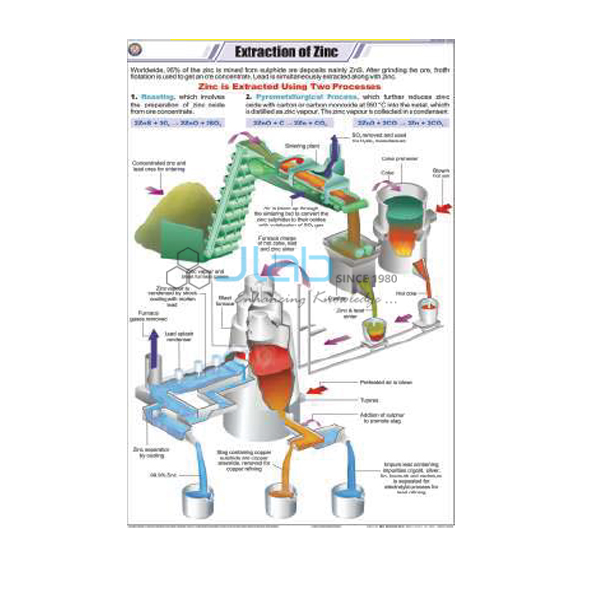
Extraction of Zinc (code EL-CC-2871) is a 58 x 90 cm chemistry wall chart on obtaining zinc from its sulphide ore — the textbook example of roasting followed by reduction with carbon. The chart is printed in full colour, laminated on both sides and fitted with plastic rollers, with English text only. JLab (Jain Laboratory Instruments Pvt Ltd, Ambala, India) supplies it to schools, colleges and dealers.
Get a quote: use the Add To Cart enquiry button below, or send your quantity and destination through the contact page.
Specifications
| Parameter | Detail |
|---|---|
| Chart topic | Extraction of zinc (Chemistry Charts series) |
| Size (overall) | 58 x 90 cm (about 22.8 x 35.4 in) |
| Paper | Coated art paper, 130 gsm |
| Printing | Full colour, offset printed using CTP technology |
| Lamination | Both sides, 30 micron heat-sealable polyester film |
| Hanging | Wall hanging, fitted with plastic rollers |
| Surface | Markable and washable |
| Weight | 228 g |
| Size when rolled | 58 x 4 x 2 cm |
| Language | English only |
| Quality check | Each chart is visually inspected before dispatch |
| Pack quantity | Each (sold individually) |
| Minimum order quantity | 10 units |
| Dispatch time | Usually 7–10 working days |
| Product code | EL-CC-2871 |
| Supplied by | Jain Laboratory Instruments Pvt Ltd (JLab), Ambala, India |
What Is the Extraction of Zinc Chart Used For?
Zinc is found mainly as zinc blende (zinc sulphide, ZnS) and also as calamine (zinc carbonate). The crushed blende is concentrated by froth flotation and then roasted in a good supply of air, which converts it to zinc oxide: 2ZnS + 3O2 → 2ZnO + 2SO2. A carbonate ore is calcined instead — heated in limited air to drive off carbon dioxide. The oxide is then heated strongly with coke, which reduces it to the metal (ZnO + C → Zn + CO). Because zinc boils at a fairly low temperature for a metal, it leaves the furnace as vapour and is condensed to liquid zinc, while the sulphur dioxide from roasting is usually converted into sulphuric acid. Much of the world’s zinc is now produced electrolytically instead: the roasted ore is dissolved in sulphuric acid and the purified zinc sulphate solution is electrolysed, so that zinc deposits on the cathode.
Zinc’s main use is galvanising — coating iron and steel with a thin zinc layer that protects them even where scratched, because zinc corrodes in preference to iron. It is also alloyed with copper to make brass and used in dry cells. In NCERT class 10 science, the roasting of zinc blende, the calcination of calamine and the reduction of zinc oxide with carbon are the worked examples for extracting metals of medium reactivity, so the chart fits those lessons directly, as well as college metallurgy and ITI or polytechnic courses. Its lamination is markable and washable for notes during class. The listing does not itemise the diagrams printed on it; request a preview image if you need to check them.
What to Specify When Ordering
- Quantity — the minimum order is 10 units, each chart sold individually.
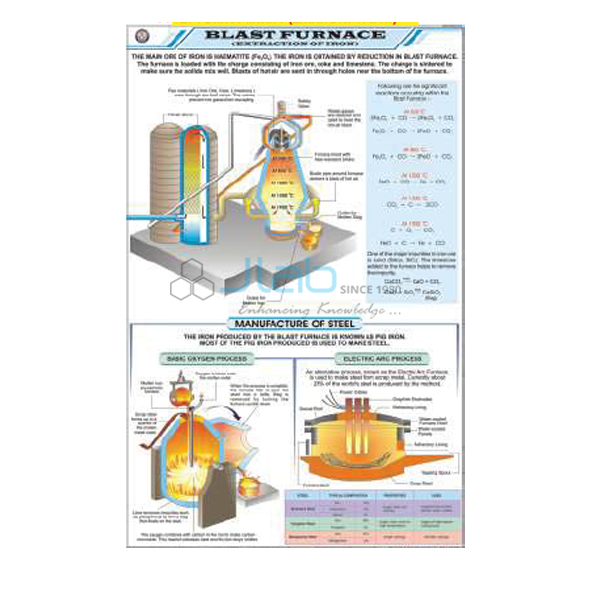
- Metallurgy companions — the Blast Furnace and Copper Metallurgy charts complete a set on extracting metals.
- Galvanising and rust — the Electroplating and Corrosion chart covers how zinc coatings protect iron.
- Delivery — destination country, port or city and delivery terms for an export quotation.
Frequently Asked Questions
What topic does the Extraction of Zinc chart cover?
The extraction of zinc metal from its ore. The product listing does not itemise the diagrams, so ask for a preview image if you need to see the exact content.
What is the difference between roasting and calcination?
Roasting heats a sulphide ore such as zinc blende in plenty of air, turning it into the oxide. Calcination heats a carbonate ore such as calamine in limited air, driving off carbon dioxide.
Why is zinc collected as a vapour?
Zinc has a low boiling point for a metal, so at the temperature needed to reduce zinc oxide with carbon it distils off and is then condensed.
Which classes is the chart suited to?
Class 10 science, where zinc is the worked example for extracting metals of medium reactivity, and college metallurgy or ITI and polytechnic courses.
How large is the chart and how is it made?
It measures 58 x 90 cm (about 22.8 x 35.4 in) on 130 gsm coated art paper, is offset printed in full colour, has 30 micron polyester lamination on both sides and plastic rollers, and weighs 228 g.
What is the minimum order and how soon can it ship?
The minimum is 10 units. Charts are visually inspected and usually dispatched within 7–10 working days; transit time for export depends on the destination.
What should an export enquiry contain?
The quantity, destination country and port or city, delivery terms such as FOB or CIF, packing or labelling instructions and any tender reference.
Who supplies this chart?
JLab, the trading name of Jain Laboratory Instruments Pvt Ltd of Ambala, Haryana, supplies it and quotes directly.
Supplier
Jain Laboratory Instruments Pvt Ltd, trading as JLab, was incorporated in 2017 and is based on Hargolal Road, Ambala, Haryana. JLab supplies printed science charts like this one in addition to its own range of laboratory apparatus, so schools and colleges can buy teaching charts and equipment from one source, and each chart is visually inspected before it is dispatched. JLab exports worldwide and can serve buyers in every region — for instance Luxembourg in Western Europe, South Africa in Southern Africa, Brunei in Southeast Asia, Oman in the Middle East and Cameroon in Central Africa. Tender buyers will find details on the JLab lab tenders page.
Related Metallurgy and Industrial Chemistry Charts
- Blast Furnace — iron reduced with coke, limestone and hot air.
- Copper Metallurgy — another sulphide ore, refined by electrolysis.
- Electroplating and Corrosion — rusting and its prevention, including galvanising with zinc.
- Prep. of Sulphur Dioxide and Sulphuric Acid — what becomes of the sulphur dioxide released by roasting.
More titles: Chemistry Charts and the full Charts range.
Request a Quote
JLab sends quotations directly. Use the Add To Cart enquiry button on this page, or write through the contact page with the quantity (minimum 10 units), any other chart titles and the delivery country and city.
Last updated: 4 October 2026