Close Packed Structures Manufacturer,Supplier and Exporter in India
Product Code : EL-CC-2881
Jlab Export is a leading Close Packed Structures Manufacturer,and suppliers in India
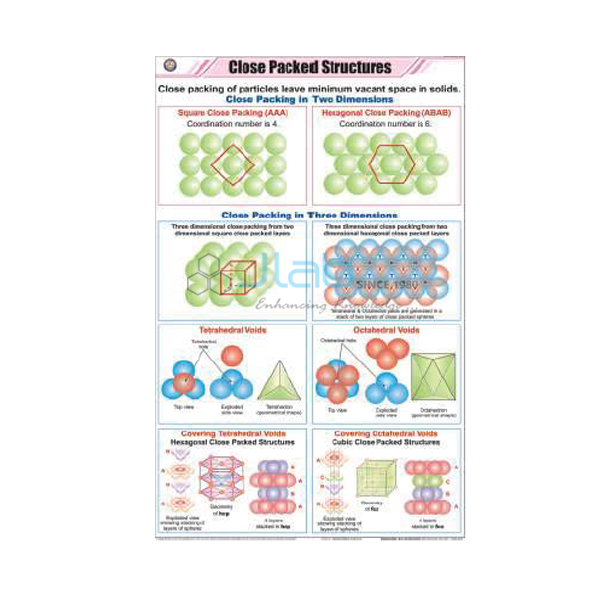
Close Packed Structures (code EL-CC-2881) is a 58 x 90 cm chemistry wall chart on close packing — the way identical spheres stack to leave the least empty space, as atoms do in many metals and ions in many ionic crystals. Printed in full colour on coated art paper, it is laminated on both sides, hangs from plastic rollers and is in English only. JLab (Jain Laboratory Instruments Pvt Ltd, Ambala, India) supplies it to schools, colleges and dealers.
Get a quote: use the Add To Cart enquiry button below, or send your quantity and destination through the contact page.
Specifications
| Parameter | Detail |
|---|---|
| Chart topic | Close packed structures (Chemistry Charts series) |
| Size (overall) | 58 x 90 cm (about 22.8 x 35.4 in) |
| Paper | Coated art paper, 130 gsm |
| Printing | Full colour, offset printed using CTP technology |
| Lamination | Both sides, 30 micron heat-sealable polyester film |
| Hanging | Wall hanging, fitted with plastic rollers |
| Surface | Markable and washable |
| Weight | 228 g |
| Size when rolled | 58 x 4 x 2 cm |
| Language | English only |
| Quality check | Each chart is visually inspected before dispatch |
| Pack quantity | Each (sold individually) |
| Minimum order quantity | 10 units |
| Dispatch time | Usually 7–10 working days |
| Product code | EL-CC-2881 |
| Supplied by | Jain Laboratory Instruments Pvt Ltd (JLab), Ambala, India |
What Is the Close Packed Structures Chart Used For?
Close packing explains how particles of the same size arrange themselves in a solid with as little wasted space as possible. In a single layer, spheres can sit directly beside and above one another, so that each touches four neighbours (square close packing), or each row can drop into the hollows of the row below, so that each touches six (hexagonal close packing) and less space is left empty. Stacking hexagonal layers gives the two three-dimensional arrangements: when the third layer lies directly over the first (ABAB…) the result is hexagonal close packing (hcp); when it covers the hollows the second layer did not use (ABCABC…) it is cubic close packing (ccp), the same as the face-centred cubic lattice. In both, every sphere touches twelve others and the spheres fill just under three-quarters of the space.
The gaps between the spheres are of two kinds: a tetrahedral void is enclosed by four spheres and an octahedral void by six, and a close-packed arrangement has one octahedral void and two tetrahedral voids for every sphere. These ideas account for the structures of metals such as magnesium and zinc (hcp) or copper and silver (ccp), and for ionic solids such as sodium chloride, whose chloride ions are close packed with the sodium ions in the octahedral voids. The topic belongs to solid-state chemistry at senior-secondary and college level and to crystallography in physics and materials-science courses, where the chart works well beside ball models that students stack layer by layer. Its markable, washable lamination takes notes and sketches during a lesson. The listing does not itemise the diagrams printed on the chart, so ask for a preview image if you need to check them.
What to Specify When Ordering
- Quantity — the minimum order is 10 units, and each chart is supplied individually.
- Structure models — add the Crystal Models Set or the crystallographic model set if students are to build sodium chloride and other structures beside the chart.
- Companion charts — Crystal Lattices (unit cells) and Sodium Chloride Crystal come in the same 58 x 90 cm format.
- Delivery details — destination country, port or city and preferred delivery terms for an export quotation.
Frequently Asked Questions
What topic does the Close Packed Structures chart cover?
Close packing of particles in solids. The listing does not itemise the individual diagrams, so ask JLab for a preview image to confirm the panels you need.
What is the difference between hcp and ccp?
Only the stacking sequence. Both are built from hexagonal close-packed layers; in hcp every third layer repeats the first (ABAB), while in ccp the pattern repeats every fourth layer (ABCABC). Each sphere has twelve nearest neighbours in either case.
What are tetrahedral and octahedral voids?
They are the two kinds of gap in a close-packed solid. A tetrahedral void lies between four spheres and an octahedral void between six; for every sphere there is one octahedral and two tetrahedral voids, and smaller ions often occupy them in ionic crystals.
What is the coordination number in close packing?
Twelve in three-dimensional hcp and ccp. Within a single layer it is four for square packing and six for hexagonal packing.
How large is the chart and what is it printed on?
It measures 58 x 90 cm (about 22.8 x 35.4 in) and is offset printed in full colour on 130 gsm coated art paper, with 30 micron polyester lamination on both sides and plastic rollers. It weighs 228 g and rolls up to 58 x 4 x 2 cm for storage or shipping.
Can teachers write on the chart?
Yes. The laminated surface is listed as markable and washable, so labels or extra layers drawn during a lesson can be wiped off afterwards.
What are the minimum order and dispatch time?
The minimum order is 10 units. Charts are visually inspected and usually dispatched within 7–10 working days; transit time for export orders depends on the destination.
What does an export quotation need?
Send the quantity, the destination country and port or city, delivery terms such as FOB or CIF, any packing or labelling instructions and the tender reference if there is one.
Who supplies this chart?
JLab — Jain Laboratory Instruments Pvt Ltd of Ambala, Haryana, India — supplies it and sends quotations directly.
Supplier
JLab is the trading name of Jain Laboratory Instruments Pvt Ltd, a science teaching-aid and laboratory equipment company incorporated in 2017 and based on Hargolal Road, Ambala, Haryana. It resells printed chemistry charts such as this one alongside its own range of apparatus and models, so a school or college can put charts, structure models and lab equipment on one order, and every chart is visually inspected before it is packed. JLab exports worldwide and is able to ship to every region — for instance to Kazakhstan in Central Asia, Algeria in North Africa, Lebanon in the Middle East, Ivory Coast in West Africa and Angola in Central Africa. Tender buyers can find details on the JLab lab tenders page.
Solid-State Charts and Structure Models
- Crystal Lattices — a companion 58 x 90 cm chart on crystal lattices and unit cells.
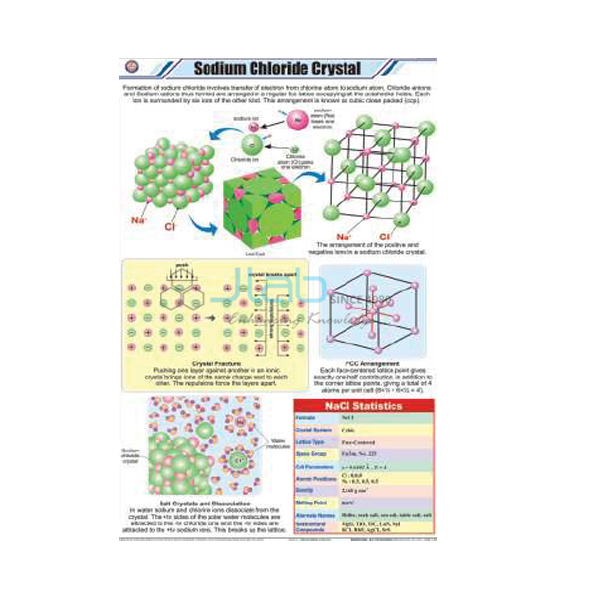
- Sodium Chloride Crystal — a chart in the same series on the rock-salt structure, a classic close-packed ionic crystal.
- Crystal Models Set — red, black and white jacks with long and short connectors for building diamond, graphite and sodium chloride structures.
- Models of Different Crystallographic Gratings — a ball-and-snap-button set for three-dimensional models of inorganic structures, sodium chloride among them.
Browse the full Chemistry Charts range or all Charts.
Request a Quote
JLab quotes directly. Use the Add To Cart enquiry button on this page, or send the number of charts (minimum 10 units), any companion charts or structure models and the delivery address or port through the contact page.
Last updated: 4 October 2026