Blast Furnace Manufacturer,Supplier and Exporter in India
Product Code : EL-CC-2869
Jlab Export is a leading Blast Furnace Manufacturer,and suppliers in India
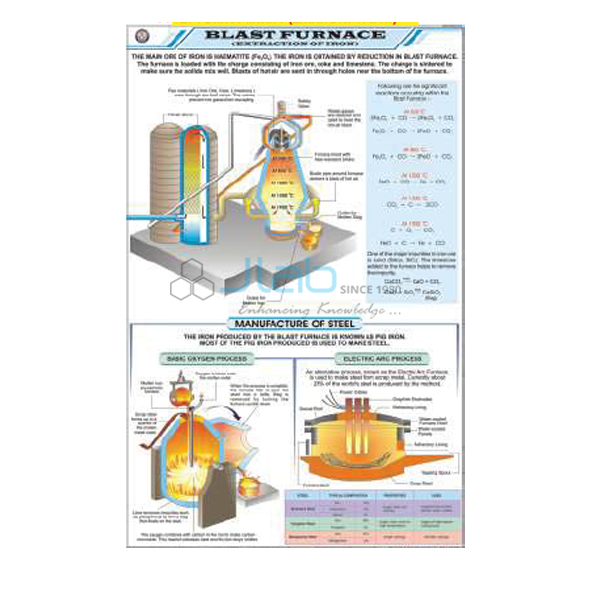
Blast Furnace (code EL-CC-2869) is a 58 x 90 cm industrial-chemistry wall chart on the blast furnace, in which iron ore is reduced to molten iron using coke, limestone and a blast of hot air. It is laminated on both sides, hangs from plastic rollers and is printed in English only. JLab (Jain Laboratory Instruments Pvt Ltd, Ambala, India) supplies it to schools, colleges and dealers.
Specifications
| Parameter | Detail |
|---|---|
| Chart topic | Blast furnace (extraction of iron) (Chemistry Charts series) |
| Size (overall) | 58 x 90 cm (about 22.8 x 35.4 in) |
| Paper | Coated art paper, 130 gsm |
| Printing | Full colour, offset printed using CTP technology |
| Lamination | Both sides, 30 micron heat-sealable polyester film |
| Hanging | Wall hanging, fitted with plastic rollers |
| Surface | Markable and washable |
| Weight | 228 g |
| Size when rolled | 58 x 4 x 2 cm |
| Language | English only |
| Quality check | Each chart is visually inspected before dispatch |
| Pack quantity | Each (sold individually) |
| Minimum order quantity | 10 units |
| Dispatch time | Usually 7–10 working days |
| Product code | EL-CC-2869 |
| Supplied by | Jain Laboratory Instruments Pvt Ltd (JLab), Ambala, India |
What Is the Blast Furnace Chart Used For?
A blast furnace is a tall steel shaft lined with heat-resistant brick. Iron ore (usually haematite, Fe2O3), coke and limestone are charged at the top, and hot air is blown in through nozzles called tuyeres near the base. The coke burns to carbon dioxide, which reacts with more hot coke to form carbon monoxide, and the carbon monoxide reduces the iron oxide to iron as the charge moves down: Fe2O3 + 3CO → 2Fe + 3CO2. The limestone decomposes to calcium oxide, which combines with sandy impurities to form a molten slag of calcium silicate. Slag floats on the molten iron, so the two are tapped off separately at the bottom, while the hot waste gases are used to preheat the incoming air.
The iron that leaves the furnace, called pig iron, still contains a good deal of carbon and is brittle. Steel is made from it by blowing oxygen through the molten metal to burn off most of the carbon (the basic oxygen process), or from scrap in an electric arc furnace. Students meet the reduction of metal oxides by carbon in class 10 science, and the blast furnace itself in metallurgy lessons at senior-secondary and college level and in ITI or polytechnic courses on iron and steel. A wall chart keeps the whole process in view while the teacher explains it, and the washable lamination survives repeated marking. The listing does not itemise the diagrams printed on the chart, so request a preview image if you need to confirm them.
What to Specify When Ordering
- Quantity — the minimum order is 10 units, supplied as individual charts.
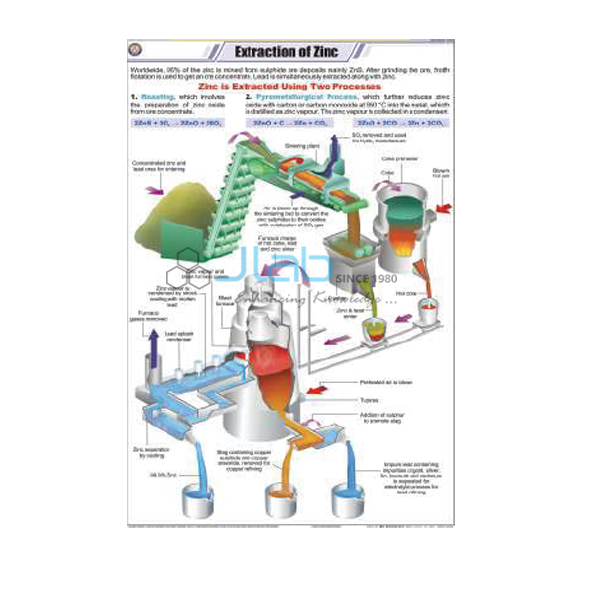
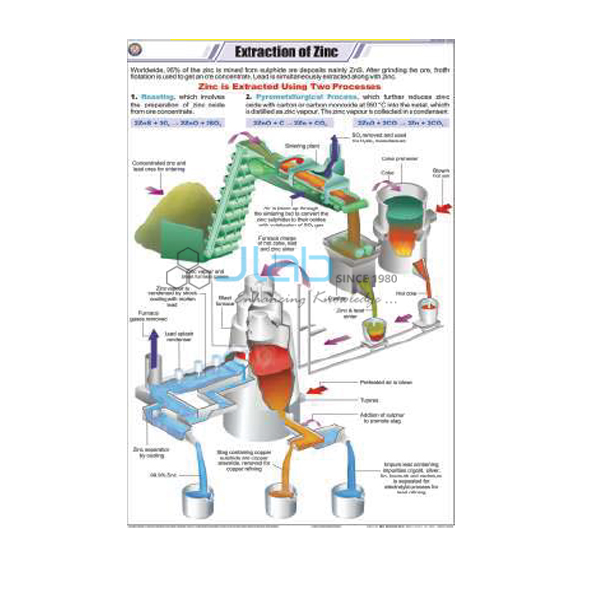
- Metallurgy set — the Extraction of Zinc, Copper Metallurgy and Aluminium Metallurgy charts come in the same 58 x 90 cm format.
- Corrosion lesson — add the Electroplating and Corrosion chart if you also teach the rusting of iron.
- Delivery — destination country, port or city and delivery terms for an export quotation.
Frequently Asked Questions
What does the Blast Furnace chart cover?
Its subject is the extraction of iron from its ore in a blast furnace. The listing does not itemise the diagrams, so ask for a preview image to check the exact content.
What goes into a blast furnace?
Iron ore, coke and limestone are fed in at the top, and a blast of hot air enters near the bottom. Molten iron and slag are drawn off at the base.
Why is limestone added?
It breaks down to calcium oxide, which reacts with sandy impurities in the ore to form slag. The slag floats on the iron and is removed separately.
Which courses can use this chart?
Class 10 science lessons on extracting metals, senior-secondary and college metallurgy, and ITI or polytechnic courses dealing with iron and steel.
What size is it and how is it finished?
58 x 90 cm (about 22.8 x 35.4 in), offset printed in full colour on 130 gsm coated art paper, laminated on both sides with 30 micron polyester film and fitted with plastic rollers; it weighs 228 g and rolls to 58 x 4 x 2 cm.
What does an export quotation need?
The quantity, destination country and port or city, delivery terms (for example FOB or CIF), packing or labelling requirements and any tender reference.
Who supplies the Blast Furnace chart?
JLab — Jain Laboratory Instruments Pvt Ltd, Ambala, Haryana — supplies it and quotes for it directly.
Supplier
JLab is the trading name of Jain Laboratory Instruments Pvt Ltd, incorporated in 2017 and located on Hargolal Road, Ambala, Haryana. It supplies chemistry and metallurgy wall charts like this one together with its own range of laboratory apparatus for schools and colleges, so a department can fill its teaching-aid list in a single order, and each chart is visually inspected before dispatch. JLab exports worldwide and is able to ship to every region — for example Ghana in West Africa, Belgium in Western Europe, Lithuania in Northern Europe, Bulgaria in Eastern Europe and Canada in North America. Tender information is on the JLab lab tenders page.
Metallurgy Charts in the Same Series
- Extraction of Zinc — a second extraction process, reducing zinc oxide with carbon.
- Copper Metallurgy — how copper is obtained and refined.
- Aluminium Metallurgy — a reactive metal extracted by electrolysis rather than by carbon.
- Electroplating and Corrosion — what happens to iron afterwards, when air and water attack it.
See all Chemistry Charts or the complete Charts range.
Request a Quote
Ask JLab for a direct quotation: use the Add To Cart enquiry button on this page, or send the number of charts (minimum 10 units), any other metallurgy titles and your delivery location through the contact page.
Last updated: 4 October 2026