Aluminium Metallurgy Manufacturer,Supplier and Exporter in India
Product Code : EL-CC-2883
Jlab Export is a leading Aluminium Metallurgy Manufacturer,and suppliers in India
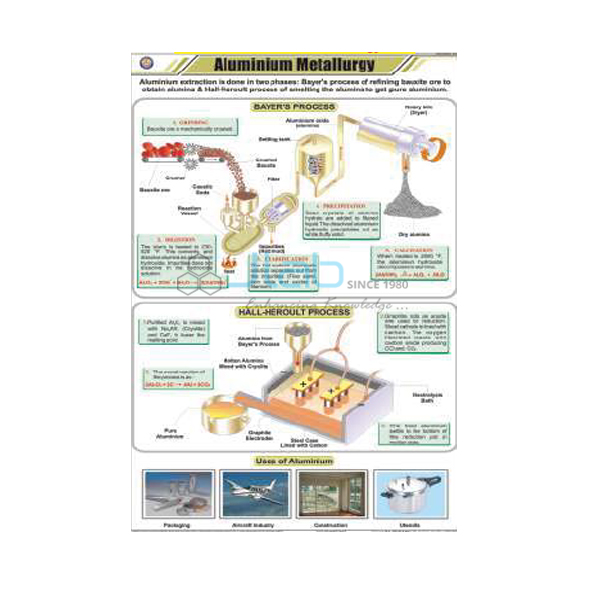
Aluminium Metallurgy (code EL-CC-2883) is a 58 x 90 cm chemistry wall chart on how aluminium is extracted from its ore, bauxite — a metal too reactive to be reduced with carbon, so it is won by electrolysis. Printed in full colour on coated art paper, it is laminated on both sides, fitted with plastic rollers and in English only. JLab (Jain Laboratory Instruments Pvt Ltd, Ambala, India) supplies it to schools, colleges and dealers.
Specifications
| Parameter | Detail |
|---|---|
| Chart topic | Aluminium metallurgy (Chemistry Charts series) |
| Size (overall) | 58 x 90 cm (about 22.8 x 35.4 in) |
| Paper | 130 gsm coated art paper |
| Printing | Full colour offset printing, CTP technology |
| Lamination | 30 micron heat-sealable polyester film on both sides |
| Hanging | For wall hanging; plastic rollers fitted |
| Surface | Markable and washable |
| Weight | 228 g |
| Size when rolled | 58 x 4 x 2 cm |
| Language | English only |
| Quality check | Each chart is visually inspected before dispatch |
| Pack quantity | Each (sold individually) |
| Minimum order quantity | 10 units |
| Dispatch time | Usually 7–10 working days |
| Product code | EL-CC-2883 |
| Supplied by | Jain Laboratory Instruments Pvt Ltd (JLab), Ambala, India |
What Is the Aluminium Metallurgy Chart Used For?
Aluminium is the most abundant metal in the Earth’s crust, but it holds on to oxygen so strongly that freeing it takes two industrial stages. In the Bayer process, crushed bauxite (hydrated aluminium oxide) is digested in hot, concentrated sodium hydroxide solution under pressure; the alumina dissolves as sodium aluminate, while iron oxide and other insoluble impurities settle out as “red mud” and are filtered off. The cooled solution is seeded so that aluminium hydroxide crystallises, and heating this strongly (calcination) gives pure alumina, Al2O3.
In the Hall–Héroult process the alumina is dissolved in molten cryolite, which lowers the working temperature and helps the melt conduct, and is electrolysed in a carbon-lined steel cell that acts as the cathode. Aluminium ions are reduced (Al3+ + 3e− → Al) and the molten metal collects at the bottom of the cell to be tapped off, while oxygen formed at the carbon anodes burns them to carbon dioxide, so the anodes have to be replaced; overall, 2Al2O3 + 3C → 4Al + 3CO2. The process needs a great deal of electricity, which is why recycling aluminium, using only a small fraction of that energy, matters. Teachers use the chart for class 10 lessons on metals and the reactivity series, the ICSE class 10 metallurgy chapter and introductory college chemistry, and to link the metal’s lightness, corrosion-resisting oxide layer and conductivity to uses in aircraft, foil and cans, window frames, cookware and overhead power lines. The markable, washable surface takes notes during the lesson. The listing does not itemise the diagrams on the chart, so ask for a preview image if you need to check them.
What to Specify When Ordering
- Quantity — minimum 10 units; each chart is supplied separately on its rollers.
- Other metallurgy titles — Copper Metallurgy, Extraction of Zinc and Blast Furnace complete a wall display on extracting metals.
- Specimens and apparatus — an ore collection that includes bauxite, or a simple electrolysis cell, makes the lesson practical.
- Destination — country, port or city and delivery terms (for example FOB or CIF) for an export quote.
Frequently Asked Questions
What does the Aluminium Metallurgy chart teach?
How aluminium is obtained from bauxite. The individual diagrams are not listed, so ask JLab for a preview image to confirm what is printed before you order.
Why can aluminium not be extracted by heating its ore with carbon?
Aluminium is more reactive than carbon, so carbon cannot remove oxygen from aluminium oxide. Electrolysis of the molten oxide supplies the electrons needed instead.
What is the role of cryolite in the Hall–Héroult process?
It acts as the solvent for alumina. Dissolving alumina in molten cryolite lets the cell run at a much lower temperature than molten alumina alone would need and improves the electrical conductivity of the melt.
Why do the carbon anodes need replacing?
Oxygen released at the anodes reacts with the hot carbon to form carbon dioxide, so the anodes are gradually burnt away during electrolysis.
What is red mud?
The insoluble residue left when bauxite is dissolved in sodium hydroxide in the Bayer process, made up mainly of iron oxide with other impurities; its red colour comes from the iron.
What size is the chart?
58 x 90 cm, about 22.8 x 35.4 in. It is printed on 130 gsm coated art paper, laminated on both sides with 30 micron polyester, weighs 228 g and rolls to 58 x 4 x 2 cm on its plastic rollers.
What details does an export quotation need?
Quantity, destination country and port or city, delivery terms such as FOB or CIF, packing or labelling requirements and any tender reference.
Who supplies this chart?
JLab, the trading name of Jain Laboratory Instruments Pvt Ltd in Ambala, Haryana, India, supplies it and replies to enquiries directly.
Supplier
JLab is the trading name of Jain Laboratory Instruments Pvt Ltd, incorporated in 2017 and based on Hargolal Road, Ambala, Haryana. Alongside its own range of laboratory apparatus, specimens and models, the company resells chemistry wall charts such as this one, so schools, colleges, dealers and importers can combine charts with practical equipment in a single order; each chart is visually inspected before it is packed. JLab exports worldwide and can deliver to every region — Mauritius in East Africa, Japan in East Asia, Moldova in Eastern Europe, Uruguay in South America and Botswana in Southern Africa are examples. Tender details are on the JLab lab tenders page.
Related Metallurgy Charts and Specimens
- Copper Metallurgy — a chart in the same series on obtaining copper from its sulphide ore and refining it.
- Extraction of Zinc — the matching chart on winning zinc from its ores.
- Blast Furnace — the series chart on iron, the metal that carbon can reduce.
- Ores of Common Metals Collection — ore specimens in a segmented tray, bauxite among them.
- Electrolysis Apparatus — a simple plastic cell with mounted carbon electrodes for demonstrating electrolysis.
More titles are in Chemistry Charts and across all Charts.
Request a Quote
Quotations are sent directly by JLab. Use the Add To Cart enquiry button on this page, or send the number of charts (minimum 10 units), any companion titles or specimens and the delivery destination through the contact page.
Last updated: 4 October 2026