Collection of 50 Rocks Manufacturer,Supplier and Exporter in India
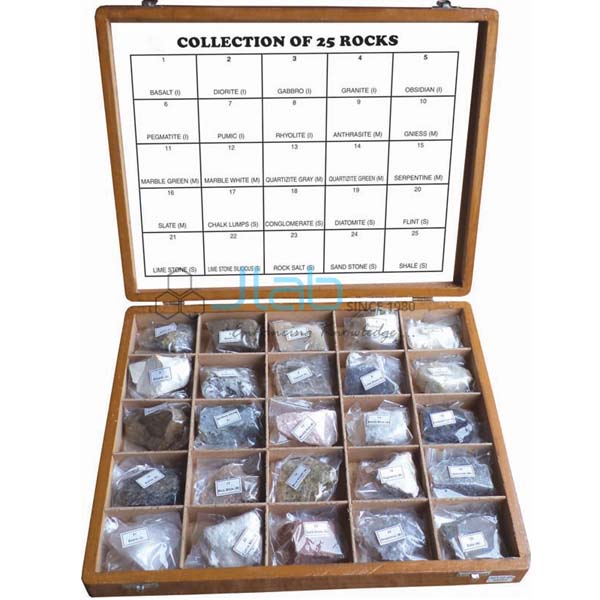
Product Code : EL-ERAM-4349
Jlab Export is a leading Collection of 50 Rocks Manufacturer,and suppliers in India
With 50 rock types, this collection goes well past the school basics and suits college and university geology as well as senior classes. Beside the common rocks it carries kimberlite, khondalite, rock phosphate and bituminous coal. It also shows how much one rock can vary, with six colours of marble, six of quartzite and four granites, one of them a porphyry.
Specifications
| Specimens | 50 rock types |
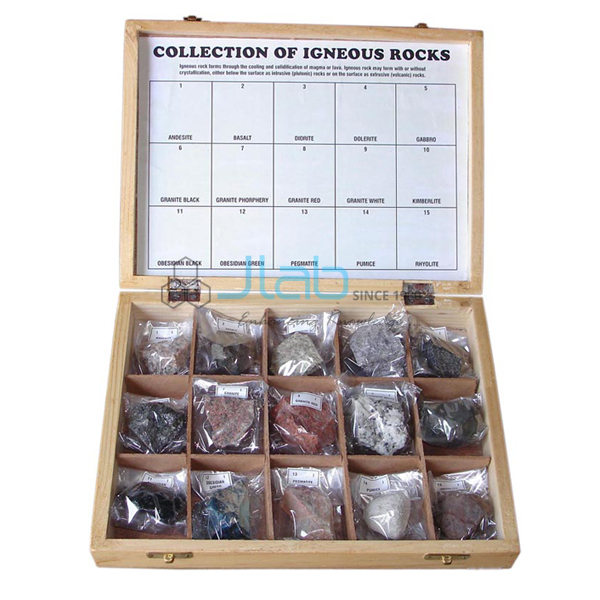
| Igneous | Andesite, Basalt, Diorite, Dolerite, Gabbro, Granite (black), Granite Porphyry, Granite (red), Granite (white), Kimberlite, Obsidian (black), Obsidian (green), Pegmatite, Pegmatite (mica), Pumice, Rhyolite |
| Sedimentary | Bituminous Coal, Breccia, Chalk Lumps, Chert, Conglomerate, Diatomite, Flint, Limestone (black), Limestone (siliceous), Limestone (white), Mudstone, Rock Phosphate, Rock Salt, Sandstone (red), Sandstone (siliceous), Shale |
| Metamorphic | Anthracite, Gneiss, Khondalite, Marble (black, chocolate, green, pink, white and yellow), Phyllite, Quartzite (black, gray, green, pink, white and yellow), Serpentine, Slate |
| Specimen size | About 25 mm (1 in) nominal per specimen, with natural variation |
| Labels | Each specimen clearly labelled |
| Minimum order quantity | 10 units |
| Dispatch time | Usually 4–6 working days |
| Manufacturer | JLab (Jain Laboratory Instruments Pvt Ltd), Ambala, India |
How the 50 Specimens Divide
Sorted by group, the specimen list gives 16 igneous, 16 sedimentary and 18 metamorphic rocks, with anthracite counted as metamorphic. Colour varieties make up much of the count: six marbles, six quartzites, four granites, three limestones and two each of obsidian, pegmatite and sandstone.
Practicals for College Geology Labs
The colour varieties give a strong first exercise. Students compare the six marbles and the six quartzites. Texture, hardness and reaction to acid stay the same, while the colour changes with small amounts of other minerals. Naming rocks by colour alone is the mistake this exercise is meant to cure.
Microscope work follows. Specimens such as basalt, gabbro, gneiss and slate can be matched with their slides in the Thin Section of Rocks set. Studied on the Laboratory Polarising Microscope, the slides link what students see in the hand to the mineral grains in section.
Frequently Asked Questions
Is one 50-rock set enough for a whole class?
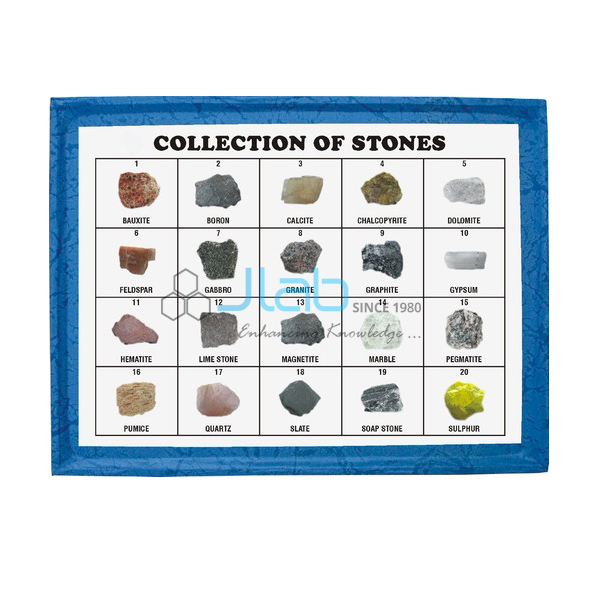
The set holds one specimen of each of the 50 types, so it is most useful as a reference set or split into stations by rock group. Many labs keep it for identification checks and give groups the smaller Collection of 20 Rocks for everyday handling.
Which specimens need care in a hot or humid store room?
Rock salt takes up moisture and can dissolve at the surface, so keep it in a closed, dry box. Shale, mudstone and chalk lumps can split or crumble as they dry out or get damp, and bituminous coal sheds black dust. A closed cabinet out of direct sun suits the whole set.
How do I pick out quartz and feldspar in the granites?
Quartz looks glassy grey and breaks with curved, shell-like surfaces. Feldspar is white, cream or pink and shows flat cleavage faces that flash as you tilt the specimen. In the red and white granites, most of the colour comes from the feldspar.
What does the granite porphyry show that the other granites do not?
It has large, well-formed crystals set in a finer groundmass. These phenocrysts grew while the magma cooled slowly at depth, and the rest crystallised faster later. In the other granites the crystals are all of a similar size.
Other Rock Collections
- Collection of 25 Rocks
- Collection of 15 Igneous Rocks
- Collection of 15 Sedimentary Rocks
- Collection of 15 Metamorphic Rocks
For a quote, use Add To Cart or send us a message through the contact page.
Last updated: 19 November 2026