Collection of 20 Stones Manufacturer,Supplier and Exporter in India

Product Code : EL-ERAM-4363
Jlab Export is a leading Collection of 20 Stones Manufacturer,and suppliers in India
Collection of 20 Stones (code EL-ERAM-4363) is a starter set of 20 basic stones that mixes common rocks, such as granite, marble, slate and pumice, with minerals such as quartz, feldspar, calcite and magnetite. It is used in primary and middle-school science and geography to introduce the difference between a rock and a mineral. Jain Laboratory Instruments Pvt Ltd (JLab) assembles the collection at its works in Ambala, India.
Specifications
| Parameter | Detail |
|---|---|
| Contents | 20 basic stones (rocks and minerals) |
| Stones listed | Bauxite, boron (as listed), calcite, chalcopyrite, dolomite, feldspar, gabbro, granite, graphite, gypsum, hematite, limestone, magnetite, marble, pegmatite, pumice, quartz, slate, soapstone and sulphur |
| Quality check | Each collection is visually inspected before dispatch |
| Pack quantity | One collection (set of 20 stones) |
| Minimum order quantity | 10 units |
| Dispatch time | Usually 7–10 working days |
| Product code | EL-ERAM-4363 |
| Manufacturer | Jain Laboratory Instruments Pvt Ltd (JLab) — OEM |
| Country of origin | India (made in Ambala, Haryana) |
How Does It Compare with Other JLab Starter Collections?
| Collection | Specimens | Mix |
|---|---|---|
| Collection of 9 Rocks | 9 specimens | Rocks only, such as marble, slate, pumice and granite |
| This collection (EL-ERAM-4363) | 20 specimens | Rocks and minerals mixed in one list, without a fixed split |
| Collection of 20 Rocks and Minerals | 20 specimens | 10 rocks of igneous, sedimentary and metamorphic types plus 10 minerals |
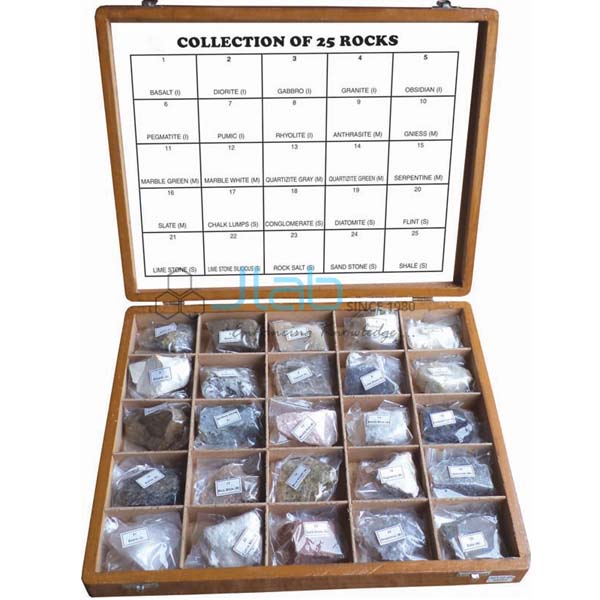
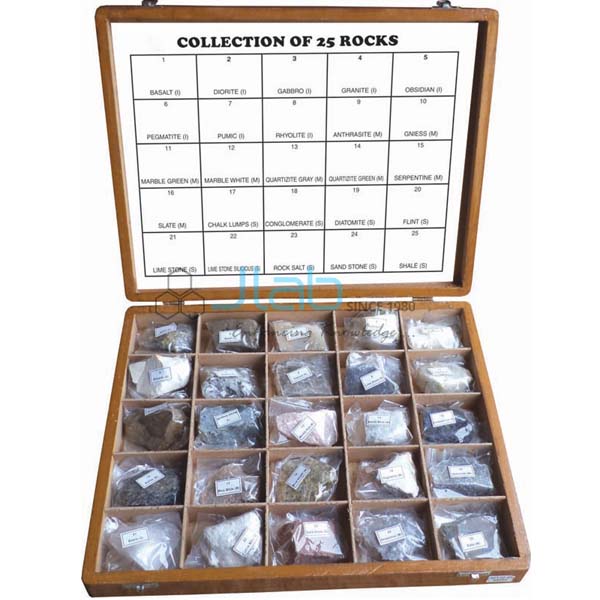
| Collection of 20 Rocks | 20 specimens | Rocks only, from all three rock groups, such as basalt, gneiss and obsidian |
Choose the 20 stones set for an introductory class that will sort the specimens itself. If you want the rocks and minerals already separated into equal halves, the 20 rocks and minerals collection is the closer fit; for rocks alone, choose the 9- or 20-rock sets.
What Is the Stones Collection Used For?
The first task with this set is usually sorting: which specimens are rocks, made of one or more minerals, and which are single minerals? Granite is a good link between the two, since students can spot its quartz and feldspar grains and then find the same minerals as separate specimens. The rocks can then be grouped by origin — gabbro, granite, pegmatite and pumice are igneous, limestone is sedimentary, and marble, slate and soapstone are metamorphic.
A few quick demonstrations keep younger classes engaged: pumice floats on water because it is full of gas holes, magnetite pulls on a magnet, graphite leaves a mark on paper, and calcite and limestone fizz with dilute acid under teacher supervision. The set suits primary and middle-school science, geography lessons on rocks and soils, and teacher-training workshops.
What to Specify When Ordering
- Collection type — mixed stones, an equal rocks-and-minerals split, or rocks only.
- Quantity — the minimum order is 10 collections.
- Testing aids — a test kit for streak, magnetism and acid tests, if needed.
Frequently Asked Questions
Which stones are in the collection?
Bauxite, boron, calcite, chalcopyrite, dolomite, feldspar, gabbro, granite, graphite, gypsum, hematite, limestone, magnetite, marble, pegmatite, pumice, quartz, slate, soapstone and sulphur are listed as typical contents. Confirm the final list with your quotation.
Why is it called stones rather than rocks or minerals?
“Stone” is an everyday word that covers both. The set mixes rocks, such as granite and slate, with minerals, such as quartz and magnetite, which makes it a good starting point for teaching the difference.
What is the difference between a rock and a mineral?
A mineral is a single naturally occurring solid with a definite chemical composition, such as quartz. A rock is a natural aggregate of one or more minerals, such as granite, which contains quartz and feldspar.
What does an export quotation need?
The quantity, destination country and port or city, delivery terms such as FOB or CIF, packing or labelling needs and any tender reference.
Who manufactures the collection?
Jain Laboratory Instruments Pvt Ltd, trading as JLab, assembles it at its works in Ambala, Haryana, India, and supplies it direct.
OEM Manufacturer
JLab is the trading name of Jain Laboratory Instruments Pvt Ltd, a manufacturer of school science and laboratory equipment in India, incorporated in 2017 and based on Hargolal Road, Ambala, Haryana. The stones collection is assembled at JLab’s own works rather than bought from a trader, so schools, colleges, dealers and importers buy it from the maker; every set is visually inspected before dispatch, and repeat orders are handled by the same team. JLab exports worldwide and ships to buyers in every region — for example Iceland in Northern Europe, Congo in Central Africa, Myanmar in Southeast Asia, Afghanistan in South Asia and North Macedonia in Southern Europe. Tender information is on the JLab lab tenders page.
Next-Step Collections
- Collection of 20 Rocks and Minerals — 10 rocks and 10 minerals, already separated.
- Collection of 20 Rocks — rocks from the igneous, sedimentary and metamorphic groups.
- Collection of 9 Rocks — a small rocks-only set for younger classes.
- Rocks and Minerals Test Kit — tools for streak, magnetism and acid reaction tests.
- Collection of 100 Rocks and Minerals — a large combined reference collection for later years.
Browse the Educational Rock and Minerals range or the Rocks and Minerals section.
Request a Quote
Quotes come direct from the manufacturer. Use the Add To Cart enquiry button, or send the number of collections (minimum 10 units), any test kits and your delivery location through the contact page.
Last updated: 9 October 2026