Transform Plate Boundaries Model Manufacturer,Supplier and Exporter in India
Product Code : EL-ERAM-4405
Jlab Export is a leading Transform Plate Boundaries Model Manufacturer,and suppliers in India
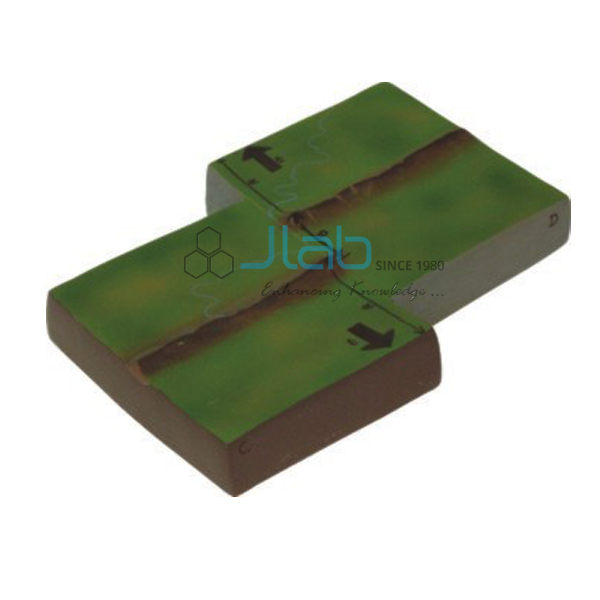
Transform Plate Boundaries Model (code EL-ERAM-4405) is a geography and geology teaching model of a transform plate boundary, where two plates move horizontally past each other on strike-slip faults. Unlike the other two boundary types, lithosphere is neither created nor destroyed here, which makes it a useful contrast piece in plate tectonics lessons. It is manufactured by Jain Laboratory Instruments Pvt Ltd (JLab) at its works in Ambala, India.
Get a quote: use the Add To Cart enquiry button below, or send your quantity and destination through the contact page.
Specifications
| Parameter | Detail |
|---|---|
| Topic | Transform plate boundaries |
| Plate movement | Horizontal, past each other on strike-slip faults |
| Lithosphere | Neither created nor destroyed |
| Size, material and labels | Not stated in the listing — ask JLab |
| Quality check | Each model is visually inspected before dispatch |
| Pack quantity | Each (sold individually) |
| Minimum order quantity | 10 units |
| Dispatch time | Usually 7–10 working days |
| Product code | EL-ERAM-4405 |
| Manufacturer | Jain Laboratory Instruments Pvt Ltd (JLab) — OEM |
| Country of origin | India (made in Ambala, Haryana) |
What Is the Transform Plate Boundaries Model Used For?
Transform boundaries are often called conservative boundaries for exactly the reason the listing gives: plates grind sideways past one another, so no crust is added or consumed. The most famous example on land is the San Andreas Fault in California, and many shorter transform faults cut across the mid-ocean ridges, offsetting one ridge segment from the next. Because the plates lock and then slip, these boundaries are known for frequent earthquakes but little volcanic activity.
In class 11 physical geography and college geology, the model helps students tell strike-slip movement apart from the up-and-down (dip-slip) movement of normal and reverse faults, and completes the set when shown next to the convergent and divergent boundary models.
Frequently Asked Questions
What is a strike-slip fault?
A fracture along which the rock on either side moves horizontally, parallel to the fault line, rather than up or down. Transform plate boundaries are large strike-slip faults.
Why is no lithosphere created or destroyed at a transform boundary?
The plates slide past each other without separating or one sinking beneath the other, so there is no spreading ridge adding crust and no subduction zone consuming it.
Can it be ordered with the other plate boundary models?
Yes; add the convergent and divergent models to the same enquiry. The minimum order is 10 units, usually dispatched in 7–10 working days.
Who makes this model?
JLab makes it in Ambala, Haryana, and quotes for it directly as the manufacturer.
OEM Manufacturer
Jain Laboratory Instruments Pvt Ltd, trading as JLab, is an Indian manufacturer of teaching models and laboratory equipment for schools and colleges, incorporated in 2017 with its base on Hargolal Road, Ambala, Haryana. Producing in its own works means dealers, importers and institutions buy direct, every model is visually inspected before dispatch, and repeat orders go back to the same workshop. JLab exports worldwide and ships to buyers in every region — for example Canada in North America, Iraq in the Middle East, Sri Lanka in South Asia, Chad in Central Africa and Egypt in North Africa.
Compare Other Boundaries and Faults
- Convergent Plate Boundaries Model — plates collide and magma forms at subduction zones.
- Divergent Plate Boundaries Model — plates drift apart and new crust forms.
- Normal Fault Model — the hanging wall moves down, under crustal tension.
- Reverse Fault Model — the hanging wall moves up, under crustal compression.
See also Educational Rock and Minerals and Rocks and Minerals.
Request a Quote
Send the quantity (10 units minimum) and your destination through the contact page, or use the Add To Cart button; the quotation comes from the manufacturer.
Last updated: 9 October 2026