Glass Tubing Manufacturer,Supplier and Exporter in India

Product Code : EL-SLE-5533
Jlab Export is a leading Glass Tubing Manufacturer,and suppliers in India
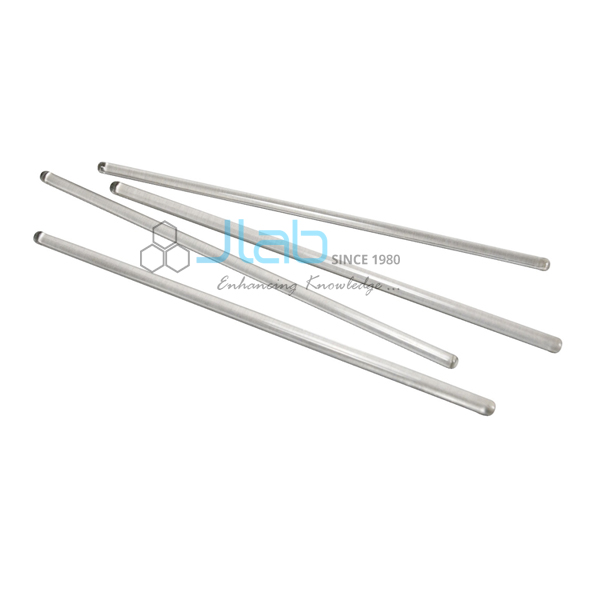
Glass Tubing (code EL-SLE-5533) is soda-glass tubing supplied in 1.5 m lengths for making delivery tubes, connectors and jets in school and college chemistry and physics labs. Three versions are listed: 7 mm OD tubing, 5 mm OD tubing and a 6.5 mm OD capillary. Soda glass softens readily in a Bunsen flame, which makes it the usual choice for students learning to bend glass and draw out jets. It is made by Jain Laboratory Instruments Pvt Ltd (JLab) at its works in Ambala, India.
Specifications
| Parameter | Detail |
|---|---|
| Material | Soda glass |
| Glass tubing, 7 mm | 7 mm outside diameter, 1.5 m length |
| Glass tubing, 5 mm | 5 mm outside diameter, 1.5 m length |
| Capillary tubing | 6.5 mm outside diameter, 1.5 m length |
| Quality check | Each length is visually inspected before dispatch |
| Pack quantity | Each (sold individually, per 1.5 m length) |
| Minimum order quantity | 10 units |
| Dispatch time | Usually 7–10 working days |
| Product code | EL-SLE-5533 |
| Manufacturer | Jain Laboratory Instruments Pvt Ltd (JLab) — OEM |
| Country of origin | India (made in Ambala, Haryana) |
How Does It Compare with Other JLab Glass Tubes?
| Product | Glass | Listed details |
|---|---|---|
| Glass Tubing (EL-SLE-5533) | Soda glass | 5 mm and 7 mm OD tubing and 6.5 mm OD capillary, in 1.5 m lengths |
| Hollow Glass Tubes Ordinary | Borosilicate glass | Clear; heat and chemical resistant; sizes not given in the listing |
| Glass Tubes | Hard glass | Clear; heat and chemical resistant; for laboratory use |
Choose this soda-glass tubing for glass-working practice, delivery tubes and general connections, where easy bending in a Bunsen flame matters. The borosilicate and hard-glass tubes suit parts that will be heated strongly or exposed to aggressive chemicals.
What Is Glass Tubing Used For?
Lengths of glass tubing are cut, bent and fire-polished to make delivery tubes for gas preparation, connecting tubes through bored corks, droppers and fine jets. Cutting a glass tube, bending it, drawing out a jet and boring a cork make up the basic laboratory techniques in the class 11 chemistry practical syllabus, and the gas-preparation set-ups used in class 10 science rely on the same skills. The capillary version, with its narrow bore, is used for capillary-rise demonstrations and for drawing out fine jets.
To cut a length, make a single firm scratch with a file or tube cutter, wrap the tube in a cloth and snap it away from the body, then fire-polish the sharp ends. Heat soda glass gradually and let it cool slowly, because it is less tolerant of sudden temperature changes than borosilicate glass. When pushing tubing into a cork or rubber stopper, wet it with water or a little glycerol, hold it close to the cork, protect your hand with a cloth and twist gently rather than push.
What to Specify When Ordering
- Version — 7 mm OD tubing, 5 mm OD tubing or 6.5 mm OD capillary, and the number of 1.5 m lengths of each.
- Quantity — the minimum order is 10 units; glass-working classes go through tubing quickly, so plan for practice pieces.
- Fittings — add rubber tubing, bored rubber corks, a cork borer or a tube cutter to the same enquiry.
Frequently Asked Questions
Which sizes of glass tubing are available?
Three soda-glass versions are listed: 7 mm OD tubing, 5 mm OD tubing and a 6.5 mm OD capillary, each in 1.5 m lengths.
Why is soda glass used for this tubing?
Soda glass softens at a lower temperature than borosilicate glass, so students can bend it and draw jets in an ordinary Bunsen flame. The trade-off is lower resistance to sudden heating and cooling.
What is the capillary tubing used for?
Its narrow bore suits capillary-rise demonstrations and drawing out fine jets. The bore size is not given in the listing, so mention any requirement in your enquiry.
How should the tubing be cut safely?
Scratch it once with a file or tube cutter, wrap it in a cloth and snap it, then round off the cut ends in a flame so they are not sharp.
Is it suitable for strong heating?
It handles the gentle heating used for bending and jet-making. For parts that will be heated strongly or for long periods, a borosilicate tube is the better option.
What details does an export quotation need?
The quantity of each version, destination country and port or city, delivery terms such as FOB or CIF, packing or labelling needs, and the tender reference if any.
Who manufactures this glass tubing?
JLab (Jain Laboratory Instruments Pvt Ltd) makes it at its works in Ambala, Haryana, India, and quotes for it directly.
OEM Manufacturer
JLab is the trading name of Jain Laboratory Instruments Pvt Ltd, a laboratory glassware and school science equipment manufacturer in India, incorporated in 2017 and based on Hargolal Road, Ambala, Haryana. The tubing is produced at JLab’s own works rather than bought from a trader, so schools, colleges, dealers and importers order direct, every length is checked by eye before packing, and repeat orders are handled by the manufacturer. JLab exports worldwide and ships to buyers in every region — Cameroon in Central Africa, Qatar in the Middle East, Canada in North America, Fiji in Oceania and Gambia in West Africa among them.
Fittings for Glass Tubing
- Rubber Tubing — flexible tubing for joining glass tubes to apparatus and gas taps.
- Rubber Corks (with One Hole) — bored stoppers that take a single glass tube.
- Cork Borer (Brass) — brass borers for cutting holes in corks and stoppers.
- Glass Tubing Cutter — a spring-loaded Griffin-type cutter for clean cuts.
More items are listed in the School Lab Equipment range.
Request a Quote
JLab quotes as the manufacturer. Use Add To Cart on this page, or send the version, number of lengths (minimum 10 units) and delivery location through the contact page.
Last updated: 4 October 2026