HDPE Bottle Dropper Manufacturer,Supplier and Exporter in India
Product Code : EL-GLE-8529
Jlab Export is a leading HDPE Bottle Dropper Manufacturer,and suppliers in India
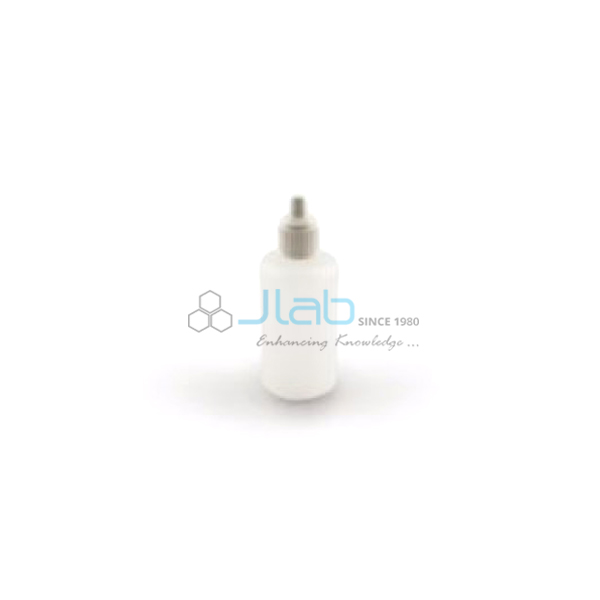
HDPE Bottle Dropper (code EL-GLE-8529) is a dropper bottle made of HDPE (high-density polyethylene) for dispensing small amounts of concentrated stain and other liquids. It is used in school biology practicals, college microbiology labs and other teaching labs where a stain or reagent is applied a few drops at a time. It is made by Jain Laboratory Instruments Pvt Ltd (JLab) at its works in Ambala, India.
Specifications
| Parameter | Detail |
|---|---|
| Type | Dropper bottle |
| Material | HDPE (high-density polyethylene) |
| Use | Dispensing small amounts of concentrated stain and other liquids |
| Quality check | Each bottle is visually inspected before dispatch |
| Pack quantity | Each (sold individually) |
| Minimum order quantity | 10 units |
| Dispatch time | Usually 7–10 working days |
| Product code | EL-GLE-8529 |
| Manufacturer | Jain Laboratory Instruments Pvt Ltd (JLab) — OEM |
| Country of origin | India (made in Ambala, Haryana) |
What Is the HDPE Bottle Dropper Used For?
Concentrated stains are needed only a drop or two at a time. In microscopy practicals, such as the stained onion-peel and cheek-cell slides of class 9 biology or the staining of bacteria in college microbiology, a drop of stain makes cells, nuclei or microbes easier to see. Dispensing straight from a dropper bottle helps students add only as much as the slide needs and keeps stain off benches and hands.
What to Specify When Ordering
- Quantity — the number of bottles, for example one for each stain on each bench.
- Product code — quote EL-GLE-8529 so the quotation is for this HDPE dropper bottle.
- Other items — glass and polyethylene dropping bottles, Pasteur pipettes and slide staining racks are separate items that can be quoted on the same enquiry.
Frequently Asked Questions
What does HDPE mean?
High-density polyethylene, a tough plastic. A bottle made from it is less likely than a glass one to break if it is knocked over or dropped.
How does it differ from the other JLab dropping bottles?
The Dropping Bottles item is blown in low-density polyethylene and gives small uniform drops when pressed lightly, while the glass Dropping Bottle has a dropping pipette ground into the neck with a rubber teat. This bottle is made of HDPE.
What information is needed for an export quotation?
The number of bottles, the destination country and port or city, delivery terms (for example FOB or CIF), packing or labelling needs and any tender reference.
Who manufactures the HDPE bottle dropper?
Jain Laboratory Instruments Pvt Ltd (JLab) makes it at its works in Ambala, Haryana, India.
OEM Manufacturer
JLab is the trading name of Jain Laboratory Instruments Pvt Ltd, a manufacturer of laboratory plasticware, glassware and school science equipment in India, incorporated in 2017 and based on Hargolal Road, Ambala, Haryana. The bottle is made at JLab’s own works rather than bought from a trader, so schools, colleges, dealers and importers order it factory-direct. JLab exports worldwide and ships to buyers in every region — for example the USA in North America, Gambia in West Africa, Brazil in South America, Algeria in North Africa and Austria in Western Europe. Tender buyers can see the JLab lab tenders page.
Dropping Bottles and Staining Supplies
- Dropping Bottles (polyethylene) — low-density polyethylene bottles that give small uniform drops when pressed lightly.
- Dropping Bottle (glass) — a narrow-mouth glass bottle with a ground-in dropping pipette and rubber teat.
- Pasteur Pipette — a small plastic pipette with a squeeze bulb for controlled dispensing.
- Slide Staining Rack — a handled rack for staining a batch of microscope slides together.
See the General Lab Equipment range or the wider Laboratory Supplies section.
Request a Quote
Use the Add To Cart enquiry button on this page to ask for a quotation, giving the number of bottles and the delivery city or port, or write through the contact page.
Last updated: 15 October 2026