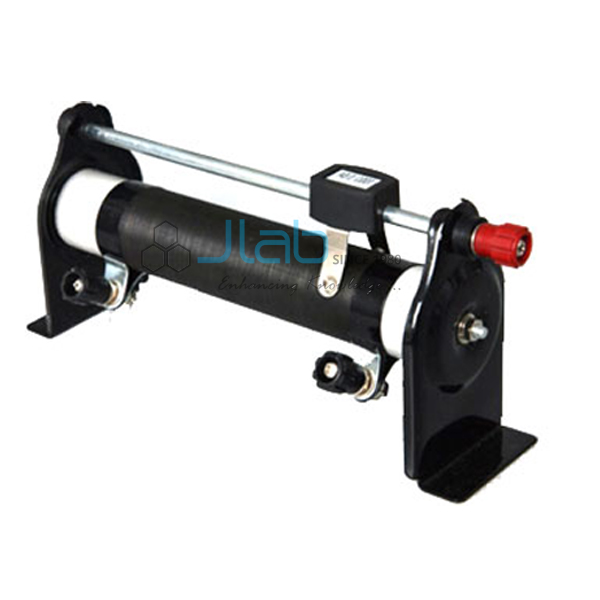
Linear Expansion Apparatus Manufacturer,Supplier and Exporter in India

Product Code : EL-SLE-4624
Jlab Export is a leading Linear Expansion Apparatus Manufacturer,and suppliers in India
Linear Expansion Apparatus (code EL-SLE-4624) is a steam-heated apparatus for finding the coefficient of linear expansion of metals. The test rod sits in a tube with a steam inlet and outlet, and its growth is read with a micrometer whose point of contact is signalled by a bell or galvanometer. Iron, copper and brass rods are supplied. It is made by Jain Laboratory Instruments Pvt Ltd (JLab) at its works in Ambala, India.
Specifications
| Parameter | Detail |
|---|---|
| Purpose | Studying the expansion of metals on heating and determining the coefficient of linear expansion of different metals |
| Heating | Steam — the rod is placed in a tube (steam chamber) with a steam inlet and outlet |
| Test rods supplied | 3 — iron, copper and brass |
| Temperature | A thermometer monitors the temperature change |
| Expansion reading | Indicator mounted at the end; micrometer contact point detected with a bell or galvanometer |
| Quality check | Each apparatus is visually inspected before dispatch |
| Pack quantity | Each (sold individually) |
| Minimum order quantity | 10 units |
| Dispatch time | Usually 7–10 working days |
| This listing covers | The apparatus with its three rods; confirm in your enquiry whether the thermometer and the bell or galvanometer are included — the steam generator and galvanometer are separate catalogue items |
| Product code | EL-SLE-4624 |
| Manufacturer | Jain Laboratory Instruments Pvt Ltd (JLab) — OEM |
| Country of origin | India (made in Ambala, Haryana) |
What Is the Linear Expansion Apparatus Used For?
When a metal rod is heated it grows longer in proportion to its original length and to the rise in temperature. The constant of proportionality is the coefficient of linear expansion, found as the increase in length divided by the original length times the temperature rise. This steam-jacketed set-up — the arrangement often called Pullinger’s apparatus — turns that definition into a bench experiment for the thermal-properties topic of class 11 physics, first-year college heat practicals and polytechnic materials labs. Testing all three rods shows that, of these metals, brass expands the most and iron the least, which leads naturally to everyday examples such as the expansion gaps left in rails and bridges.
To run it, measure the rod’s length at room temperature, place it in the tube, and note the starting temperature on the thermometer. Turn the micrometer until it just touches the end of the rod — the bell rings or the galvanometer deflects — record the reading, then back the screw off a few turns. Pass steam through the tube until the thermometer reading stops rising, advance the micrometer to the point of contact again, and the difference between the two readings is the expansion. The tube and rod become very hot, so let them cool before handling; drain any condensed water and dry the rods afterwards so the iron rod does not rust.
What to Specify When Ordering
- Quantity — the minimum order is 10 sets; many labs plan one per practical bench.
- Steam supply — add a steam generator to the enquiry if your lab has no steam source.
- Contact indicator and thermometer — state whether you need a bell or a galvanometer, and ask JLab to confirm which items come with the set.
- Spare rods — ask for extra iron, copper or brass rods if students will use the set heavily.
Frequently Asked Questions
What does the linear expansion apparatus measure?
The coefficient of linear expansion of a metal rod. You measure how much the rod lengthens when steam heats it, together with its original length and the temperature rise, and calculate the coefficient from those three values.
Which test rods are included?
Three rods are provided: iron, copper and brass. Comparing them shows how different metals expand by different amounts for the same heating.
How is such a small expansion measured accurately?
With a micrometer at the end of the rod. A bell or galvanometer in the contact circuit signals the exact moment the micrometer touches the rod, so the before-and-after readings are taken at the same point of contact rather than judged by eye.
Is a steam generator supplied?
It is not part of this listing. The apparatus has a tube with a steam inlet and outlet; the steam generator linked below is a separate item that can be added to the same order.
How does it differ from the simple Expansion Apparatus?
The Expansion Apparatus is listed as a simple version for comparing common metals. This apparatus is built for measurement, with steam heating, a thermometer and a micrometer contact, so students can calculate the coefficient of linear expansion.
What should I include in an export enquiry?
The quantity, destination country and port or city, preferred delivery terms such as FOB or CIF, any packing or labelling requirements, and the tender reference if the purchase is for a tender.
Who manufactures this apparatus?
Jain Laboratory Instruments Pvt Ltd (JLab) builds it at its works in Ambala, Haryana, India, and quotes for it directly as the manufacturer.
OEM Manufacturer
JLab is the trading name of Jain Laboratory Instruments Pvt Ltd, a physics and general science laboratory equipment manufacturer in India, incorporated in 2017 and based on Hargolal Road, Ambala, Haryana. The linear expansion apparatus is built at JLab’s own works rather than bought in from a trader, so schools, colleges, dealers and importers buy it factory-direct; each set is checked visually before dispatch, and spare rods and repeat orders come from the manufacturer. The company holds MSME Udyam registration UDYAM-HR-01-0003849 (manufacturing enterprise) and Importer-Exporter Code 3317504552. JLab exports worldwide and ships to buyers in every region — Tanzania in East Africa, Morocco in North Africa, Myanmar in Southeast Asia, El Salvador in Central America and the Caribbean and Turkmenistan in Central Asia among them. Tender details are on the JLab lab tenders page.
Heat and Expansion Apparatus
- Steam Generator — a steam generator with a water gauge to supply the steam tube.
- Galvanometer — a sensitive current indicator that can signal the micrometer contact.
- Expansion Apparatus — a simple version for comparing the expansion of common metals.
- Ball and Ring Apparatus — a brass ball and ring for a quick class demonstration of expansion on heating.
- Bimetallic Strips with a Wooden Handle — shows two metals expanding by different amounts as the strip bends.
See more physics practical apparatus in the School Lab Equipment range.
Request a Quote
Quotes come direct from the manufacturer. Use the Add To Cart enquiry button on this page, or send the quantity (minimum 10 units), whether you need a steam generator, a bell or galvanometer and spare rods, and your delivery location through the contact page.
Last updated: 4 October 2026