Model of Drum Brake Unit Manufacturer,Supplier and Exporter in India
Product Code : EL-AELE-9419
Jlab Export is a leading Model of Drum Brake Unit Manufacturer,and suppliers in India
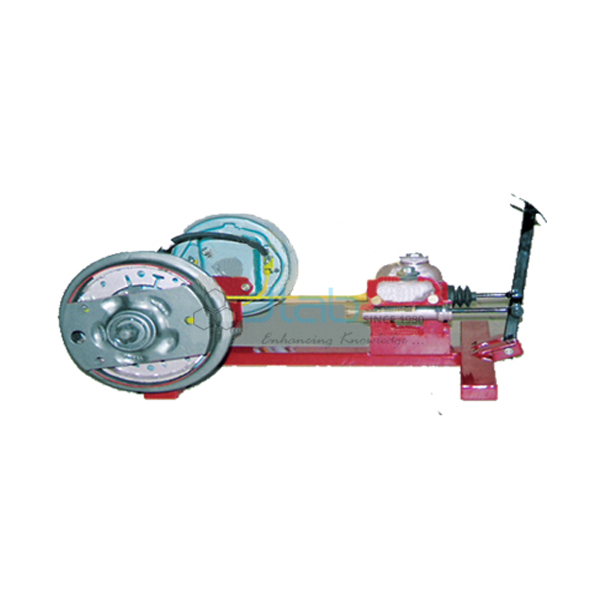
Two complete brake drum assemblies make up this hydraulic drum brake model, built from original parts. It has two master cylinders, one of them sectioned, wheel cylinders with one sectioned, and brake shoes. Working the lever applies the brakes for demonstration, and the sectioned cylinders show what happens inside.
Specifications
| Brake drum assemblies | Two |
| Master cylinders | Two (one sectioned) |
| Wheel cylinders | Included, one sectioned |
| Other parts | Brake shoes |
| Built from | Original parts |
| Operation | Lever |
| Minimum order quantity | 1 unit |
| Dispatch time | Usually 14–18 working days |
| Manufacturer | JLab (Jain Laboratory Instruments Pvt Ltd), Ambala, India |
How the Shoes Grip the Drum
In a hydraulic drum brake, the wheel cylinder sits between the upper ends of the two shoes. Fluid pressure from the master cylinder drives its two pistons outwards, and the shoes swing about their anchor until the linings touch the drum.
On one shoe, drum rotation drags the lining harder into contact. This self-energising shoe brakes more strongly than the other, trailing shoe and wears faster. When the pressure drops, return springs pull both shoes back from the drum.
Drum Brake Practicals for ITI Students
Students work the lever and relate each movement to the sectioned master cylinder and wheel cylinder: piston forward, fluid displaced, wheel cylinder pistons out. They can then identify the self-energising shoe in each drum assembly and say which lining should show more wear.
To compare ways of expanding the shoes, the class can turn to the Internally Expanding Mechanical Drum Brake System, where a cam-lever spreads them. The Vacuum Assisted Hydraulic Drum Brake then shows a vacuum booster adding force at the master cylinder.
Frequently Asked Questions
How does a hydraulic drum brake work?
Pressing the lever or pedal builds fluid pressure in the master cylinder. That pressure pushes the wheel cylinder pistons outwards, the shoes press their linings against the rotating drum, and friction slows the wheel.
How do you know drum brakes need adjusting?
The pedal or lever travels further before the brakes bite, and the parking brake needs more clicks to hold. Both happen as the linings wear and the gap to the drum grows. Shoes adjusted too tight have the opposite fault: they drag, run hot and can glaze the drum.
What does self-energising mean in a drum brake?
On one shoe, the turning drum tends to drag the lining harder onto it, adding to the applied force. That shoe is self-energising. On the trailing shoe, rotation tends to push the lining away, so it gives less braking.
Why do drum brakes fade on long downhill runs?
Heat from braking builds up inside the closed drum. The drum expands away from the shoes and the lining friction falls, so the same pedal effort gives less braking until the drum cools.
Disc and Drum Brake Models
- Model of Disc Brake System
- Model of Hydraulic Brake Unit Four Wheel Type
- Single Shoe Brake Working Model
For a quote, use Add To Cart or send us a message through the contact page.
Last updated: 5 November 2026