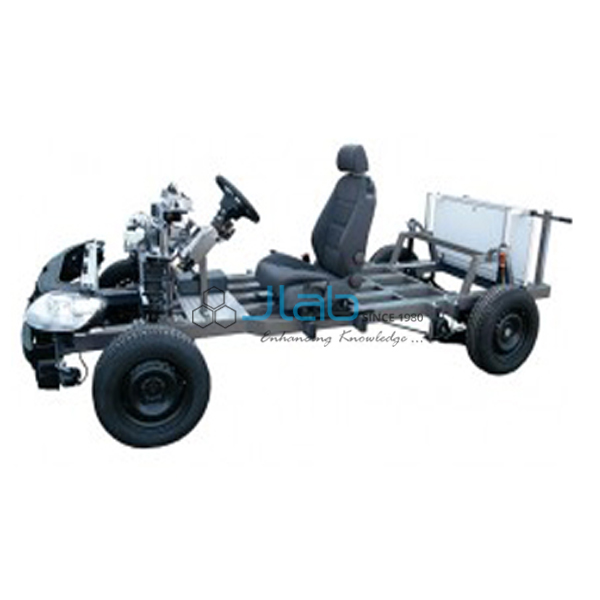
Model of Hydraulic Brake Unit Four Wheel Type Manufacturer,Supplier and Exporter in India
Product Code : EL-AELE-9418
Jlab Export is a leading Model of Hydraulic Brake Unit Four Wheel Type Manufacturer,and suppliers in India
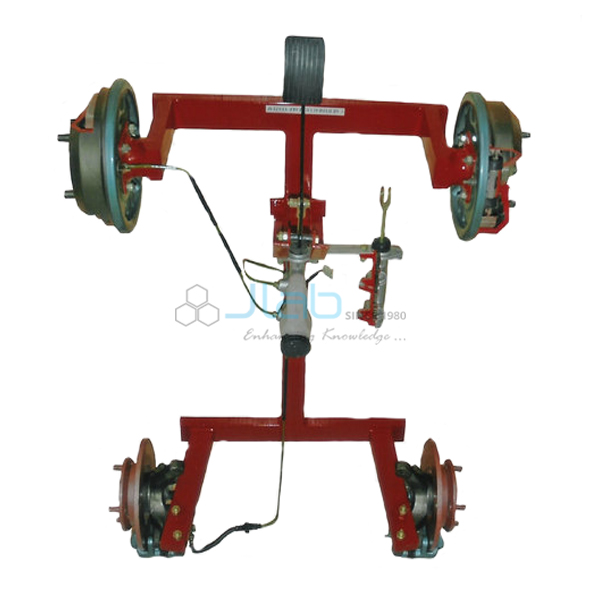
Many cars brake with discs at the front and drums at the rear, and this model lays out that four wheel hydraulic system on one frame. It is built from original parts: two master cylinder assemblies, one sectioned and one working, with wheel cylinder, brake drum, brake shoes and calipers. A lever operates the brakes for demonstration.
Specifications
| Brake layout | Two disc brakes at the front, two drum brakes at the rear |
| Master cylinders | Two (one sectioned, one working) |
| Other parts | Wheel cylinder, brake drum, brake shoes, calipers |
| Built from | Original parts, suitably sectioned |
| Operation | Lever |
| Mounting | Sturdy iron frame |
| Minimum order quantity | 1 unit |
| Dispatch time | Usually 14–18 working days |
| Manufacturer | JLab (Jain Laboratory Instruments Pvt Ltd), Ambala, India |
Pascal’s Law in the Brake Lines
Moving the lever pushes the piston in the working master cylinder. The pressure it creates in the brake fluid is passed equally along the lines to every caliper and wheel cylinder, as Pascal’s law states. Each piston then pushes with a force equal to that pressure times its own area.
At the front, caliper pistons squeeze pads onto both faces of the brake disc. At the rear, wheel cylinder pistons push the brake shoes outwards against the drum. Front brakes do more of the work because weight shifts forward when a car slows, which is one reason the front wheels get discs.
Hydraulic Brake Exercises for Students
Students can operate the lever and follow the fluid pressure to each wheel. On the sectioned master cylinder they name the piston, seals, return spring and reservoir port. They can then sketch the circuit from master cylinder to each wheel and mark which wheels have discs and which have drums.
For a closer look at each type, the class can use the Model of Disc Brake System and the Model of Drum Brake Unit. Comparing the two shows why discs shed heat faster and why drum brake shoes need adjusting as the linings wear.
Frequently Asked Questions
Why does a car use discs at the front and drums at the rear?
When a car brakes, weight moves onto the front wheels, so they do most of the stopping. Discs cool faster and resist fade under that load, while rear drums cost less and make a simple parking brake.
Why does the model have two master cylinders?
One master cylinder is sectioned so students can see its piston and seals. The other is a working unit, so the brakes can be applied with the lever. Together they show both the inside and the action.
Why does a car pull to one side when braking?
One side is braking harder than the other. Common causes are a seized caliper piston or wheel cylinder, a lining soaked in oil or fluid, a blocked brake hose or unequal tyre pressures. Comparing the two sides of the model shows which parts must match from left to right.
What makes brakes drag?
Dragging means the pads or shoes do not fully release. A sticking caliper piston, a weak shoe return spring or shoes set too tight are common causes. A blocked compensating port in the master cylinder can also hold pressure in the lines. A dragging brake runs hot and wears the linings quickly.
Other Hydraulic Brake Models
- Model of Hydraulic Braking System
- Model of Hydraulic Braking System with Vacuum Booster
- Hydraulic Brake Chassis Trainer
For a quote, use Add To Cart or send us a message through the contact page.
Last updated: 5 November 2026