Hydraulic Brake Chassis Trainer Manufacturer,Supplier and Exporter in India
Product Code : EL-AELE-9376
Jlab Export is a leading Hydraulic Brake Chassis Trainer Manufacturer,and suppliers in India
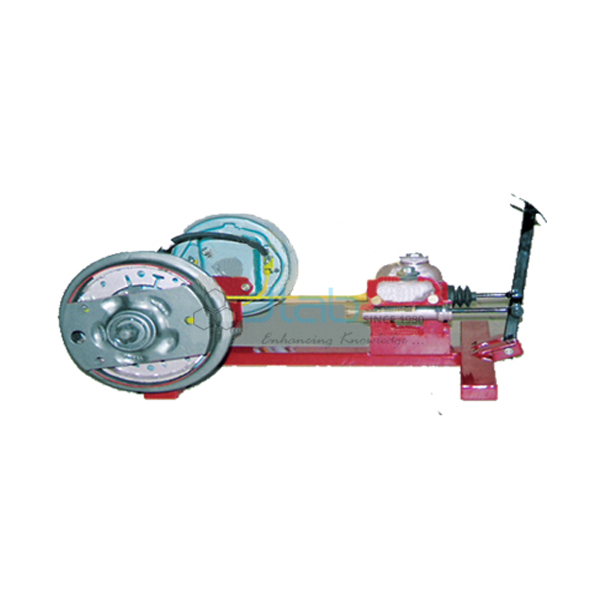
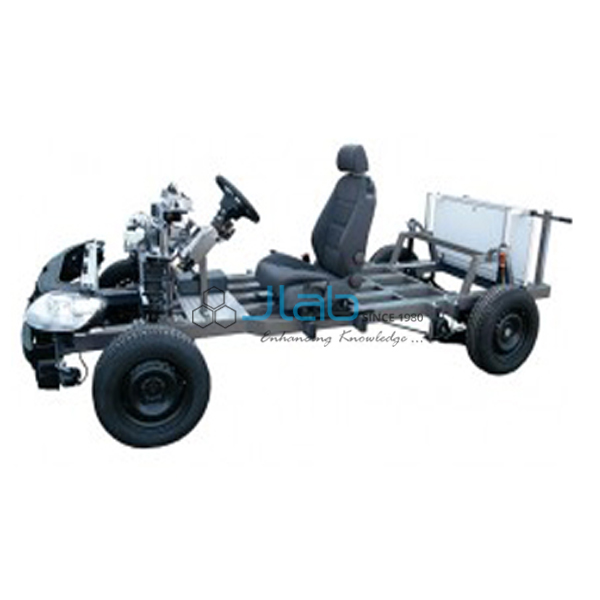
Brake work is learned with the hands: bleeding the lines, checking for leaks, adjusting and replacing parts. This trainer mounts original automotive hydraulic brake components into a simulated vehicle chassis on a mobile floor stand. Students practise operation, installation, maintenance and repair, with a colour-coded schematic chart of the brake circuit behind a polycarbonate screen.
Specifications
| Type | Hydraulic brake system trainer on a simulated vehicle chassis |
| Components | Original automotive hydraulic brake components |
| Stand | Integrated floor stand on wheels |
| Stand material | Powder-coated electro-galvanised steel |
| Reference chart | Colour-coded schematic of the brake system and circuit |
| Chart cover | Polycarbonate protective screen |
| Training scope | Operation, installation, maintenance and repair |
| Minimum order quantity | 1 unit |
| Dispatch time | Usually 14–18 working days |
| Manufacturer | JLab (Jain Laboratory Instruments Pvt Ltd), Ambala, India |
Workshop Practice on Hydraulic Brakes
Before working on the chassis, students see how the system works on a sectioned model such as the Model of Hydraulic Brake Unit Four Wheel Type. Its two master cylinders are one sectioned and one working. On the trainer they then trace the pipes from the master cylinder to each wheel and check every union for leaks.
Bleeding is the core practical. One student works the pedal while another opens and closes the bleed screw, and the reservoir is kept topped up so no new air is drawn in. When parts are refitted, mounting bolts and pipe fittings are tightened with a Torque Wrench to the figures in the service data.
Frequently Asked Questions
How does a hydraulic brake multiply pedal force?
By Pascal’s principle, pressure from the master cylinder piston acts equally through all the fluid. Wheel cylinder or caliper pistons with a larger area than the master piston produce a larger force at the brakes from the same pressure.
Why must air be bled out of the system?
Brake fluid hardly compresses, but air does. Air in the lines makes the pedal feel spongy and lets it travel further before the brakes apply, so less force reaches the wheels.
In which order are the brakes bled?
Usually the wheel farthest from the master cylinder is bled first, working towards the nearest one. Some dual-circuit and ABS systems need a different order, so the service manual for the system decides.
Why is brake fluid changed at intervals?
Glycol-based brake fluid absorbs moisture from the air over time. The water lowers its boiling point, which can cause vapour lock after hard braking, and it corrodes cylinders and pipes from inside.
Can the trainer be moved between workshop bays?
Yes. The chassis sits on an integrated floor stand of powder-coated electro-galvanised steel, mounted on wheels for mobility.
Other Brake Trainers and Models
- Pneumatic Air Brake Trainer
- Anti-Locking Braking System Trainer
- Model of Drum Brake Unit
- Vacuum Assisted Hydraulic Drum Brake
For a quote, use Add To Cart or send us a message through the contact page.
Last updated: 5 November 2026