Oersted Apparatus Manufacturer,Supplier and Exporter in India
Product Code : EL-ELA-5412
Jlab Export is a leading Oersted Apparatus Manufacturer,and suppliers in India
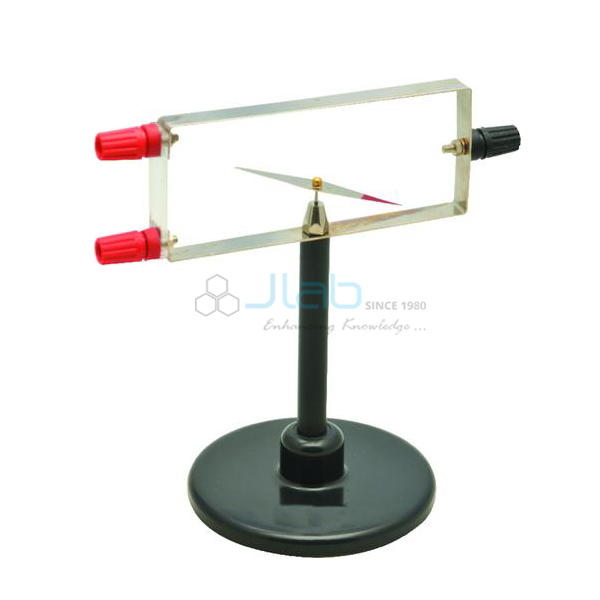
Oersted Apparatus (code EL-ELA-5412) is a physics demonstration unit that shows the action of an electric current on a magnet. A 75 mm cobalt steel needle turns on an agate bearing inside a 130 x 50 mm rectangular conductor frame, so students see the needle swing as soon as current flows. It is used in school and college physics labs and is made by Jain Laboratory Instruments Pvt Ltd (JLab) at its works in Ambala, India.
Specifications
| Parameter | Detail |
|---|---|
| Demonstrates | The action of an electric current on a magnet |
| Needle | Cobalt steel, 75 mm long |
| Bearing and support | Agate bearing, supported by a pivot |
| Base | Plastic; carries the pivot |
| Frame | Rectangular, 130 x 50 mm, in the vertical plane, surrounding the needle |
| Terminals | 4 mm socket terminals — two at one end of the frame, one at the other |
| Quality check | Each apparatus is visually inspected before dispatch |
| Pack quantity | Each (sold individually) |
| Minimum order quantity | 10 units |
| Dispatch time | Usually 7–10 working days |
| This listing covers | The apparatus; DC supply, plug key, rheostat and leads are separate items |
| Product code | EL-ELA-5412 |
| Manufacturer | Jain Laboratory Instruments Pvt Ltd (JLab) — OEM |
| Country of origin | India (made in Ambala, Haryana) |
How Does It Compare with Other JLab Oersted Apparatus?
| Model | Needle and bearing | Conductor and terminals |
|---|---|---|
| This apparatus (EL-ELA-5412) | Cobalt steel needle, 75 mm; agate bearing on a pivot; plastic base | 130 x 50 mm rectangular frame in the vertical plane; 4 mm sockets, two at one end and one at the other |
| Oersteds Apparatus | Magnetic needle, 75 mm; brass bearing on a pivot; plastic base | Rectangular copper rod fitted with terminals |
| Oersted Law Apparatus | Magnetic needle with brass bearing on a pivot, on a base | Rectangle of copper rod with terminals, connected so current can flow over or under the needle in either direction |
Choose this model for the cobalt steel needle on an agate bearing and a frame with 4 mm sockets; the Oersted Law Apparatus is listed specifically for routing current over or under the needle.
What Is the Oersted Apparatus Used For?
The apparatus repeats Hans Christian Oersted’s classic observation that a current-carrying wire deflects a nearby magnetic needle — the starting point of the “Magnetic Effects of Electric Current” chapter in CBSE class 10 science and of moving charges and magnetism in class 12 physics. It is standard school physics lab equipment and also serves college demonstrations and ITI and TVET electrical courses.
Turn the base until the needle at rest lies along the long side of the frame, then connect a low-voltage DC supply through a plug key and, if needed, a rheostat to the terminals. When the key is closed the needle swings; reversing the current reverses the swing, and the conductor above and below the needle deflects it in opposite senses, which students can predict with the right-hand thumb rule. Switch off between readings and keep other magnets away from the needle.
What to Specify When Ordering
- Model — this cobalt steel needle and agate bearing model, or one of the brass-bearing versions compared above.
- Quantity — the minimum order is 10 units.
- Circuit items — add a DC supply, plug key, rheostat and leads to the same enquiry if your lab does not already have them.
Frequently Asked Questions
What does the Oersted apparatus demonstrate?
It shows the action of an electric current on a magnet: the needle deflects when current flows through the surrounding frame, showing that a current produces a magnetic field.
How is the frame connected to a circuit?
The 130 x 50 mm frame stands in the vertical plane around the needle and has 4 mm socket terminals, two at one end and one at the other, which take 4 mm plug leads.
Is a power supply included?
No. This listing covers the apparatus only; the DC supply, key, rheostat and connecting leads are separate items, several of them linked below.
How does it differ from the Oersted Law Apparatus?
This model has a cobalt steel needle on an agate bearing and a frame with 4 mm sockets; the Oersted Law Apparatus uses a brass bearing and a copper-rod rectangle connected so current can pass over or under the needle in either direction.
Who manufactures this apparatus?
Jain Laboratory Instruments Pvt Ltd, trading as JLab, makes it at its works in Ambala, Haryana, India, and quotes for it as the manufacturer.
OEM Manufacturer
JLab is the trading name of Jain Laboratory Instruments Pvt Ltd, a physics and science lab equipment manufacturer in India, incorporated in 2017 and based on Hargolal Road, Ambala, Haryana. The Oersted apparatus is assembled at JLab’s own works, not bought from a trader, so schools, colleges, dealers and importers buy it factory-direct and repeat orders are handled by the manufacturer. The company is registered under CIN U29309HR2017PTC069123 and holds MSME Udyam registration UDYAM-HR-01-0003849 as a manufacturing enterprise. JLab exports worldwide and ships to buyers in every region — for example Algeria in North Africa, Ivory Coast in West Africa, Cameroon in Central Africa, Poland in Eastern Europe and Ecuador in South America. Physics lab tenders are covered on the JLab lab tenders page.
Equipment for the Experiment
- Battery Eliminator — supplies DC power from a source other than dry cells.
- Connecting Leads — plastic-coated leads with connectors for wiring the circuit.
- Rheostat — a single-tube sliding-contact rheostat for varying the current.
- Magnetic Plotting Compass — for plotting field lines around wires and coils.
- Electromagnet — a U-shaped soft-iron electromagnet for the next magnetic-effect experiment.
See more in the Educational Laboratory Apparatus range or the full Laboratory Apparatus range.
Request a Quote
Quotes come direct from the manufacturer. Use the Add To Cart enquiry button on this page, or send the quantity (minimum 10 units), any circuit items you want added and your delivery location through the contact page.
Last updated: 9 October 2026