Electrophoresis Horizontal Manufacturer,Supplier and Exporter in India
Product Code : EL-ELA-5428
Jlab Export is a leading Electrophoresis Horizontal Manufacturer,and suppliers in India
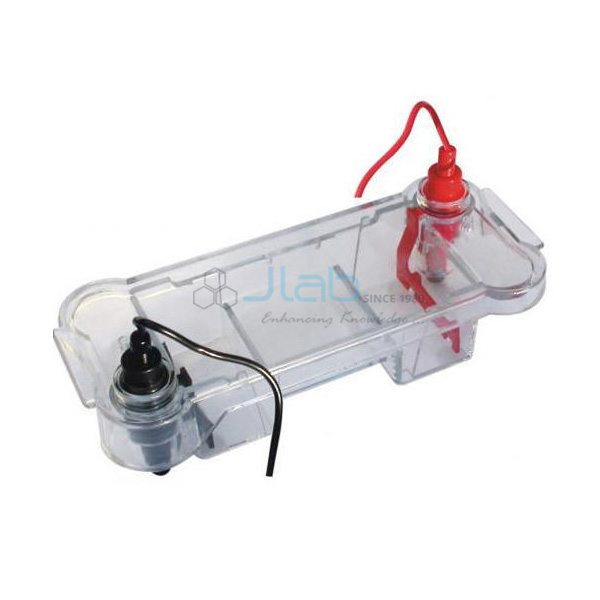
Electrophoresis Horizontal (code EL-ELA-5428) is a mini-size horizontal (submarine) gel electrophoresis unit for nucleic acid (DNA and RNA) characterisation in biotechnology and molecular biology labs at colleges, universities and research institutes. Its jointless tank is moulded in transparent polycarbonate to avoid leakage, and it comes with three comb sizes, two casting tray sizes and an electrode set. It is made by Jain Laboratory Instruments Pvt Ltd (JLab) at its works in Ambala, India.
Specifications
| Parameter | Detail |
|---|---|
| Type | Horizontal submarine gel electrophoresis unit, mini size |
| Also called | Submarine electrophoresis unit; agarose gel electrophoresis unit (the listing also names polyacrylamide gel electrophoresis) |
| Application | Nucleic acid (DNA and RNA) characterisation |
| Construction | Jointless, moulded in transparent polycarbonate to avoid leakage |
| Unit includes | Buffer chamber; safety lid with cables |
| Combs (as listed) | 9 wells / 10 teeth, set of 2; 11 wells / 12 teeth, set of 2; 13 wells / 14 teeth, set of 5 |
| Casting trays | 10 x 7 cm, set of 2; 7 x 7 cm, set of 2 |
| Electrodes | Electrode set, set of 2 pieces |
| Power supply | Not among the listed standard accessories — JLab lists electrophoresis power supplies separately |
| Quality check | Each unit is visually inspected before dispatch |
| Pack quantity | Each (one unit with the standard accessories above) |
| Minimum order quantity | 10 units |
| Dispatch time | Usually 7–10 working days |
| Product code | EL-ELA-5428 |
| Manufacturer | Jain Laboratory Instruments Pvt Ltd (JLab) — OEM |
| Country of origin | India (made in Ambala, Haryana) |
How Does It Compare with Other JLab Horizontal Electrophoresis Units?
| Model | Gel tray | Other listed details |
|---|---|---|
| This unit (EL-ELA-5428) | Mini size; casting trays 10 x 7 cm and 7 x 7 cm | Jointless transparent polycarbonate; buffer chamber and safety lid with cables; combs of 9, 11 and 13 wells; electrode set |
| Horizontal Gel Electrophoresis System | UV-transparent tray, 12–15 cm long and 12–15 cm wide | Jointless transparent polycarbonate; buffer chamber and safety lid with cables; combs of 10–15 and 25–30 wells |
| Horizontal Electrophoresis System | Gel casting tray (size not stated) | Platinum electrodes; one comb with a terminal lead |
Choose this mini unit for teaching and routine DNA checks where small gels and a choice of comb sizes are enough. The larger system suits runs with more samples per gel or a longer separation path, and the Horizontal Electrophoresis System is the one whose listing specifies platinum electrodes; this unit’s electrode material is not stated, so ask if your tender names it.
What Is the Horizontal Electrophoresis Unit Used For?
In horizontal gel electrophoresis, DNA or RNA samples are loaded into wells in an agarose gel that lies submerged in buffer — hence the name submarine unit. When a voltage is applied, the negatively charged nucleic acids move towards the positive electrode, and smaller fragments travel faster through the gel, so the samples separate into bands by size. Typical work includes checking DNA after extraction, comparing restriction digests and confirming PCR products in class 12 biotechnology, BSc and MSc molecular biology practicals and research labs. With 9-, 11- and 13-well combs and two tray sizes, a teacher can match the gel to the number of samples in each run.
To run a gel, cast the agarose in a casting tray with a comb in place, lift out the comb once the gel has set, place the tray in the buffer chamber and cover the gel with running buffer. Load the samples, close the safety lid and connect the cables to a power supply. Switch the supply off before opening the lid, wear gloves when handling gels and DNA stains, and view stained gels only behind a UV-protective shield. After use, rinse the tank, trays and combs with distilled water and keep organic solvents away from the polycarbonate.
What to Specify When Ordering
- Power supply — choose the analog fixed or the digital variable model listed below, or state the supply you already have.
- Extra trays and combs — spare 7 x 7 cm casting trays are listed in packets of 2; mention any other spares in the same enquiry.
- Gel type — tell us if you plan to run anything other than agarose gels for DNA and RNA.
- Quantity — the minimum order is 10 units; many colleges plan one unit per bench group.
Frequently Asked Questions
What is supplied with the unit?
The buffer chamber with a safety lid and cables, plus the standard accessories: combs of 9 wells (set of 2), 11 wells (set of 2) and 13 wells (set of 5), casting trays of 10 x 7 cm and 7 x 7 cm (two of each) and an electrode set of 2 pieces.
What gel sizes can be cast?
Two sizes, using the 10 x 7 cm and 7 x 7 cm casting trays supplied with the unit. For larger gels, JLab lists a separate horizontal system with 12–15 cm trays.
Is a power supply included?
No, it is not among the listed accessories. The Electrophoresis Power Supply, Analog Fixed (fixed 200 mA with fixed 50, 100, 150 and 200 V) is listed as recommended for the mini horizontal apparatus, and the Digital, Variable model (0–300 V, 0–200 mA, with digital timer) is listed for both mini horizontal and mini vertical units.
Can it be used for polyacrylamide gels?
Check with JLab first. The listing names polyacrylamide gel electrophoresis among the unit’s other names, but horizontal submarine units are mainly used with agarose gels for DNA and RNA, while protein gels are usually run in a vertical system.
What information is needed for an export quotation?
Send the number of units, the power supply and spares you need, the destination country and port or city, your preferred delivery terms (for example FOB or CIF), packing or labelling requirements, and the tender reference if there is one.
Who manufactures this electrophoresis unit?
Jain Laboratory Instruments Pvt Ltd, trading as JLab, makes it at its works in Ambala, Haryana, India, and quotes for it directly as the manufacturer.
OEM Manufacturer
JLab is the trading name of Jain Laboratory Instruments Pvt Ltd, a manufacturer of educational and biotechnology laboratory equipment in India, incorporated in 2017 and based on Hargolal Road, Ambala, Haryana. This unit is moulded and assembled at JLab’s own works rather than bought from a trader, so colleges, research institutes, dealers and importers buy it factory-direct, each unit is visually inspected before dispatch, and spare combs, trays and electrodes are handled by the manufacturer. The company holds MSME Udyam registration UDYAM-HR-01-0003849 (manufacturing enterprise) and exports under Importer-Exporter Code 3317504552. JLab ships worldwide to buyers in every region, with Eswatini in Southern Africa, the Dominican Republic in Central America and the Caribbean, Lebanon in the Middle East, Cameroon in Central Africa and Tunisia in North Africa as examples. Institutions buying by tender can see the JLab lab tenders page.
Power Supplies and Spares for Electrophoresis
- Electrophoresis Power Supply, Analog Fixed — an LED-display analog supply listed as recommended for the mini horizontal apparatus.
- Electrophoresis Power Supply, Digital, Variable — constant-current and constant-voltage supply with digital timer for mini horizontal and vertical units.
- Electrophoresis Accessories — spare 7 x 7 cm gel casting trays, packet of 2, for this mini unit.
- Vertical Electrophoresis System — a vertical system that takes precast or hand-cast gels between glass plates.
- Gel Electrophoresis System — JLab’s general listing for separating DNA, RNA or proteins by molecular size.
See more in the Educational Laboratory Apparatus range or the full Laboratory Apparatus range.
Request a Quote
Quotes come direct from the manufacturer. Use the Add To Cart enquiry button on this page, or send the number of units (minimum 10 units), the power supply and any spare combs or trays you need, and your delivery location through the contact page.
Last updated: 9 October 2026