

Polygraph Manufacturer,Supplier and Exporter in India
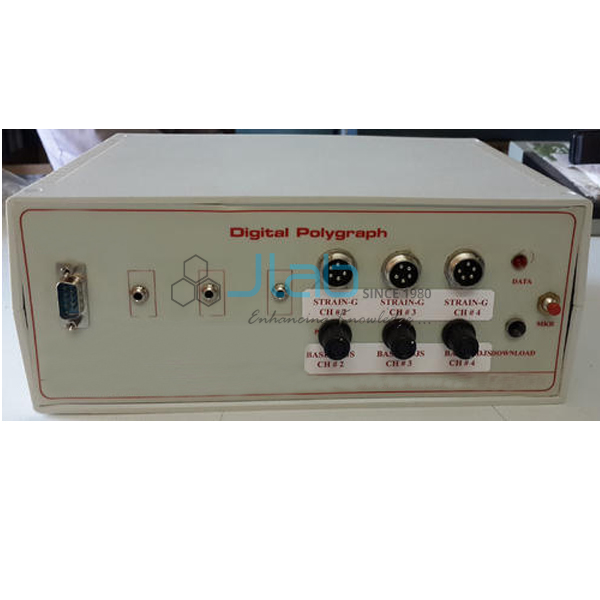
Product Code : EL-P-2379
Jlab Export is a leading Polygraph Manufacturer,and suppliers in India
Polygraph (code EL-P-2379) is an ink-writing chart recorder for psychology and physiology laboratories, built around modular pen motors that can be exchanged in a minute or two and 120 mm pens with a frequency response of 70 Hz at -3 dB. A silent, backlash-free chart drive feeds Z-fold paper, and a time and event channel is available as an option. It is made by Jain Laboratory Instruments Pvt Ltd (JLab) at its works in Ambala, India.
Specifications
| Parameter | Detail |
|---|---|
| Pen motors | Modular, easily interchangeable in a minute or two |
| Pen length | 120 mm, ink-writing system |
| Frequency response | 70 Hz at -3 dB with 120 mm ink pens; appreciably higher with shorter 75 or 80 mm pens |
| Chart drive | Silent gear train with an imported synchronous motor, free from backlash |
| Chart paper | Z-fold, for easy back reference and recording |
| Power supply | Ripple-free, high stabilisation, overload protection |
| Time and event channel | Modular, optional |
| Quality check | Each polygraph is visually inspected before dispatch |
| Pack quantity | Each (sold individually) |
| Minimum order quantity | 10 units |
| Dispatch time | Usually 7–10 working days |
| Product code | EL-P-2379 |
| Manufacturer | Jain Laboratory Instruments Pvt Ltd (JLab) — OEM |
| Country of origin | India (made in Ambala, Haryana) |
How Does It Compare with the JLab Student Physiograph?
| Model | Pen system | Chart drive | Transducers and accessories in the listing |
|---|---|---|---|
| Polygraph (EL-P-2379) | Modular interchangeable pen motors; 120 mm ink pens; 70 Hz at -3 dB | Silent, backlash-free gear train; Z-fold paper | Not listed — configured to your enquiry |
| Student Physiograph | Modular interchangeable pen motors; 120 mm ink pens; 70 Hz at -3 dB | Ten speeds, 0.05 to 50 mm/s; Z-fold paper | Pressure, volume, force, respiration, pulse and isotonic transducers, couplers and EKG/EEG electrodes listed |
Choose the polygraph when you want the recorder itself and will specify the signals to suit your own practicals; the student physiograph listing comes with a defined set of transducers, couplers and electrode accessories.
What Is a Polygraph Used For?
A polygraph writes several physiological signals side by side on one moving chart, so that changes in each can be compared at the same instant. In psychology departments it is used for practicals on emotion, arousal and stress responses, and physiology teaching labs use it for multi-signal recordings. A time and event channel, if fitted, lets the operator mark when a stimulus was given alongside the traces.
Several details of this design matter for clean traces. Each pen swings on an arc, and a short pen exaggerates that arc distortion; the 120 mm pens keep it lower, with a 70 Hz (-3 dB) response that rises if shorter 75 or 80 mm pens are used. The chart drive is deliberately silent, because a noisy or humming gear train or motor can act on the subject and show up as biofeedback in the recording. Z-fold paper makes it easy to turn back to earlier sections of a long session, and the ripple-free, stabilised supply with overload protection keeps electrical noise off the pens.
What to Specify When Ordering
- Signals and transducers — list what you need to record so JLab can confirm the configuration.
- Time and event channel — optional; state whether you want it.
- Consumables — spare Z-fold chart paper and ink for a term of practicals.
- Quantity and tender details — the minimum order is 10 units; quote any tender reference.
Frequently Asked Questions
Why are the pens 120 mm long?
A longer pen reduces the arc distortion of the waveform. With 120 mm ink pens the response is 70 Hz at -3 dB; shorter 75 or 80 mm pens respond appreciably faster but distort more.
Can a pen motor be changed if it fails?
Yes. The pen motors are modular and can be interchanged in a minute or two, and JLab supplies replacements as the maker.
Which transducers and how many channels does it have?
This listing does not state them. Tell JLab which signals you want to record together and the configuration will be confirmed with your quotation.
How is it different from the student physiograph?
Both use modular pen motors, 120 mm ink pens and Z-fold paper. The student physiograph listing also specifies ten chart speeds and a set of transducers, couplers and EKG/EEG accessories; the polygraph listing leaves those to your order.
Who manufactures this polygraph?
JLab (Jain Laboratory Instruments Pvt Ltd) makes it at its works in Ambala, Haryana, and quotes for it directly as the manufacturer.
OEM Manufacturer
JLab is the trading name of Jain Laboratory Instruments Pvt Ltd, an Indian manufacturer of psychology and physiology laboratory equipment and general lab apparatus, incorporated in 2017 and based on Hargolal Road, Ambala, Haryana. The polygraph is assembled at JLab’s own works rather than bought in from a trader, which lets universities, colleges, dealers and importers order factory-direct and get replacement pen motors and repeat units from the same source. JLab exports worldwide and ships to buyers in every region — for example Madagascar in East Africa, Slovenia in Southern Europe, Iceland in Northern Europe, Jordan in the Middle East and Libya in North Africa. For institutional purchases, see the JLab lab tenders page.
Related Recording Apparatus
- Student Physiograph — a recorder listed with ten chart speeds, transducers and EKG/EEG accessories.
- Student Electrical Kymographs — recording drums driven by a constant-speed electric motor and gear-box.
- Kymograph — a device that records a movement graphically against time.
- Bicycle Ergograph — apparatus for work and fatigue studies in the psychology lab.
See the Polygraph category or the complete Psychology Lab Equipments range.
Request a Quote
Quotes come direct from the manufacturer. Use the Add To Cart enquiry button, or send the quantity (minimum 10 units), the signals you need to record, whether you want the time and event channel, and your delivery location through the contact page.
Last updated: 9 October 2026