Rubber Tubing Silicon Manufacturer,Supplier and Exporter in India
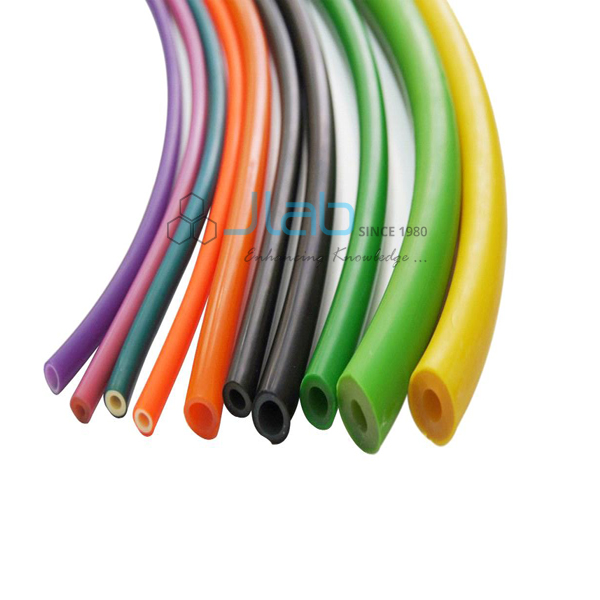
Product Code : EL-SLE-4721
Jlab Export is a leading Rubber Tubing Silicon Manufacturer,and suppliers in India
Rubber Tubing Silicon (code EL-SLE-4721) is silicone rubber tubing of 5 mm diameter made for burette clips and other short flexible joints in school, college and analytical labs. It is sold in rolls of 10 metres, so each burette or apparatus can be fitted with a freshly cut length. The tubing is made by Jain Laboratory Instruments Pvt Ltd (JLab) at its works in Ambala, India.
Specifications
| Parameter | Detail |
|---|---|
| Material | Silicone rubber (listed as “silicon made rubber tubing”) |
| Diameter | 5 mm (the listing does not say whether this is the bore or the outside diameter — confirm when ordering) |
| Made for | Burette clips |
| Roll length | 10 metres |
| Quality check | Each roll is visually inspected before dispatch |
| Pack quantity | One roll of 10 metres |
| Minimum order quantity | 10 units |
| Dispatch time | Usually 7–10 working days |
| Product code | EL-SLE-4721 |
| Manufacturer | Jain Laboratory Instruments Pvt Ltd (JLab) — OEM |
| Country of origin | India (made in Ambala, Haryana) |
Silicone or Rubber: Comparing JLab Tubing
| Item | Material | Listed size | Listed use or feature |
|---|---|---|---|
| This tubing (EL-SLE-4721) | Silicone rubber | 5 mm diameter, 10 metre roll | Burette clips |
| Rubber Tubing | Rubber | 10 metre roll; diameter not stated | Pressure applications and burette clips; reddish or soft pink |
| Rubber Tubing (chemistry range) | Natural rubber | 5 mm or 8 mm, 10 metre length | Very soft; wall thickness to customer requirement |
Choose this silicone tubing when a burette needs a 5 mm flexible outlet that stays supple for longer. The rubber tubing roll suits gas and water connections at the bench, and the chemistry-range tubing is the option when you need an 8 mm size or a specified wall thickness.
What Is Silicone Tubing Used For in the Lab?
The use named in the listing is the burette clip: a short piece of tubing joins the burette body to its glass jet, and a pinch clip squeezed on the tubing controls the flow drop by drop, as in a Mohr’s burette. The same tubing makes flexible joints between glass tubes in chemistry set-ups, links small pumps or aspirators, and carries water in demonstrations where a soft, easily cut tube is needed.
As a material, silicone rubber stays flexible over a wider temperature range than natural rubber and ages more slowly in sunlight and ozone, which is why it is often chosen for clip joints that are opened and closed many times. It is less tear-resistant than natural rubber, however, so cut it square with a sharp blade and slide it onto wetted glass rather than forcing it over sharp edges. Silicone lets gases pass through its wall slowly and swells in many non-polar organic solvents, so check your method before using it for gas-tight or solvent work.
What to Specify When Ordering
- Number of rolls — each roll is 10 metres and the minimum order is 10 units.
- Diameter check — confirm whether you need a 5 mm bore or a 5 mm outside diameter to suit your burette jets and pinch clips.
- Application — say if the tubing is for burettes, water lines or another set-up, so JLab can confirm suitability.
- Fittings — glass tubing and tubing connectors can be added to the same enquiry.
Frequently Asked Questions
What size is this silicone tubing?
It is listed at 5 mm diameter and supplied in 10 metre rolls. The listing does not say whether 5 mm is the bore or the outside diameter, so state which you need when you enquire.
Is it the same as silicon?
The listing calls it “silicon made rubber tubing”. In practice laboratory tubing of this kind is made from silicone rubber, a flexible polymer based on silicon and oxygen, not from the element silicon itself.
Why use silicone tubing on a burette?
A burette clip squeezes the tubing every time the flow is stopped. Silicone stays supple and recovers its shape well, so the clip keeps closing cleanly through many titrations.
Can it carry organic solvents?
Not reliably. Silicone swells in many non-polar solvents, so in a teaching lab keep it for water and aqueous solutions; ask JLab before using it with solvents.
Is a pinch clip or burette included?
No. This listing covers the tubing roll only; clips, burettes and glass connectors are separate items.
What do I send for an export quotation?
Send the number of rolls, the diameter you require, the destination country and port or city, preferred delivery terms such as FOB or CIF, labelling or packing needs and any tender reference.
Who makes this tubing?
JLab, trading name of Jain Laboratory Instruments Pvt Ltd, manufactures it at its works in Ambala, Haryana, India.
OEM Manufacturer
JLab is the trading name of Jain Laboratory Instruments Pvt Ltd, a laboratory equipment and consumables manufacturer in India, incorporated in 2017 and operating from Hargolal Road, Ambala, Haryana. The silicone tubing is produced at JLab’s own works, not bought in from a trader, so schools, colleges, dealers and importers get factory-direct supply, every roll is inspected by eye before dispatch, and repeat orders are handled by the manufacturer. JLab exports worldwide and ships to buyers in every region — for example Poland in Eastern Europe, Colombia in South America, Tajikistan in Central Asia, Uganda in East Africa and South Korea in East Asia. Institutional buyers can check the JLab lab tenders page.
Related Tubing and Connectors
- Rubber Tubing — reddish or soft pink rubber tubing in 10 metre rolls for bench connections.
- Rubber Tubing (chemistry range) — natural rubber tubing in 5 mm and 8 mm sizes.
- Tubing Connectors — straight, T-shape and Y-shape glass connectors.
- Glass Tubing — soda glass tubing and capillary to join with flexible tubing.
More school lab consumables are in the School Lab Equipment range.
Request a Quote
Your quotation comes directly from the manufacturer. Use the Add To Cart button on this page, or send through the contact page the number of rolls (minimum 10), whether 5 mm should be the bore or the outside diameter, the application, and the delivery destination.
Last updated: 4 October 2026