Social Reformers Chart Manufacturer,Supplier and Exporter in India
Product Code : EL-SFIF-3222
Jlab Export is a leading Social Reformers Chart Manufacturer,and suppliers in India
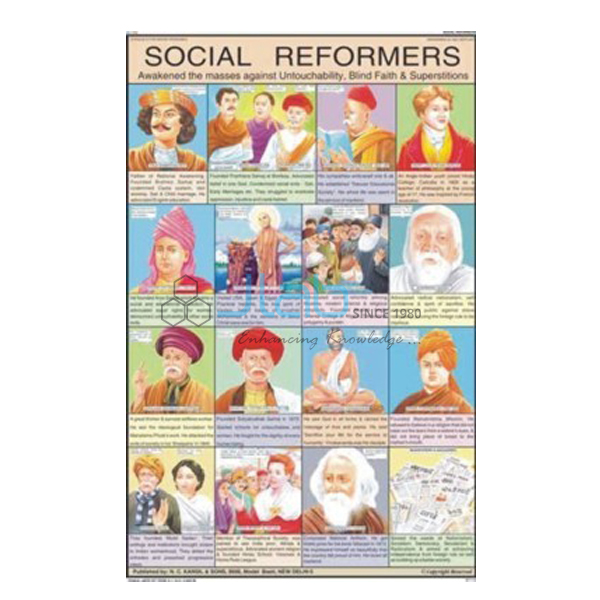
This history chart introduces India’s social reformers through pictures and short life sketches. It lets a class put a face and a story to each name in the reform chapter. It is printed in colour on a 50 x 75 cm sheet and comes in English or Hindi.
Specifications
| Subject | Social reformers of India |
| Content | Pictures and life sketches, explained in pictures and words |
| Size | 50 x 75 cm |
| Printing | Colour |
| Language | English or Hindi |
| Minimum order quantity | 10 units |
| Dispatch time | Usually 4–6 working days |
| Manufacturer | JLab (Jain Laboratory Instruments Pvt Ltd), Ambala, India |
Classroom Activities for the Reform Lesson
In the class 8 history chapter on women, caste and reform, the teacher can put this chart up beside the Impact of British Rule Chart. Students first see how society looked at the time, then match each reformer to the practice he or she worked against.
For map work, groups mark on the India Chart the region where each reformer worked, such as Bengal, Maharashtra or the Madras Presidency. Each student then writes a short life sketch card for one reformer, using the chart as a starting point.
Frequently Asked Questions
The charts arrive rolled. How are they flattened for display?
Unroll the chart print side up on a clean table and weight the corners with books. Leave it for a day, and if it still curls, roll it loosely the other way for a minute. Do not iron it or dampen it, as heat and moisture can mark the print.
What should be checked when a new batch of charts is unrolled?
Unroll a few charts with clean, dry hands and look along the edges for tears, creases and crushed corners. Check that the language edition, English or Hindi, matches the order, and that the colour printing is even, with no smudges.
Who campaigned against sati?
Raja Rammohun Roy, founder of the Brahmo Samaj, argued in his writings that the old texts did not demand sati. His campaign helped persuade the British government to ban the practice.
What did Ishwar Chandra Vidyasagar and Pandita Ramabai work for?
Vidyasagar used the old texts to argue that widows could remarry, and a law allowing widow remarriage followed. Pandita Ramabai worked for the education of women and set up a home for widows at Poona, where they could study and support themselves.
What was the Satyashodhak Samaj?
It was the society Jyotirao Phule founded to work for caste equality. His book Gulamgiri, meaning slavery, compared the treatment of the lower castes with slavery in America. With Savitribai Phule he also opened schools for girls.
Other Freedom Struggle Charts
For a quote, use Add To Cart or send us a message through the contact page.
Last updated: 15 November 2026