Triac and AC Phase Control Manufacturer,Supplier and Exporter in India
Product Code : EL-PET-1417
Jlab Export is a leading Triac and AC Phase Control Manufacturer,and suppliers in India
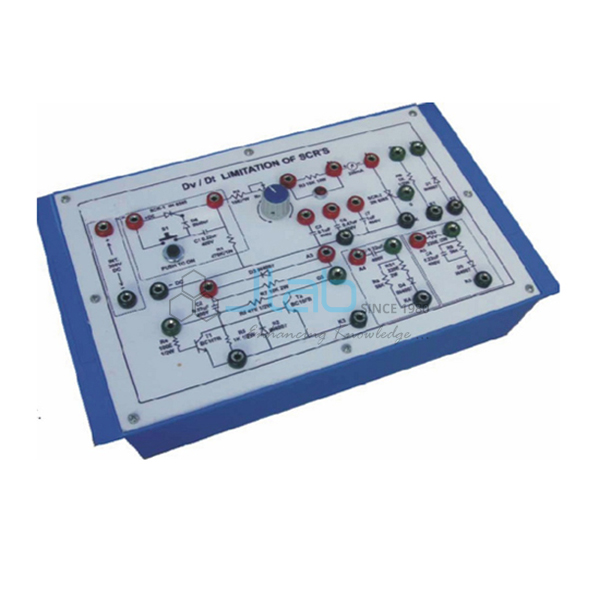
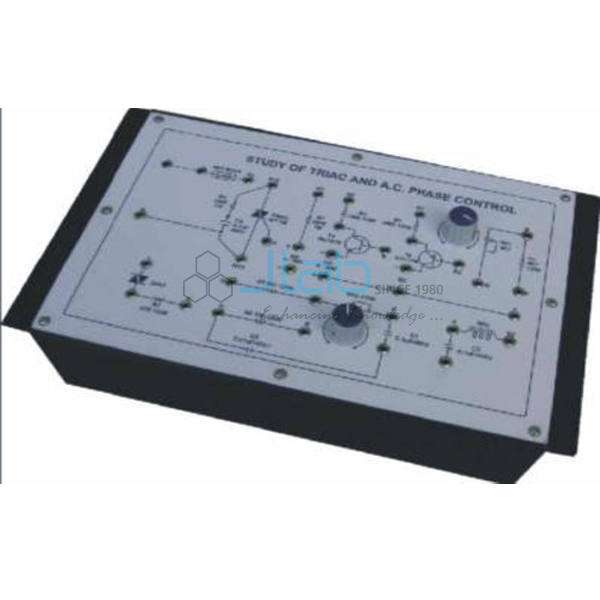
Triac and AC Phase Control (code EL-PET-1417) is a power electronics training board for studying the TRIAC in all four triggering modes and its use in AC phase control, with a DIAC as the gate trigger and a 40 W lamp as the load. JLab produces the board at its own works in Ambala, India.
Specifications
| Parameter | Detail |
|---|---|
| Devices | TRIAC; DIAC |
| Controls | Two potentiometers for biasing and phase control |
| RFI filter | RF choke and capacitor |
| Load | Lamp holder with 40 W lamp, as load and power control indicator |
| Mains controls | Mains on/off switch, fuse and jewel light |
| Mains supply | 230 V ±10%, 50 Hz AC |
| Patch cords | Stackable, 4 mm spring-loaded plugs, half a metre long |
| Terminals | Terminals/sockets on the panel for connections and observation of waveforms |
| Operating instructions | Detailed, giving object, theory, design procedures, report suggestions and book references |
| Other apparatus required | Digital multimeter, 3¾ digit; 0–30 V, 1 A IC-regulated power supply; dual trace cathode ray oscilloscope, 20 MHz (unearthed) |
| Weight | 3 kg (approx.) |
| Dimensions | W 340 x H 110 x D 210 |
| Packing | Corrugated box |
| Quality check | Each board is visually inspected before dispatch |
| Pack quantity | Each (sold individually) |
| Minimum order quantity | 10 units |
| Dispatch time | Usually 7–10 working days |
| Product code | EL-PET-1417 |
| Manufacturer | Jain Laboratory Instruments Pvt Ltd (JLab) — OEM |
| Country of origin | India (made in Ambala, Haryana) |
How Does It Compare with Other JLab Triac Boards?
| Model | TRIAC studies | Other parts |
|---|---|---|
| This board (EL-PET-1417) | Operation in modes I+, I−, III+ and III−; NPN and PNP transistor gate control; DIAC-triggered phase control; light dimmer hysteresis and gate slaving; RFI suppression | DIAC; two potentiometers; RF choke and capacitor; 40 W lamp |
| Training Board for Triac | Gate characteristics in all four modes; terminal characteristics in modes I+ and III+; static switching, AC control with an AC signal and holding current | Regulated DC and fixed AC supplies built in |
| Triac AC Line Switching | Five experiments on the TRIAC as an AC mains power switch | 40 W lamp load; isolation transformer |
Choose this board for TRIAC phase control as used in lamp dimmers, including hysteresis, gate slaving and RFI suppression. The Training Board for Triac is set up for device characteristics and simple applications, and Triac AC Line Switching for the TRIAC as an AC power switch.
What Is the Triac and AC Phase Control Board Used For?
A TRIAC is a bidirectional thyristor that conducts in both half-cycles of the mains, so a single device can control the full AC power to a load such as a lamp. A DIAC in the gate circuit breaks over at a definite voltage in either direction and delivers a sharp trigger pulse, which makes the pair the basis of the ordinary light dimmer. The board is used in power electronics practicals in diploma and degree courses in electrical and electronics engineering. Experiments that can be performed:
- TRIAC characteristics and operation in all four modes: I+, I−, III+ and III−
- Gate control of the TRIAC with an NPN transistor
- Gate control of the TRIAC with a PNP transistor
- Phase control with the TRIAC and a DIAC as pulse generator for gate trigger
- TRIAC light dimmer: hysteresis effect and its minimisation by the gate slaving technique
- Radio frequency interference (RFI) in phase control and its suppression by an RFI filter
What to Specify When Ordering
- Other apparatus — the multimeter, regulated power supply and oscilloscope are separate items; name the ones you need on the enquiry.
- Companion boards — the Training Board for Triac or the SCR phase control board if the course covers them.
- Quantity — the number of boards for your lab.
Frequently Asked Questions
What are the four triggering modes of a TRIAC?
Modes I+ and I− are with main terminal MT2 positive with respect to MT1 and a positive or negative gate current; III+ and III− are with MT2 negative and a positive or negative gate current. The board lets each mode be studied.
What is the hysteresis effect in a TRIAC dimmer?
In a simple DIAC-TRIAC dimmer the lamp switches on at a different control setting from the one at which it goes off, because once the DIAC fires it partly discharges the timing capacitor, which changes the starting voltage for the next half-cycle. The board demonstrates the effect and its minimisation by gate slaving.
Why does phase control produce radio frequency interference?
The TRIAC switches the load current on abruptly part-way through each half-cycle, and the fast edges contain high-frequency components. The RF choke and capacitor on the board form a filter that suppresses this interference.
What other apparatus is needed?
A 3¾-digit digital multimeter, a 0–30 V, 1 A IC-regulated power supply and a 20 MHz dual trace cathode ray oscilloscope used unearthed. They are separate items that can be quoted together with the board.
What information is needed for an export quotation?
Send the number of boards, the destination country and port or city, the delivery terms you prefer (for example FOB or CIF), packing or labelling requirements and any tender reference.
Who manufactures the Triac and AC Phase Control board?
Jain Laboratory Instruments Pvt Ltd (JLab) builds it at its works in Ambala, Haryana, India.
OEM Manufacturer
JLab is the trading name of Jain Laboratory Instruments Pvt Ltd, an Indian maker of power electronics and electrical engineering trainers, incorporated in 2017 and based on Hargolal Road, Ambala, Haryana. This board is produced in JLab’s own works rather than bought from a trader, so engineering colleges, dealers and importers order it from the manufacturer, each unit is visually inspected before dispatch, and repeat orders are handled by the same team. JLab exports worldwide and ships to buyers in every region — for example Mauritius in East Africa, Lesotho in Southern Africa, Canada in North America, Norway in Northern Europe and Cyprus in Southern Europe. Tender information is on the JLab lab tenders page.
Related Power Electronics Trainers
- AC Regulators Using Triac Anti Parallel Thyristor — compares triac, anti-parallel thyristor and triac-diac AC regulators.
- Training Board for DIAC — V-I characteristics of a DIAC and its use as a sawtooth and pulse train generator.
- SCR And AC Phase Control — resistance, RC and UJT trigger circuits for SCR phase control.
- Dual Trace Oscilloscope — a DC to 20 MHz two-channel cathode ray oscilloscope, quoted separately.
See all Power Electronics Trainers or the full Electronics Lab Equipments range.
Request a Quote
To request a quotation, use the Add To Cart enquiry button or the contact page, with the number of boards, the delivery destination and any apparatus or companion trainers you want included.
Last updated: 22 October 2026