AC Regulators Using Triac Anti Parallel Thyristor Manufacturer,Supplier and Exporter in India

Product Code : EL-PET-1432
Jlab Export is a leading AC Regulators Using Triac Anti Parallel Thyristor Manufacturer,and suppliers in India
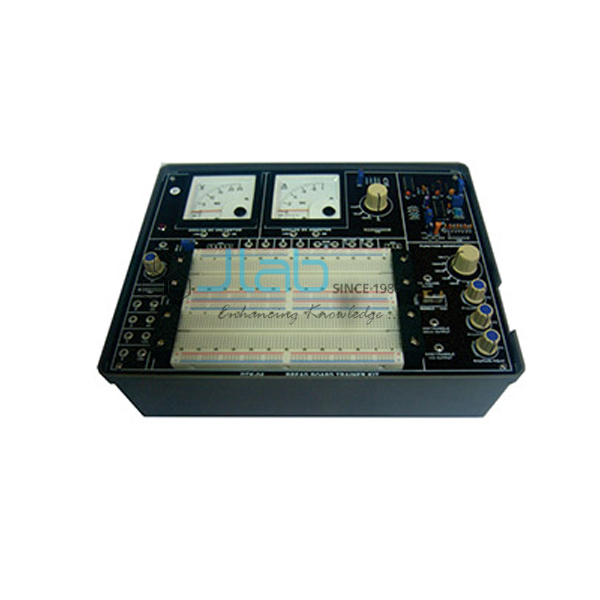
AC Regulators Using Triac Anti Parallel Thyristor (code EL-PET-1432) is a power electronics training board for building and comparing three kinds of AC regulator on one panel, with a 40 W, 230 V AC bulb built in. Jain Laboratory Instruments Pvt Ltd, trading as JLab, manufactures the board in Ambala, India.
Specifications
| Parameter | Detail |
|---|---|
| Experiments | AC regulator using a triac; AC regulator using thyristors connected in anti-parallel; AC regulator using a triac and a diac (with R-C triggering circuit) |
| Isolated transformer | 230 V AC, 50 W |
| DC supply | 9 V DC at 100 mA, zener regulated |
| Thyristors | Two silicon controlled rectifiers (SCRs) |
| Other devices | UJT; TRIAC; DIAC |
| Pulse transformer | 1:1:1 |
| Potentiometers | Two: one for controlling the UJT firing angle, one for varying the load |
| Bulb | 40 W, 230 V AC |
| Mains controls | Mains ON/OFF switch, fuse and jewel light |
| Mains supply | 230 V ±10%, 50 Hz AC |
| Patch cords | Adequate number, stackable, 4 mm spring-loaded plugs, ½ metre long |
| Terminals | Terminals and sockets on the panel for connections and observation of waveforms |
| Operating instructions | Detailed: object, theory, design procedures, report suggestions and book references |
| Weight | 6 kg (approx.) |
| Dimensions | W 300 × H 140 × D 200 |
| Other apparatus required | Dual-trace cathode ray oscilloscope, 20 MHz (unearthed), or with an isolation transformer for unearthing |
| Quality check | Each board is visually inspected before dispatch |
| Pack quantity | Each (sold individually) |
| Minimum order quantity | 10 units |
| Dispatch time | Usually 7–10 working days |
| Product code | EL-PET-1432 |
| Manufacturer | Jain Laboratory Instruments Pvt Ltd (JLab) — OEM |
| Country of origin | India (made in Ambala, Haryana) |
What Is the AC Regulator Board Used For?
An AC regulator, or AC voltage controller, applies phase control to both half-cycles of the mains so that the RMS voltage reaching the load can be varied smoothly without a bulky variable transformer. Working through the three circuits lets students compare a single-triac power stage, an anti-parallel SCR pair and the low-cost diac–triac circuit with R-C triggering that is found in light dimmers and fan regulators. The same principle controls heaters and lamps and is used for the soft-starting of AC motors.
What to Specify When Ordering
- The number of boards required.
- Whether an oscilloscope or an isolation transformer should be quoted alongside.
- Companion phase-control boards, for example Triac and AC Phase Control or Universal Motor Speed Control, if you are setting up a full bench of AC control practicals.
- Destination, delivery terms and any tender reference.
Frequently Asked Questions
Why use two SCRs in anti-parallel instead of a triac?
Each SCR conducts in one half-cycle, so together they control both half-cycles just as a triac does. Separate SCRs are generally available in higher current and voltage ratings and cope better with inductive loads, which is why anti-parallel pairs are preferred at higher power, while a triac is simpler as a single device.
What is the 1:1:1 pulse transformer for?
In an anti-parallel pair the two SCR cathodes sit at different points of the circuit, so each gate needs its own isolated pulse. A 1:1:1 pulse transformer has one primary and two isolated secondary windings, so a single trigger pulse can be delivered to two gates at once.
How does a diac fire the triac with R-C triggering?
The R-C network delays the voltage applied to the diac. When that voltage reaches the diac’s breakover level the diac conducts and passes a pulse into the triac gate; changing the resistance in such a circuit changes the delay and therefore the firing angle.
Which supplies are built in?
The board runs from 230 V ±10%, 50 Hz mains. It has a 230 V AC isolated transformer of 50 W and a 9 V DC, 100 mA zener-regulated supply.
What oscilloscope is required?
A 20 MHz dual-trace cathode ray oscilloscope, either of the unearthed type or used with an isolation transformer for unearthing. JLab’s 20 MHz dual-trace oscilloscope is linked below as a separate item.
How does it differ from the SCR And AC Phase Control board?
That board concentrates on SCR trigger circuits — resistance, R-C and UJT types, including UJT ramp and pedestal variations — and includes full-wave phase control with inverse-parallel SCRs. This board is organised around complete AC regulators and compares their power stages.
What information does an export quotation need?
The quantity, the destination country and port or city, the delivery terms you want (such as FOB or CIF), any packing or labelling requirements, and the tender reference if one applies.
Who manufactures this AC regulator board?
Jain Laboratory Instruments Pvt Ltd (JLab) manufactures it at its works in Ambala, Haryana, India.
OEM Manufacturer
JLab is the trading name of Jain Laboratory Instruments Pvt Ltd, a manufacturer of power electronics trainers and other laboratory equipment in India, incorporated in 2017 and based on Hargolal Road, Ambala, Haryana. The AC regulator board is produced at JLab’s own works and not bought in from a trader, so engineering colleges, polytechnics, dealers and importers buy from the maker directly; every board is visually inspected before dispatch, and repeat orders and spares are handled in-house. JLab is registered as a manufacturing enterprise under MSME Udyam registration UDYAM-HR-01-0003849 and holds Importer-Exporter Code 3317504552. JLab exports worldwide and ships to buyers in every region — for example Finland in Northern Europe, Turkey in the Middle East, Kyrgyzstan in Central Asia, Sudan in North Africa and Hong Kong in East Asia. Tender buyers can refer to the JLab lab tenders page.
Related AC Phase-Control Boards
- Triac and AC Phase Control — triac triggering modes, DIAC phase control, gate slaving and RFI suppression.
- SCR And AC Phase Control — resistance, R-C and UJT trigger circuits for SCR phase control.
- Lamp Dimmer Using Diac and Triac — a diac–triac board with a potentiometer to set the lamp brightness.
- Universal Motor Speed Control — SCR and triac speed control of a universal motor.
- Diac Characteristics Apparatus — for plotting the V–I characteristics of a diac.
- Dual Trace Oscilloscope — a 20 MHz dual-channel oscilloscope.
Browse the Power Electronics Trainers section or the full Electronics Lab Equipments range.
Request a Quote
Use the Add To Cart enquiry button on this page or the contact page to ask for a quotation, and say how many boards you need, where they are going and whether an oscilloscope should be included.
Last updated: 22 October 2026