DC Step Down Mosfet Chopper Manufacturer,Supplier and Exporter in India
Product Code : EL-PET-1445
Jlab Export is a leading DC Step Down Mosfet Chopper Manufacturer,and suppliers in India
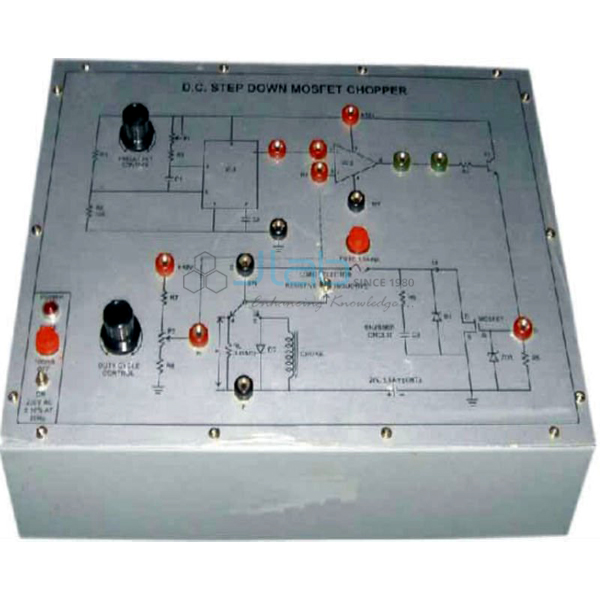
DC Step Down Mosfet Chopper (code EL-PET-1445) is a power electronics training board for studying a DC step-down chopper switched by a MOSFET. An IC generates a triangular pulse, a second IC drives the MOSFET, and two potentiometers vary the switching frequency and the duty cycle. The trainer is made at the Ambala works of Jain Laboratory Instruments Pvt Ltd (JLab) in India.
Specifications
| Parameter | Detail |
|---|---|
| Object | To study the DC step-down MOSFET chopper |
| Regulated DC supplies | ±12 V DC at 100 mA; 20 V DC at 1 A |
| Pulse generation | IC for triangular pulse generation |
| Gate drive | IC to drive the MOSFET |
| Switching device | MOSFET |
| Controls | Two potentiometers, for varying the frequency and the duty cycle |
| Other components | Adequate number of other electronic components |
| Mains switch and indicator | Mains ON/OFF switch and neon jewel light |
| Mains supply | 230 V ±10%, 50 Hz AC |
| Patch cords | Adequate number, stackable from the rear at both ends, 4 mm spring-loaded plugs, 1/2 metre long |
| Terminals | Terminals and sockets at appropriate places on the panel for connections and observation of waveforms |
| Operating instructions | Detailed, including object, theory, design procedures, report suggestions and book references |
| Other apparatus required | Dual trace cathode ray oscilloscope, 20 MHz (unearthed) |
| Quality check | Each board is visually inspected before dispatch |
| Pack quantity | Each (sold individually) |
| Minimum order quantity | 10 units |
| Dispatch time | Usually 7–10 working days |
| Product code | EL-PET-1445 |
| Manufacturer | Jain Laboratory Instruments Pvt Ltd (JLab) — OEM |
| Country of origin | India (made in Ambala, Haryana) |
How Does It Compare with the JLab Thyristor Chopper?
| Board | Switching device | Built-in DC supplies | Pulse and drive circuit |
|---|---|---|---|
| This board (EL-PET-1445) | MOSFET | ±12 V at 100 mA; 20 V at 1 A | Triangular pulse IC, MOSFET driver IC, potentiometers for frequency and duty cycle |
| Voltage Commutated Thyristorised Chopper | Two SCRs, voltage commutated | ±12 V at 100 mA; 5 V at 100 mA | UJT relaxation oscillator, op-amp, timer and hex inverter gate ICs, two NPN transistors, two 1:1:1 pulse transformers |
Both boards study a step-down DC chopper with a 20 MHz dual trace oscilloscope. Pick the MOSFET board when the course covers transistor choppers and pulse-width control of the output; the thyristorised board is for studying how SCRs in a chopper are commutated.
What Is the MOSFET Chopper Used For?
A step-down chopper switches a DC supply on and off rapidly so that the load receives a lower average voltage, set by the duty cycle, the fraction of each switching period for which the switch conducts. A MOSFET suits this job because it is turned on and off directly by its gate voltage, so no commutation circuit is needed and it can switch at high frequency. On this board science and engineering students vary the switching frequency and duty cycle with the two potentiometers and watch the gate drive and output waveforms on an oscilloscope, relating the duty cycle to the average output.
What to Specify When Ordering
- Quantity — the number of chopper boards required.
- Oscilloscope — whether one should be quoted with the boards.
- Companion boards — for example the thyristor chopper or a MOSFET characteristics trainer for the same lab.
Frequently Asked Questions
How does the duty cycle set the output of a step-down chopper?
For an ideal step-down chopper the average output voltage equals the input voltage multiplied by the duty cycle. Raising the on-time share of each period raises the average output; the switching frequency changes how fast the pulses repeat, not the ideal average.
Why use a MOSFET instead of a thyristor in a chopper?
A MOSFET is voltage-controlled and turns off as soon as its gate drive is removed, whereas a thyristor on a DC supply needs a commutation circuit to turn off. MOSFETs also switch quickly, which allows higher chopping frequencies and smaller filter components.
What is the triangular pulse used for in a PWM chopper?
In a common pulse-width modulation method a triangular wave is compared with an adjustable reference level, and the switch is on while one is above the other. Moving the level changes the pulse width, and the triangle’s frequency sets the switching frequency.
What other apparatus is required?
A 20 MHz dual trace cathode ray oscilloscope, used unearthed. JLab’s Dual Trace Oscilloscope is a separate item that can be quoted on the same enquiry.
What should an export enquiry include?
The number of boards, the destination country and port or city, the delivery terms (FOB, CIF or another term), any packing or labelling requirements and the tender reference where there is one.
Who manufactures the DC Step Down Mosfet Chopper?
JLab, trading name of Jain Laboratory Instruments Pvt Ltd, makes it at its works in Ambala, Haryana, India.
OEM Manufacturer
JLab is the trading name of Jain Laboratory Instruments Pvt Ltd, a manufacturer of engineering lab equipment and electronic training boards in India, incorporated in 2017 and based on Hargolal Road, Ambala, Haryana. The MOSFET chopper is produced at JLab’s own works rather than bought in from a trader, which means colleges, institutes, dealers and importers buy straight from the manufacturer, each board is visually inspected before dispatch and repeat orders are supplied by the same works. JLab exports worldwide and ships to buyers in every region — for example Portugal in Southern Europe, Hungary in Eastern Europe, Myanmar in Southeast Asia, Afghanistan in South Asia and the Dominican Republic in Central America and the Caribbean. The JLab lab tenders page gives details for tender buyers.
Related Chopper and MOSFET Trainers
- Voltage Commutated Thyristorised Chopper — a step-down chopper board switched by two SCRs, with a freewheeling diode and 1:1:1 pulse transformers.
- Training Board for MOSFET — an analog electronics board for MOSFET drain characteristics and the MOSFET as a common-source amplifier.
- Single Phase PWM Converter — a power electronics board for studying a single-phase PWM converter, with a timer, an op-amp, and hex inverter and Ex-OR gates.
- Dual Trace Oscilloscope — a 20 MHz dual-channel cathode ray oscilloscope, sold separately.
See the Power Electronics Trainers range or all Electronics Lab Equipments.
Request a Quote
For a quotation, use the Add To Cart button on this page or the contact page, listing the number of boards, the delivery destination and any other trainers or instruments you would like quoted.
Last updated: 22 October 2026