

Ultrasonic Diagnostic Imaging Systems Manufacturer,Supplier and Exporter in India
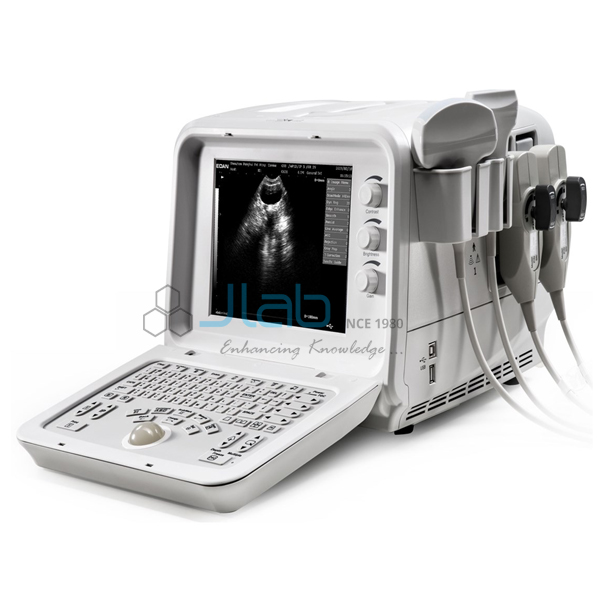
Product Code : EL-USM-4017
Jlab Export is a leading Ultrasonic Diagnostic Imaging Systems Manufacturer,and suppliers in India
This compact ultrasound imaging system comes as a main unit with a 10 in non-interlaced monitor and one 3.5 MHz probe. It supports electronic convex and linear scanning between 2.5 and 7.5 MHz, to a depth of 200 mm. A colour-coded display can tint the grey image in any of 7 colours.
JLab supplies ultrasound machines only to buyers who hold the registration that the law requires for this equipment.
Specifications
| Imaging modes | B, B+B, B+M and M |
| Scanning | Electronic convex and electronic linear |
| Probe frequency | 2.5–7.5 MHz; multi-frequency probe available |
| Standard set | Main unit with 10 in monitor and one 3.5 MHz probe |
| Monitor | 10 in high-resolution, non-interlaced; 256 grey levels |
| Colour-coded display | 7 selectable colours |
| Scanning depth | 200 mm |
| Zoom | Write and read zoom, up to 2 times |
| Power | 220 V ±10%, 50 Hz, 50 VA |
| Size and weight | 353 x 315 x 253 mm; 11.5 kg with convex probe |
| Supply condition | Only to buyers with the required registration |
| Minimum order quantity | 1 unit |
| Dispatch time | Usually 7–10 working days |
| Supplied by | JLab (Jain Laboratory Instruments Pvt Ltd), Ambala, India |
Teaching Exercises with the Imaging System
In a biomedical-engineering lab, students compare write zoom with read zoom on a test phantom. Read zoom enlarges a frozen image, while write zoom rescans only the selected area, so the zoomed picture keeps more detail. They then switch the colour-coded display on and off over the same image and discuss whether a tint shows the grey-level steps more clearly.
A supply check comes first: students confirm the mains voltage is within 220 V ±10% with a Digital Multimeter before connecting the unit. Teachers can show the same pulse-timing idea with the Ultrasonic Pulse Velocity Tester, which times a pulse through a concrete block.
Frequently Asked Questions
What does the colour-coded display add?
It maps the grey levels to one of 7 colours. Some users find small brightness differences easier to see in a tint than in grey. It changes only how the image is shown, not the echoes the probe receives.
Linear or convex: which scanning should I use?
A linear probe gives a rectangular view with a wide near field for shallow parts. A convex probe gives a fan-shaped view for deeper areas. The unit supports both, and its weight figure includes the convex probe.
What should be checked on the probe before each session?
Look along the lens for pinholes, pitting or peeling, and along the cable for cracks in the sheath. Check that the strain relief where the cable meets the probe is not torn. Then scan a phantom and watch for dark lines in the image.
Why does the monitor being non-interlaced matter?
A non-interlaced monitor redraws every line on each refresh instead of alternate lines. That gives a steadier picture with less flicker during long sessions. Place the unit so the screen faces the operator at eye level.
How much space and power does it need?
The unit measures 353 x 315 x 253 mm and weighs 11.5 kg with the convex probe, so it fits on a trolley shelf or bench. It draws 50 VA from a 220 V, 50 Hz supply.
Other Ultrasound Machines
For a quote, use Add To Cart or send us a message through the contact page.
Last updated: 20 November 2026

