Astronomical Telescope Manufacturer,Supplier and Exporter in India
Product Code : EL-ELA-5330
Jlab Export is a leading Astronomical Telescope Manufacturer,and suppliers in India
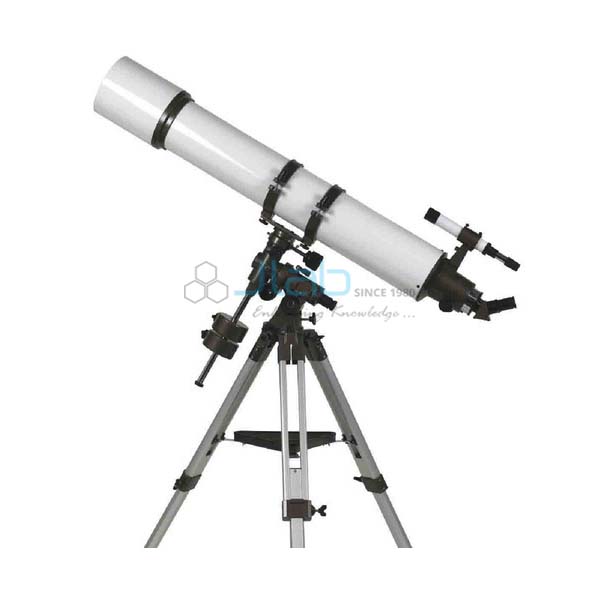
Astronomical Telescope (code EL-ELA-5330) is a simple two-lens refracting telescope model for physics teaching, built to show how an astronomical telescope forms an inverted image. A 50 mm double convex objective of 500 mm focal length and a 38 mm focal length plano-convex eyepiece sit in two tubes that slide one inside the other for focusing. It is made by Jain Laboratory Instruments Pvt Ltd (JLab) at its works in Ambala, India.
Specifications
| Parameter | Detail |
|---|---|
| Type | Simple astronomical (refracting) telescope model |
| Image | Inverted |
| Objective lens | Double convex, 50 mm diameter, 500 mm focal length |
| Objective tube | 400 x 55 mm diameter (approximately) |
| Eyepiece lens | Plano-convex, 38 mm focal length |
| Eyepiece tube | 400 x 50 mm diameter |
| Focusing | The smaller tube slides inside the larger tube on foam plastic rings |
| Magnifying power (calculated) | About 13 times in normal adjustment (500 mm ÷ 38 mm) |
| Quality check | Each telescope is visually inspected before dispatch |
| Pack quantity | Each (sold individually) |
| Minimum order quantity | 10 units |
| Dispatch time | Usually 7–10 working days |
| Product code | EL-ELA-5330 |
| Manufacturer | Jain Laboratory Instruments Pvt Ltd (JLab) — OEM |
| Country of origin | India (made in Ambala, Haryana) |
What Is the Astronomical Telescope Used For?
The model makes the class 12 ray optics topic of optical instruments something students can hold and adjust. The long-focus objective forms a real, inverted image of a distant object near its focus; the short-focus eyepiece then acts as a magnifier for that image. When the final image is at infinity (normal adjustment) the lenses are separated by the sum of their focal lengths, about 538 mm here, and the magnifying power is the ratio of the focal lengths, about 13 times. Students can slide the tubes to focus on a distant tree or building, see that the view is upside down, and check the calculation for themselves; the inverted image does not matter for stars and the Moon, which is why astronomical telescopes do without an erecting lens.
Use it to compare with a terrestrial telescope, to discuss why a large objective gathers more light, or as a display model in a physics lab. Never look at the Sun through the telescope, wipe the lenses only with a soft lens cloth, and slide the tubes gently so the foam rings keep a smooth fit.
What to Specify When Ordering
- Quantity — the minimum order is 10 telescopes; one per group of students works well for a practical session.
- Comparison models — add the terrestrial telescope model if you want to show both image types in the same lesson.
- Optics accessories — convex lenses and an optical bench can be added for the focal-length measurements that lead into the telescope lesson.
Frequently Asked Questions
What lenses does the astronomical telescope use?
A double convex objective lens of 50 mm diameter and 500 mm focal length, and a plano-convex eyepiece of 38 mm focal length.
What is its magnifying power?
About 13 times in normal adjustment, calculated as the objective focal length divided by the eyepiece focal length (500 mm ÷ 38 mm). The listing itself does not state a magnification figure.
Why is the image upside down?
Because it is an astronomical telescope: the objective forms an inverted real image and the eyepiece magnifies it without turning it the right way up. That is acceptable for viewing the sky.
How is it focused?
The smaller eyepiece tube slides inside the larger objective tube on foam plastic rings, so the lens separation can be changed smoothly until the image is sharp.
How does it differ from the Terrestrial Telescope model?
The terrestrial model is listed with three convex lenses — objective, inverter and eyepiece — so it shows images the way terrestrial telescopes form them. This model has two lenses and gives an inverted image.
What should an export enquiry include?
The quantity, destination country and port or city, delivery terms such as FOB or CIF, any packing or labelling needs and a tender reference if there is one.
Who manufactures this telescope model?
Jain Laboratory Instruments Pvt Ltd (JLab) at its works in Ambala, Haryana, India.
OEM Manufacturer
JLab is the trading name of Jain Laboratory Instruments Pvt Ltd, an optics and physics lab equipment manufacturer in India, incorporated in 2017 and based on Hargolal Road, Ambala, Haryana. The telescope is assembled at JLab’s own works rather than bought from a trader, so schools, colleges, dealers and importers buy it factory-direct, each unit is inspected by eye before dispatch, and repeat orders are handled by the manufacturer. JLab exports worldwide and ships to buyers in every region — for example Argentina in South America, Sierra Leone in West Africa, Romania in Eastern Europe, Turkmenistan in Central Asia and Iraq in the Middle East. Tender information is available on the JLab lab tenders page.
Related Optics Equipment
- Terrestrial Telescope — a model with objective, inverter and eyepiece lenses that shows how a terrestrial telescope forms its image.
- Telescope — a school telescope on a portable, foldable tripod.
- Convex Lens — converging lenses in a range of focal lengths for optics practicals.
- Optical Bench Wooden — a rigid wooden bench that holds lenses and screens in line.
Browse Educational Laboratory Apparatus or the full Laboratory Apparatus range.
Request a Quote
JLab quotes as the manufacturer. Use the Add To Cart enquiry button, or send the quantity (minimum 10 units), any related optics items and your delivery location through the contact page.
Last updated: 9 October 2026