

Auto Karl Fischer Titrimeter Manufacturer,Supplier and Exporter in India
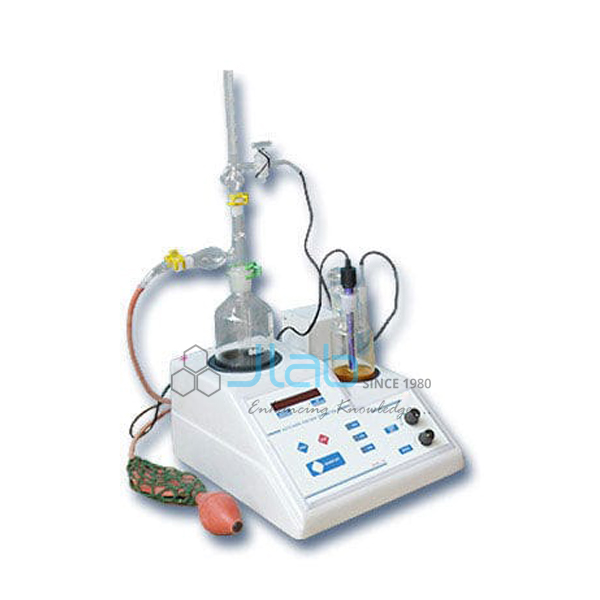
Product Code : EL-MT-2208
Jlab Export is a leading Auto Karl Fischer Titrimeter Manufacturer,and suppliers in India
Two boxes make up this automatic Karl Fischer set: a control unit and a titration unit that also serves as the titration stand. Press START and reagent flows from the auto zero burette through a solenoid valve into the 200 ml air-tight cell. The control unit shuts the valve by itself at the end point, so the operator only reads the burette.
Technical Details
| Units | Control unit and titration unit |
| Sample size | 1–50 mg of water |
| Burette | Pressure filling, auto zero, 10 ml clear glass, 0.05 ml resolution |
| Titration cell | Air tight, 200 ml |
| Electrode and detection | Dual platinum electrode, current sensing by electronic control |
| Control unit display | Array of 10 LEDs, RUN, ADD and END shown in auto mode |
| Timer and alarm | Adjustable timer, buzzer |
| Stirrer | Variable speed magnetic stirrer with on/off control |
| Power | 230 V AC, 50 Hz |
| Size and weight (approx.) | Control unit 340 x 250 x 125 mm, 2 kg; titration unit 325 x 180 x 98 mm, 3 kg |
| Minimum order quantity | 1 unit |
| Dispatch time | Usually 7–10 working days |
| Manufacturer | JLab (Jain Laboratory Instruments Pvt Ltd), Ambala, India |
How the Burette and Valve Work
The reagent sits in a 500 ml reservoir bottle under the 10 ml glass burette. Squeezing the rubber bellow pumps air through the moisture trap and pushes reagent up until the burette fills and settles at zero. Because that air passes the trap first, damp room air does not reach the reagent.
During a run the solenoid valve lets reagent into the cell, and the magnetic stirrer keeps the cell contents moving. The reading on the burette, in 0.05 ml steps, multiplied by the reagent factor gives the water in the sample.
Moisture Practicals for Students
Students first find the water equivalent of the reagent. They weigh sodium tartrate dihydrate on an Electronic Analytical Balance, add it to the cell and titrate. The known water in the salt and the burette reading give the factor.
Next they titrate a sugar or a drug raw material and report its moisture as a percentage. Samples and the standard are kept in a Desiccator Vacuum between weighings. Teachers can also open the cell for a few minutes and run a blank, to show how room moisture raises the result.
Frequently Asked Questions
How is the burette filled and set to zero?
Pump the rubber bellow. The air pressure lifts reagent from the reservoir into the burette. The auto zero design sets the level at zero each time, so every run starts from the same mark.
What do the RUN, ADD and END lights show?
In auto mode they show the stage of the titration. RUN means a titration is in progress, ADD means reagent is being fed through the valve and END means the end point has been reached.
Why are the control and titration units separate?
The titration unit holds the stirrer and the solenoid valve and acts as the stand. The control unit holds the electronics, which keeps the circuit away from the reagent at the cell.
Why is the solvent in the cell titrated before the sample goes in?
Fresh solvent and the cell walls hold some water of their own. Reagent is run in until the end point is reached, which dries the cell. Only then is the sample added, so the burette reading counts the water from the sample alone.
How should the reagent be looked after between runs?
Keep the reservoir closed and the drying agent in the moisture trap fresh. The reagent slowly loses strength, so check its factor again at the start of each working day.
Other Moisture Testing Instruments
- Microprocessor K.F. Moisture Titrator (motorized dispensing model)
- Infra Red Moisture Balance
- Digital Moisture Testing Machine
For a quote, use Add To Cart or send us a message through the contact page.
Last updated: 12 November 2026
