Briquette Mould Manufacturer,Supplier and Exporter in India
Product Code : EL-CACTE-9468
Jlab Export is a leading Briquette Mould Manufacturer,and suppliers in India
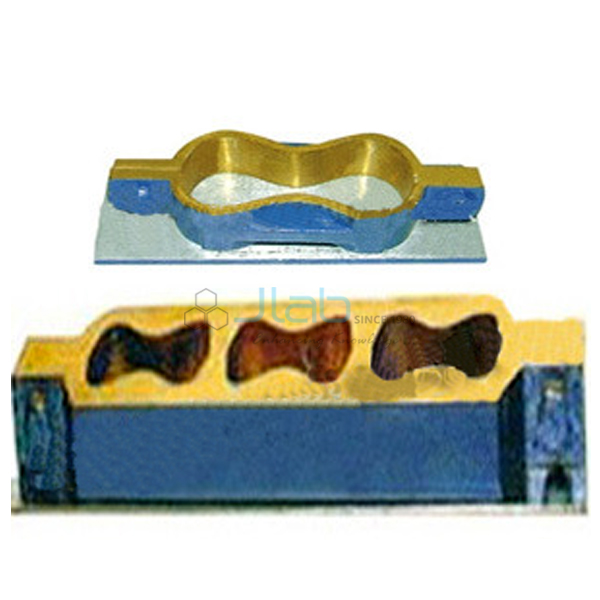
Cement mortar briquettes for the tensile strength test are cast in this two-part split mould of gun metal. Each briquette narrows to a minimum cross section of 25.4 x 25.4 mm at its waist. Two thumb screws hold the halves together and free them quickly for demoulding. A steel base plate comes with the mould, which is made as a single or a three-gang version.
Specifications
| Use | Casting cement briquettes for tensile strength tests |
| Construction | Two-part split mould |
| Material | Gun metal |
| Assembly | Two thumb screws |
| Minimum cross section of briquette | 25.4 x 25.4 mm |
| Versions | Single and three-gang |
| Supplied with | Steel base plate |
| Minimum order quantity | 10 units |
| Dispatch time | Usually 4–6 working days |
| Manufacturer | JLab (Jain Laboratory Instruments Pvt Ltd), Ambala, India |
Tensile Strength Practicals with Briquettes
In a cement testing practical, students mix cement, standard sand and water by hand or in the Cement Mortar Mixer. They oil the assembled mould on its base plate, fill it with mortar and press the mix well into the ends with the Standard Spatula. The top is struck off level, and the briquette is left to set before the thumb screws are loosened.
After curing, each briquette is placed in the Tensile Strength Tester, where lead shot loads the double lever until the briquette breaks. Students divide the breaking load by the 25.4 x 25.4 mm waist area to get the tensile strength. Comparing briquettes broken at different ages shows how cement keeps gaining strength while it cures.
Frequently Asked Questions
What size of briquette does this mould make?
The briquette has the familiar figure-of-eight outline, with a minimum cross section of 25.4 x 25.4 mm at the waist. That is one square inch. The test breaks it across this narrow section, so the mould fixes the area used in the strength calculation.
Why is the mould split into two parts?
A freshly set briquette is weak at its waist and would crack if it were pushed out of a one-piece mould. Loosening the two thumb screws lets the halves part sideways, so the briquette comes free without force. The halves close again just as quickly for the next casting.
Should I choose the single or the three-gang mould?
The single mould casts one briquette at a time and suits small groups or occasional tests. The three-gang version casts three at once, which gives three results for one test age from a single batch of mortar. Both versions are gun metal and stand on a steel base plate.
How are the briquettes cured before testing?
Usual practice is to keep the filled mould in moist air until the mortar has set. The briquettes are then taken out and stored under water until the test age. Test each briquette soon after it comes out of the water, with its surface wiped.
Which machine breaks the briquettes?
They are broken on the Tensile Strength Tester, a double lever machine loaded with lead shot up to 5 kN. That tester comes with one standard briquette mould, so extra moulds let a class cast more briquettes for each test age.
Other Cement Test Moulds
- Prism Mould Three Gang (mortar prisms for bending and compression)
- Le Chatelier Mould (soundness of cement by expansion)
- Test Bar Moulds (bars with embedded contact points)
- Cube Moulds (cast iron and mild steel cube moulds)
For a quote, use Add To Cart or send us a message through the contact page.
Last updated: 6 November 2026