Burette Manufacturer,Supplier and Exporter in India
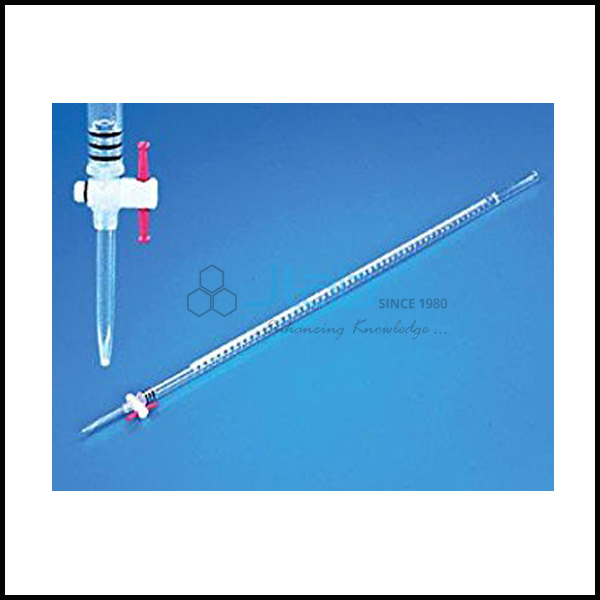
Product Code : EL-VP-124
Jlab Export is a leading Burette Manufacturer,and suppliers in India
Burette (code EL-VP-124) is a transparent acrylic burette for delivering measured volumes of titrant in titrations, with a leak-proof stopcock fitted with a self-lubricating PTFE plug. Every burette is individually calibrated, and the range covers 25 ml, 50 ml and 100 ml. It is produced by JLab, the trading name of Jain Laboratory Instruments Pvt Ltd, in Ambala, India.
Specifications
| Parameter | Detail |
|---|---|
| Body | Transparent acrylic |
| Material | Polymethyl methacrylate (PMMA) / TPX |
| Stopcock | Leak-proof, fitted with a self-lubricating PTFE plug |
| Calibration | Each burette individually calibrated |
| Capacities | 25 ml, 50 ml and 100 ml |
| Chemical resistance | Acrylic body unaffected by dilute mineral acids and bases, except hydrofluoric acid and ammonium hydroxide |
| Working range | pH 1–14; acids up to 5% w/w or bases up to 30% |
| Graduation interval and tolerance class | Supplied to the customer’s requirement — specify the graduation interval and the class (for example Class A or Class B) in your enquiry |
| Calibration certificate | Supplied with Class A burettes |
| Quality check | Each burette is visually inspected before dispatch |
| Pack quantity | Packs of 10 for each capacity |
| Minimum order quantity | 10 units |
| Dispatch time | Usually 7–10 working days |
| Product code | EL-VP-124 |
| Manufacturer | Jain Laboratory Instruments Pvt Ltd (JLab) — OEM |
| Country of origin | India (made in Ambala, Haryana) |
How Does It Compare with Other JLab Burettes?
| Model | Body | Flow control | Other details |
|---|---|---|---|
| This burette (EL-VP-124) | Transparent acrylic (PMMA / TPX) | Leak-proof stopcock with self-lubricating PTFE plug | 25, 50 and 100 ml in packs of 10; individually calibrated |
| Burette, Borosilicate Glass, with PTFE Stopcock | Borosilicate glass | PTFE stopcock with interchangeable, replaceable keys | 50 ml; blue enamel graduations |
| Plastic Burette | Plastic, graduated | Simple pinch valve | Graduation interval and class to order |
Pick the acrylic burette when a see-through body that is less likely than glass to shatter matters on a busy bench, or when 25 ml or 100 ml sizes are needed as well as 50 ml. The Plastic Burette uses a simple pinch valve for flow control.
What Is the Acrylic Burette Used For?
In a titration the burette releases titrant into the flask in a controlled stream and then drop by drop until the end point, and the volume used is read from the scale. That makes it the measuring instrument of acid–base and redox titrations in chemistry practicals and of routine volumetric analysis. The PTFE plug is self-lubricating, so the stopcock turns smoothly for drop-wise control.
What to Specify When Ordering
- Capacity — any of the three sizes, with the number of packs of each.
- Graduation interval and tolerance class — Class A comes with a calibration certificate; Class B is the usual choice for routine teaching titrations.
- Bench accessories — a burette stand, clamp and cleaning brush are separate catalogue items and can go on the same enquiry.
Frequently Asked Questions
Which graduation interval and maximum permitted error does the burette have?
You choose them when ordering. JLab graduates the burette to the interval and tolerance class you specify, and the maximum permitted error is the limit set for that class at the burette’s nominal capacity of 25, 50 or 100 ml.
Does the burette come with a calibration certificate?
Yes, when ordered as Class A. Every burette in the range is individually calibrated; the certificate accompanies Class A burettes, which tenders and analytical labs often ask for.
Which chemicals should not go in this burette?
Hydrofluoric acid and ammonium hydroxide. The acrylic body resists dilute mineral acids and bases across pH 1–14, up to 5% w/w for acids or 30% for bases, but not those two.
Why use an acrylic burette instead of glass?
Mainly to cut breakage: a transparent acrylic body is far less likely than glass to shatter if a burette is knocked over, while still letting students watch the meniscus.
What should an export enquiry for burettes include?
The capacities and number of packs, the graduation interval and class, the destination country and port or city, the delivery terms you prefer (for example FOB or CIF), any labelling or packing needs, and the tender reference if one applies.
Who manufactures this acrylic burette?
JLab (Jain Laboratory Instruments Pvt Ltd) makes it at its own works in Ambala, Haryana, and quotes as the manufacturer.
OEM Manufacturer
JLab is the trading name of Jain Laboratory Instruments Pvt Ltd, a manufacturer of laboratory plasticware, glassware and science teaching equipment in India, incorporated in 2017 and based on Hargolal Road, Ambala, Haryana. The acrylic burettes are made in JLab’s own works rather than bought in from a trader, so schools, colleges, dealers and importers buy factory-direct, each burette is visually inspected before it leaves, and repeat orders are handled by the maker. The company holds MSME Udyam registration UDYAM-HR-01-0003849 (manufacturing enterprise) together with Importer-Exporter Code 3317504552. JLab exports worldwide and ships to buyers in every region — for example Ireland in Western Europe, Eswatini in Southern Africa, Panama in Central America and the Caribbean, Burkina Faso in West Africa and Bhutan in South Asia. For tender supply, see the JLab lab tenders page.
Titration Stand, Clamp and Brush
- Burette Stand — a weighted polypropylene-base stand with a polypropylene-coated steel rod, for one or two burettes.
- Mild Steel Burette Clamp — a black powder-coated single clamp with its own boss head for a retort stand rod.
- Nylon Burette Cleaning Brush — a white nylon brush for cleaning burettes.
See the rest of the Volumetric PlasticWare range or all Lab Plasticware.
Request a Quote
Add the burettes to an enquiry with the Add To Cart button, or use the contact page to send the capacities, the graduation interval and class, the number of packs and the delivery location.
Last updated: 22 October 2026