Chain Tanker Acrylic Robotic Kit Manufacturer,Supplier and Exporter in India
Product Code : EL-MLK-13572
Jlab Export is a leading Chain Tanker Acrylic Robotic Kit Manufacturer,and suppliers in India
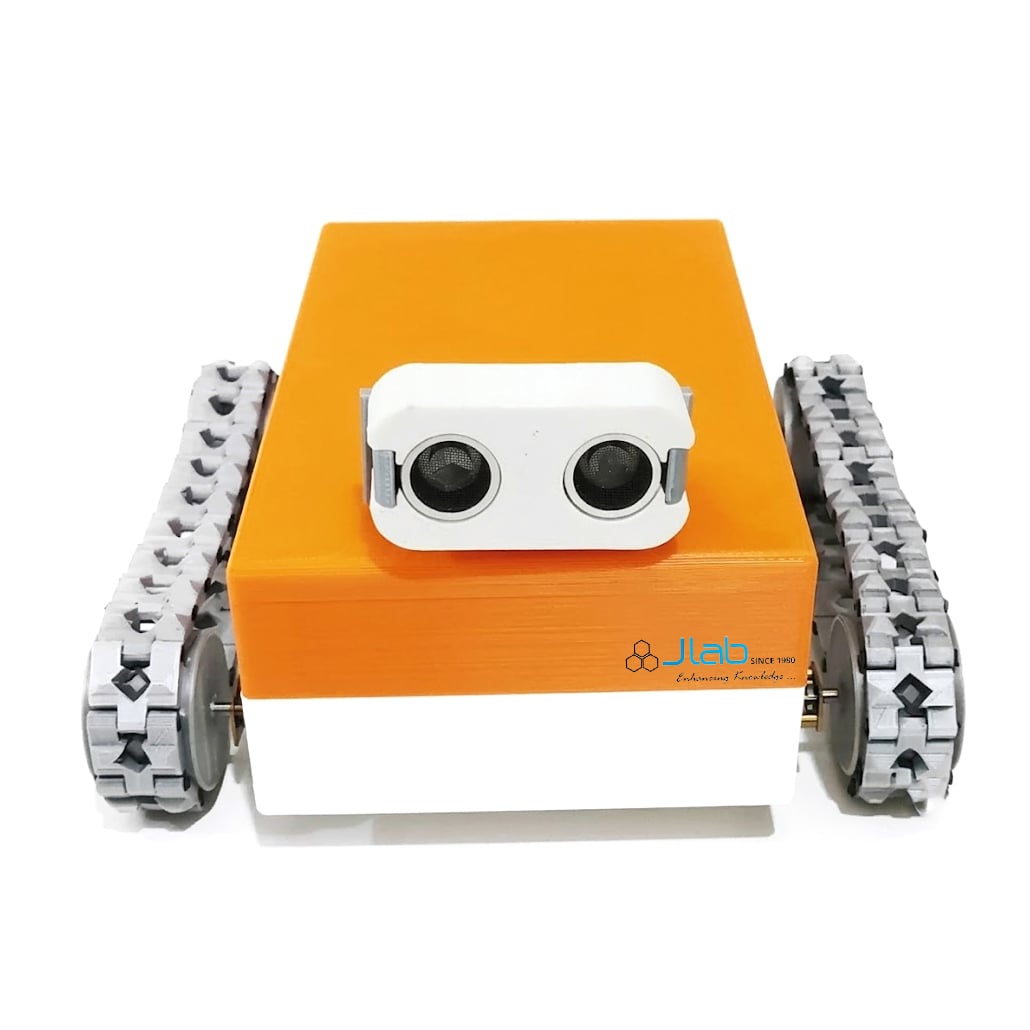
Chain Tanker Acrylic Robotic Kit (code EL-MLK-13572) is a programmable tracked robot on an acrylic chassis, driven by two geared DC motors on dual crawler tracks and fitted with a front ultrasonic sensor for obstacle detection. It steers by controlling the left and right motors independently, and it is used for robotics, electronics and coding activities in schools, STEM programmes and robotics clubs. It is made by Jain Laboratory Instruments Pvt Ltd (JLab) at its works in Ambala, India.
Specifications
| Parameter | Detail |
|---|---|
| Product type | Programmable tracked-vehicle robotics platform |
| Chassis | Acrylic, with visible wiring and electronic components |
| Running gear | Dual continuous crawler tracks |
| Drive | Dual geared DC motors with an electronic motor-driver module |
| Steering | Independent control of the left and right tracks |
| Controller | Programmable controller (microcontroller) |
| Sensor | Front-mounted ultrasonic obstacle-detection sensor |
| Power | Battery-powered, portable; battery holder on the chassis |
| Activities | Assembly and coding; reusable for further projects |
| Quality check | Each kit is visually inspected before dispatch |
| Pack quantity | Each (sold individually) |
| Minimum order quantity | 10 units |
| Dispatch time | Usually 7–10 working days |
| Product code | EL-MLK-13572 |
| Manufacturer | Jain Laboratory Instruments Pvt Ltd (JLab) — OEM |
| Country of origin | India (made in Ambala, Haryana) |
How Does It Compare with Other JLab Robot Vehicles?
| Model | Drive | Movement | Sensor |
|---|---|---|---|
| This kit (EL-MLK-13572) | Two geared DC motors on dual crawler tracks | Turns by driving the left and right tracks independently | Front ultrasonic sensor |
| 4WD Beige Chassis Acrylic Robotic Kit | Four geared DC motors; large black tyres with yellow hubs | Forward, reverse and turning | Front ultrasonic distance sensor |
| Mecanum Wheeled Acrylic Robotic Kit | Four geared DC motors on four independently driven Mecanum wheels | Forward, backward, sideways and diagonal, plus rotation | Front ultrasonic sensor |
Choose the Chain Tanker when you want students to work with tracked movement and steering by motor control. The 4WD kit is the wheeled alternative on four driven wheels, and the Mecanum kit adds sideways and diagonal movement.
What Is the Chain Tanker Robotic Kit Used For?
A tracked robot has no steering wheels: it turns by running one track faster than the other, or in the opposite direction, so students learn steering as a matter of motor control in their code. The front ultrasonic sensor measures distance by timing the echo of a sound pulse, which lets a program detect obstacles and guide the robot around them. On the acrylic chassis students can see the microcontroller, motor driver, geared motors, battery holder, wiring and mechanical transmission, and relate each part to what the robot does.
The kit is suited to school laboratories, STEM programmes, coding classes, robotics clubs, science exhibitions and beginner automation projects, and it is reusable from one project to the next.
What to Specify When Ordering
- Quantity — the number of kits, for example one per student team.
- Other models — wheeled, Mecanum or Bluetooth robot kits to quote on the same enquiry.
- Delivery — destination city or port and any packing or labelling needs.
Frequently Asked Questions
How does the Chain Tanker robot turn?
By controlling its left and right motors independently. Each motor drives one crawler track, and a difference in track speed or direction turns the robot.
Which parts can students see on the chassis?
The microcontroller, the motor driver, the geared motors, the battery holder, the wiring and the mechanical transmission are all visible on the acrylic chassis.
What is the ultrasonic sensor used for?
It can be programmed to detect obstacles in front of the robot and help it navigate its surroundings.
Is the robot programmable?
Yes. It is a reusable, programmable robotics platform with a programmable controller, suited to assembly and coding activities.
What information is needed for an export quotation?
Send the number of kits, the destination country and port or city, your preferred delivery terms (for example FOB or CIF), any packing or labelling needs, and the tender reference if the order is for a tender.
Who manufactures this robotic kit?
Jain Laboratory Instruments Pvt Ltd, trading as JLab, at its works in Ambala, Haryana, India.
OEM Manufacturer
JLab is the trading name of Jain Laboratory Instruments Pvt Ltd, a manufacturer of robotics and STEM kits and school laboratory equipment in India, incorporated in 2017 and based on Hargolal Road, Ambala, Haryana. The Chain Tanker kit is made at JLab’s own works rather than bought from a trader, so schools, dealers and importers order from the maker and repeat orders come from the same source. The company is registered under CIN U29309HR2017PTC069123 and holds MSME Udyam registration UDYAM-HR-01-0003849 (manufacturing enterprise). JLab exports worldwide and ships to buyers in every region — for example Tonga in Oceania, Switzerland in Western Europe, Finland in Northern Europe, Kazakhstan in Central Asia and Mongolia in East Asia. Tender information is on the JLab lab tenders page.
Other Robotics Kits
- 6WD Yellow Chassis Acrylic Robotic Kit — a six-wheel-drive robot car on six high-traction rubber wheels with an ultrasonic distance sensor.
- Bluetooth Rover Acrylic Robotic Kit — a four-wheel rover controlled over Bluetooth from a mobile device, with a front ultrasonic sensor.
- Trash Bin Acrylic Robotic Kit — a sensor-operated automatic trash-bin model with a servo-controlled flap.
Browse the full Maths Lab Kit range or all Maths Lab Equipment.
Request a Quote
Send your enquiry with the Add To Cart button on this page, or give the number of kits, any other robot models and your delivery city or port through the contact page.
Last updated: 16 October 2026