CP Tuning Fork Manufacturer,Supplier and Exporter in India
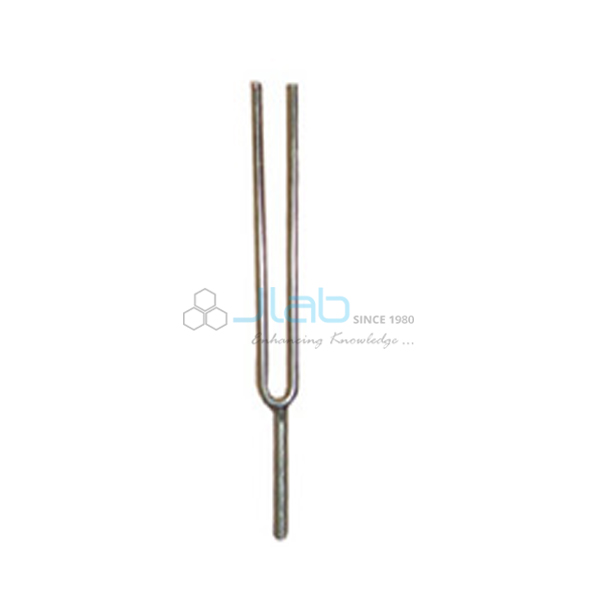
Product Code : EL-PL-4950
Jlab Export is a leading CP Tuning Fork Manufacturer,and suppliers in India
This single tuning fork is made of a polished aluminium alloy, which is light and does not rust in a humid store room. It comes in 256 Hz, 440 Hz and 512 Hz versions. Struck on a rubber pad, it gives one fixed note, the reference that students match an air column or a stretched wire to in sound practicals.
Specifications
| Material | Aluminium alloy |
| Finish | Polished |
| Frequency | 256 Hz, 440 Hz or 512 Hz, each sold as a single fork |
| Use | Resonance tube and sonometer practicals |
| Minimum order quantity | 10 units |
| Dispatch time | Usually 4–6 working days |
| Manufacturer | JLab (Jain Laboratory Instruments Pvt Ltd), Ambala, India |
Resonance Tube Experiments for Students
With a Resonance Tube Apparatus, students hold the struck fork just above the open end, with the prongs one above the other. They raise or lower the water level until the sound is loudest. The first and second resonance lengths give the speed of sound in air.
Between readings the fork is struck again on a Rubber Pad, which gives a clean note without a ringing overtone. Each length is read twice, once with the water rising and once with it falling, and the two readings are averaged.
Frequently Asked Questions
Does the polished finish change the fork’s pitch?
No. Polishing only smooths the surface, and the note is set by the length, thickness and metal of the prongs. A deep dent or a heavy scratch near the prong tips matters far more than the finish, so handle and store forks with care.
How should aluminium forks be stored in a humid store?
Aluminium alloy does not rust, but damp and sweat slowly dull the polished surface. Wipe off fingerprints and moisture after use, and keep the forks in a closed box with a sachet of silica gel. Keep them away from steel tools that could dent the prongs.
Why use two forks of different frequency in the resonance tube practical?
Each fork gives its own pair of resonance lengths and its own value for the speed of sound. If the two results agree, the method is working, and their average is a better answer than one fork alone. A large difference points to a reading error.
What is the end correction, and why does the two-resonance method avoid it?
The antinode forms a little above the open end of the tube, so each measured length is short by the same amount, the end correction. Subtracting the first resonance length from the second cancels it, which is why the formula uses the difference of the two lengths.
More Forks and Resonance Apparatus
For a quote, use Add To Cart or send us a message through the contact page.
Last updated: 19 November 2026