Digital Point Load Tester Manufacturer,Supplier and Exporter in India
Product Code : EL-CL-8857
Jlab Export is a leading Digital Point Load Tester Manufacturer,and suppliers in India
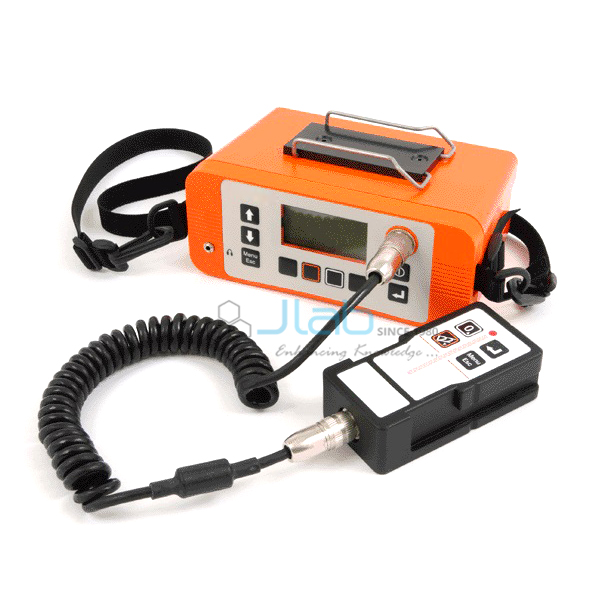
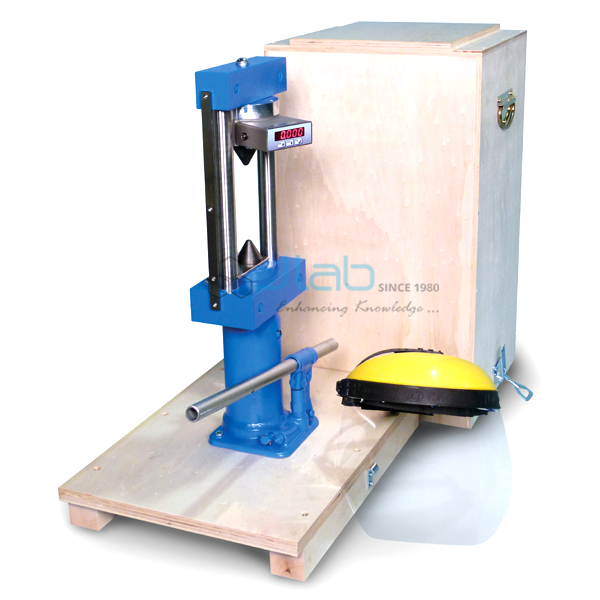
A point load test breaks a piece of rock between two cone-shaped points and turns the failure load into a strength index. This tester does it on site or in the lab. A hand-pumped hydraulic jack loads cores up to 101.6 mm (4 in) diameter on a 56 kN frame, and a load cell shows the load on a digital display.
Specifications
| Use | Strength index of rock specimens, in the field or the laboratory |
| Load frame | Up to 56 kN, with a manual hydraulic jack |
| Specimens | Cores up to 101.6 mm (4 in) diameter |
| Loading points | Two cone-shaped points, with a graduated scale for the distance between them |
| Load measurement | Electric load cell with digital display, 0–56 kN |
| Resolution | 0.001 kN |
| Linearity, hysteresis, repeatability | 0.05%, 0.03%, 0.02% |
| Supplied with | Wooden carrying case, goggles and accessories |
| Dimensions | 400 × 530 × 720 mm |
| Minimum order quantity | 1 unit |
| Dispatch time | Usually 7–10 working days |
| Manufacturer | JLab (Jain Laboratory Instruments Pvt Ltd), Ambala, India |
Rock Strength Practicals for Students
In an engineering geology or rock mechanics practical, students first measure each core with a Vernier Caliper and note the rock type. Each core is set between the points and the jack is pumped until the rock splits. They record the failure load from the display and the spacing D from the scale.
The strength index Is is the failure load P divided by D squared. A class can test cores across the diameter and along the axis, then compare the two sets of results. Teachers can also crush cylinders of the same stone in the Motorized Compression/Tension Machine and plot point load index against compressive strength.
Frequently Asked Questions
How is the point load strength index worked out?
Divide the failure load P by the square of D, the distance between the cone points when the rock breaks. P comes from the digital display in kN and D from the graduated scale. Keep the units consistent and convert the result to MPa for reporting.
Should I run a diametral or an axial test?
A diametral test loads a core across its diameter, and an axial test loads it along its length. Layered rock often gives different values in the two directions, so record the test type with every result. Irregular lumps can be tested as well when no cores are available.
Why is a size correction applied to the index?
The index of one rock falls as the specimen gets larger. Standard methods therefore correct each result to a reference core size, so that tests on different diameters can be compared. Your test method gives the correction to use.
What makes a point load test invalid?
A test is rejected when the fracture does not pass through both loading points, or when the cones just crush into the surface. Keep the specimen centred, seat the points firmly before pumping, and wear the goggles supplied, as fragments can fly at failure.
Other Concrete Laboratory Test Equipment
For a quote, use Add To Cart or send us a message through the contact page.
Last updated: 6 November 2026