Dimmerstat Variac and Autotransformer Manufacturer,Supplier and Exporter in India
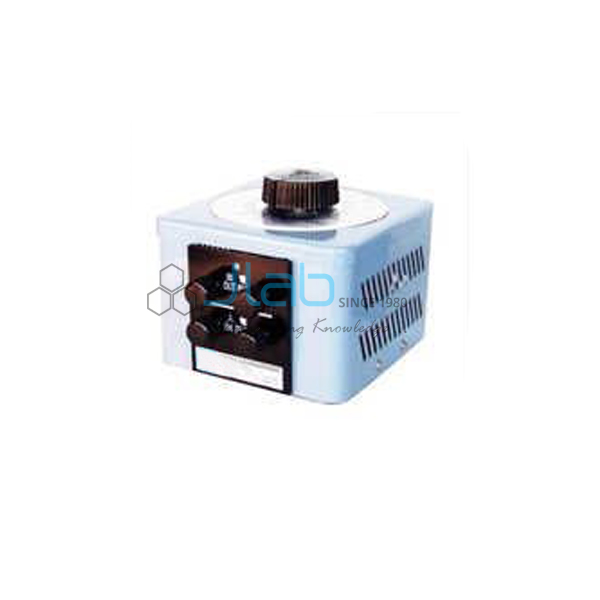
Product Code : EL-PSAT-1222
Jlab Export is a leading Dimmerstat Variac and Autotransformer Manufacturer,and suppliers in India
Dimmerstat Variac and Autotransformer (code EL-PSAT-1222) is a variable autotransformer — the type commonly called a dimmerstat or variac — that delivers a continuously variable AC voltage, 0–270 V from a 240 V mains input, for heating devices, AC motors and other equipment in college, polytechnic, ITI and school labs. It is offered in 2, 4, 6 and 8 A current capacities. It is made by Jain Laboratory Instruments Pvt Ltd (JLab) at its works in Ambala, India.
Specifications
| Parameter | Detail |
|---|---|
| Type | Variable autotransformer giving continuously variable AC voltage |
| Mains input | 240 V, via mains cable |
| Output voltage | 0–240 V (line voltage connection); 0–270 V (over-voltage connection) |
| Current capacity | 2 A, 4 A, 6 A or 8 A — the 0–270 V output range is the same for each |
| Brush contact | Carbon brush that covers at least one turn of wire at all times |
| Brush track | Area of winding swept by the brush is metal-plated to prevent oxidation, for long life with negligible maintenance |
| Enclosure and cooling | Metal box, air cooled |
| Voltage control | Knob and dial on the top, which adjust and indicate the voltage |
| Output terminals | Insulated 4 mm socket terminals and a 3-pin 5 A socket |
| Switch and indication | ON/OFF switch with indicator |
| Overload protection | Slow-blow fuse in the output line |
| Quality check | Each autotransformer is visually inspected before dispatch |
| Pack quantity | Each (sold individually) |
| Minimum order quantity | 10 units |
| Dispatch time | Usually 7–10 working days |
| Product code | EL-PSAT-1222 |
| Manufacturer | Jain Laboratory Instruments Pvt Ltd (JLab) — OEM |
| Country of origin | India (made in Ambala, Haryana) |
How Does It Compare with Other JLab Power Supplies?
| Item | Output | Typical role |
|---|---|---|
| This autotransformer (EL-PSAT-1222) | AC, continuously variable 0–270 V; 2, 4, 6 or 8 A | Adjusting the mains voltage fed to heaters, lamps, AC motors and other mains equipment |
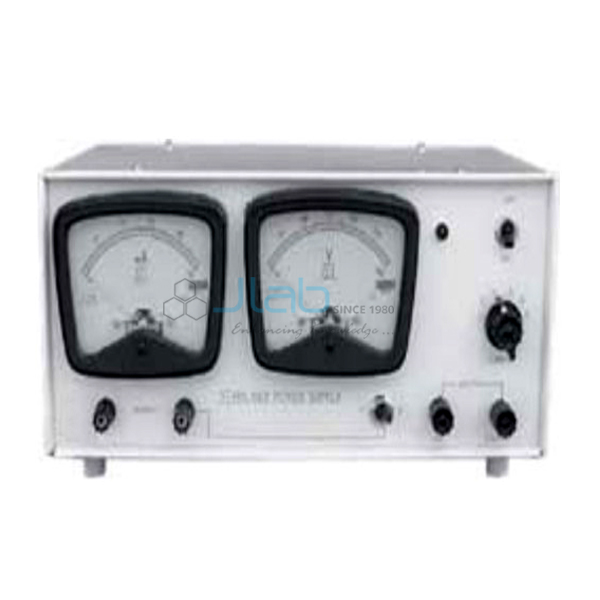
| Power Supply 0-30 Volts 3 Amp | DC, continuously variable 0–30 V at 0–3 A | Low-voltage DC circuits, with both voltage and current variable |
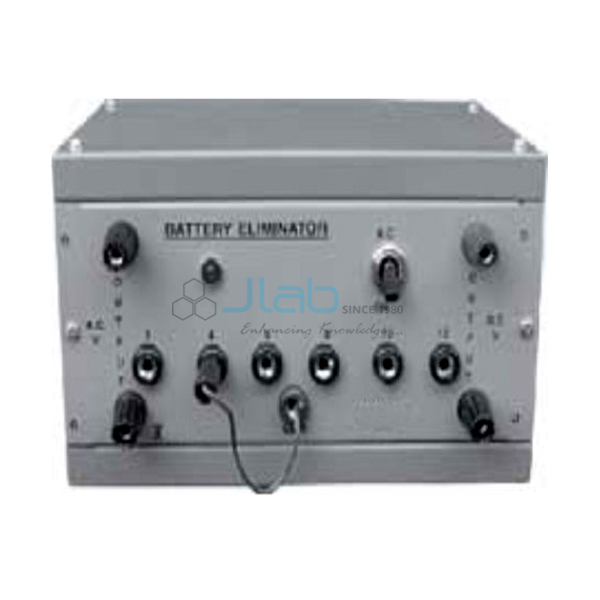
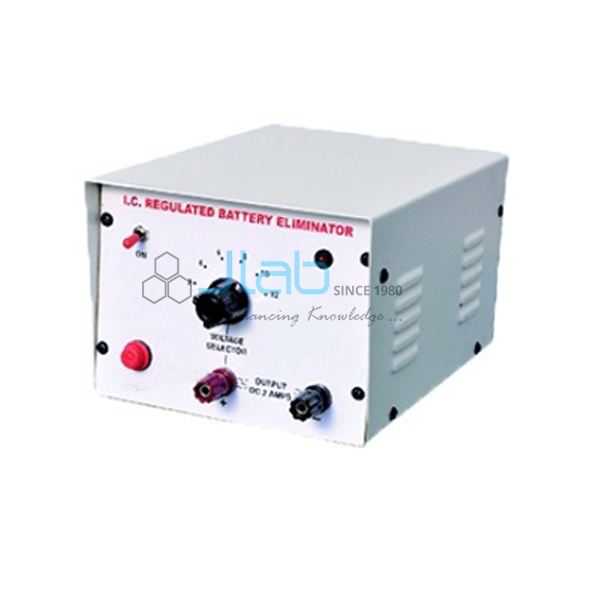
| Battery Eliminators | 2 to 6 V or 2 to 12 V, 1 to 6 A, selected by socket or band-switch | Replacing batteries in student experiments |
| Transformers and Stabilizers | Ratings not stated in its listing | Fixed transformers wound with double-enamelled copper wire on silicon alloy steel cores |
Choose the autotransformer when you need to vary a mains-level AC voltage smoothly. For low-voltage DC work the 0–30 V supply or a battery eliminator is the right tool, and the autotransformer is not a substitute for them.
What Is a Dimmerstat Used For?
A variable autotransformer has a single winding on a core; the carbon brush moves along the turns as the knob is turned, tapping off any voltage from zero to the top of the range. Because the brush always covers at least one turn, the output changes smoothly without breaking contact, and the plated track keeps that contact free of oxidation. In engineering, polytechnic and ITI electrical labs it is used to control the temperature of heaters and heating mantles, dim filament lamps while students plot their voltage–current characteristic, run small AC motors at reduced voltage, test appliances at low and high supply voltage, and apply a gradually rising voltage in transformer open-circuit and short-circuit tests. In school physics labs it feeds a step-down transformer or heating coil when a variable AC supply is needed.
Unlike a two-winding transformer, an autotransformer gives no isolation from the mains: the output terminals can be at mains potential even when the dial is set low, so treat every output as live and use an isolating transformer where isolation is required. Set the dial to zero before switching on, then raise the voltage slowly while watching the load. Keep the load current within the capacity you ordered, use the over-voltage connection only for equipment that can take more than its normal supply voltage, and switch off before changing connections. The slow-blow fuse in the output line tolerates brief starting surges but opens on a sustained overload.
What to Specify When Ordering
- Current capacity — 2, 4, 6 or 8 A, with a margin above the steady current of your load; motors draw extra current when they start.
- Output connection — whether you will use the line voltage (0–240 V) or over-voltage (0–270 V) range.
- Mains supply — the listed input is 240 V; state your local supply in the enquiry.
- Quantity — the minimum order is 10 units; add step-down transformers or DC supplies to the same enquiry if your lab needs them.
Frequently Asked Questions
What is a dimmerstat or variac used for?
It varies the AC voltage supplied to a load, so heaters, lamps, motors and other mains equipment can be run at any voltage within the range. Labs use it for heating control, lamp and motor experiments and transformer tests.
What output voltage does it give?
From a 240 V mains input it gives 0–240 V on the line voltage connection and 0–270 V on the over-voltage connection. The output range is the same for every current capacity.
Which current capacity should I choose?
Pick a capacity above the steady current of your load. A heater drawing 3 A at full voltage, for example, needs at least the 4 A model; for motors, leave extra margin for starting current.
Is the output isolated from the mains?
No. An autotransformer uses one winding for input and output, so the output is connected to the mains. Treat the terminals as live at every setting and use an isolating transformer where your experiment needs isolation.
How is it protected and connected?
A slow-blow fuse in the output line gives overload protection, and an ON/OFF switch with indicator is fitted. Mains enters through a cable, and the output is available on insulated 4 mm socket terminals and a 3-pin 5 A socket; do not draw more than 5 A through that socket.
Why does the carbon brush cover at least one turn?
So the brush never loses contact with the winding as the knob is turned, which gives smooth, uninterrupted control of the voltage. The track under the brush is metal-plated to prevent oxidation.
What should an export enquiry contain?
The current capacities and quantities, destination country and port or city, preferred delivery terms such as FOB or CIF, any packing or labelling requirements, and the tender reference if there is one.
Who manufactures this variable autotransformer?
Jain Laboratory Instruments Pvt Ltd (JLab) makes it at its works in Ambala, Haryana, India, and quotes for it directly.
OEM Manufacturer
JLab is the trading name of Jain Laboratory Instruments Pvt Ltd, a manufacturer of electrical and scientific laboratory equipment in India, incorporated in 2017 and based on Hargolal Road, Ambala, Haryana. These autotransformers are built at JLab’s own works, not bought from a trader, so engineering colleges, polytechnics, ITIs, schools, dealers and importers can buy factory-direct; each unit is visually inspected before dispatch, and repeat orders and replacement queries are handled by the manufacturer. JLab exports worldwide and ships to buyers in every region — for example Germany in Western Europe, Tanzania in East Africa, Slovakia in Eastern Europe, Australia in Oceania and Uzbekistan in Central Asia. Institutions purchasing by tender can see the JLab lab tenders page.
Related Transformers and Power Supplies
- Transformers and Stabilizers — transformers wound with double-enamelled copper wire on silicon alloy steel cores, vacuum impregnated.
- Demountable Transformer — a teaching transformer students can take apart, with interchangeable secondary coils.
- Power Supply 0-30 Volts 3 Amp — a variable DC bench supply for low-voltage circuits.
- Battery Eliminators — steel-cabinet low-voltage supplies for student experiments.
See the full Power Supplies and Transformers range or all Scientific Instrument products.
Request a Quote
Quotes come direct from the manufacturer. Use the Add To Cart enquiry button on this page, or send the current capacity, the quantity (minimum 10 units), your mains supply and your delivery location through the contact page.
Last updated: 8 October 2026