

Power Supplies and Transformers Manufacturer, Suppliers and Exporter in India
Jlabexport is a leading Power Supplies and Transformers Manufacturer,and suppliers in India, United States, Indonesia, Brazil, Bangladesh, Mexico, Japan, Egypt, Philippines, Democratic Republic of the Congo, Vietnam, Iran, Turkey, Tanzania, United Kingdom, France, South Africa, Italy, Kenya, Colombia, Sudan, Uganda, South Korea, Argentina, Afghanistan, Yemen, Angola, Morocco, Poland, Uzbekistan, Mozambique, Malaysia, Ghana, Saudi Arabia, Peru, Madagascar, Côte d’Ivoire, Cameroon, Niger, Venezuela, Australia, Syria, Mali, Burkina Faso, Sri Lanka, Malawi, Zambia, Chad, Kazakhstan, Somalia, Chile, Senegal, Ecuador, Cambodia, Zimbabwe, Guinea, Benin, Rwanda, Burundi, Bolivia, South Sudan, Tunisia, Haiti, Belgium, Dominican Republic, Jordan, United Arab Emirates, Honduras, Tajikistan, Papua New Guinea, Portugal, Togo, Sierra Leone, Belarus, Laos, Turkmenistan, Libya, Kyrgyzstan, Nicaragua, Paraguay, Bulgaria, Serbia, Republic of the Congo, Lebanon, Liberia, Central African Republic, Palestine, Oman, Mauritania, New Zealand, Costa Rica, Kuwait, Panama, Croatia, Georgia, Eritrea, Mongolia, Uruguay, Qatar, Namibia, Bosnia and Herzegovina, Moldova, Armenia, Gambia, Jamaica, Lithuania, Albania, Gabon, Botswana, Lesotho, Guinea-Bissau, Slovenia, Equatorial Guinea, Latvia, North Macedonia, Bahrain, Trinidad and Tobago, Timor-Leste, Cyprus, Estonia, Eswatini, Mauritius, Djibouti, Fiji, Comoros, Solomon Islands, Guyana, Bhutan, Luxembourg, Suriname, Montenegro, Malta, Maldives, Cabo Verde, Brunei, Belize, Bahamas, Iceland, Vanuatu, Barbados, São Tomé and Príncipe, Samoa, Saint Lucia, Kiribati, Seychelles, Grenada, Saint Vincent and the Grenadines, Antigua and Barbuda.
Last updated: 13 November 2026
What Are Laboratory Power Supplies and Transformers?
Laboratory power supplies are mains-operated units that give the steady DC voltages that physics, electronics and biology practicals need. This range has 18 items in six groups. It covers HT, LT and grid bias supplies for valve experiments, fixed IC regulated supplies for trainer boards, and variable bench supplies up to 30 V. It also has an electrophoresis supply, a 0 to 1500 V EHT supply, battery chargers and eliminators, lab transformers and a variable autotransformer for AC up to 270 V. Schools, colleges, polytechnics and ITIs buy them for their student benches. JLab (Jain Laboratory Instruments Pvt Ltd), Ambala, India, makes all 18 items.
Request a quotation | Compare the power supplies | See the practicals covered
Which Power Supplies Are in the Range?
| Group | Items | What it covers |
|---|---|---|
| Valve Experiment Power Supplies | 4 | HT supplies of 0 to 300 V with 6.3 V LT filament supplies and grid bias, for diode, triode, tetrode and pentode valve practicals. |
| Fixed IC Regulated Supplies | 3 | Fixed single, dual and four-output supplies for 741, 555, 723 and mixed analog and digital IC boards. |
| Variable Bench Power Supplies | 4 | Single and dual variable DC supplies from 0 to 15 V and 0 to 30 V, with analog or digital meters and up to 10 A. |
| Electrophoresis and EHT Supplies | 2 | A 0 to 300 V supply for gel electrophoresis tanks and a 0 to 1500 V supply for photomultipliers and other radiation detectors. |
| Battery Chargers and Eliminators | 3 | Steel-cabinet chargers for lab accumulators and low-voltage eliminators, by version letter or as TE-23 to TE-28 models, that stand in for cells in current-electricity work. |
| Transformers and Variacs | 2 | Lab transformers wound on silicon alloy steel cores, and a dimmerstat variable autotransformer giving 0 to 270 V AC at 2 to 8 A. |
Compare Laboratory Power Supplies by Output
Each table sets the supplies of one group side by side, using the outputs, currents, regulation and meters given on each product page.
Valve Experiment Power Supplies (4)
| Model | HT output | LT output | Grid bias | Meters |
|---|---|---|---|---|
| Power Supplies for Diode Valve Experiment Model | 0 to 300 V, 30 mA | Not listed | None | Two, for voltage and current |
| Power Supply Model | 0 to 300 V, 30 mA | 6.3 V, 3 A | Not listed | Two, for HT voltage and current |
| Power Supply for Triode Valve Experiment Model | 0 to 300 V, 50 mA | 6.3 V, 3 A | 0 to 25 V, either polarity | Three, for HT voltage, HT current and bias |
| Power Supply for Tetrode and Pentode Valve Model | Two: 0 to 300 V at 50 mA and 0 to 300 V at 25 mA | 6.3 V, 3 A | 0 to 25 V, 5 mA | Five |
Fixed IC Regulated Supplies (3)
| Model | Outputs | Current | Regulation | Protection |
|---|---|---|---|---|
| Fixed Voltage IC Regulated Power Supplies | One fixed voltage: 5 or 6 V, 9 or 12 V, or 15 or 18 V, by version | 500 mA or 1 A | Not listed | Not listed |
| Fixed Voltage IC Regulated Dual Power Supplies | One fixed pair: ±5 or ±6 V, ±9 or ±12 V, or ±15 or ±18 V, by model | 500 mA or 1 A | Not listed | Not listed |
| Regulated Power Supply Model | Four fixed: +5 V, −5 V, +12 V and −12 V | 300 mA on each output | ±0.05%, no load to full load | Over-current protection and thermal shutdown |
Variable Bench Power Supplies (4)
| Model | Outputs | Current | Regulation | Meters |
|---|---|---|---|---|
| Digital Regulated Power Supply | One: 0 to 15 V or 0 to 30 V, by version | 1, 2, 3, 5 or 10 A, by version | Not listed | Two 3½-digit digital panel meters |
| Dual Power Supply 0-30 Volt 1 Amp | Two: 0 to 30 V positive and 0 to 30 V negative | 1 A on each | ±0.1% | Four |
| Dual Power Supply 15 Volt 500mA | Two variable: 0 to 15 V positive and negative, plus fixed +5 V | 500 mA; 400 mA on the 5 V output | ±0.1% | Two |
| Power Supply 0-30 Volts 3 Amp | One: 0 to 30 V, with variable current | 0 to 3 A | Load ±0.01%, line 0.1% | Two |
Electrophoresis and EHT Supplies (2)
| Model | Output | Current | Meters or display | Other points |
|---|---|---|---|---|
| Power Supply for Electrophoresis Experiment Model | 0 to 300 V DC, stabilised | 100 mA | Two meters | Rated for continuous working |
| High Voltage Power Supply Model | 0 to 1500 V, positive or negative as ordered | 1 mA | 3½-digit LED display | ±0.5% regulation; overload and short-circuit protection |
Battery Chargers and Eliminators (3)
| Item | Output voltage | Current | Meter | Housing |
|---|---|---|---|---|
| Battery Chargers | 6/12 V or 18 V, by version | 2 to 6 A at 6/12 V; 2 to 4 A at 18 V | Output current meter | Steel cabinet, fuse protected |
| Battery Eliminators | 2 to 6 V or 2 to 12 V, by version | 1 to 6 A, by version | Not listed | Steel cabinet |
| Battery Eliminator | 2 to 6 V (TE-23) or 2 to 12 V (TE-24 to TE-28) | 1 A (TE-23) to 6 A (TE-28) | Not listed | Steel cabinet |
Transformers and Variacs (2)
| Item | Type | Input | Output | Construction |
|---|---|---|---|---|
| Transformers and Stabilizers | Laboratory transformers and stabilizers | Not listed | Not listed | Double-enamelled copper winding on a silicon alloy steel core, vacuum impregnated |
| Dimmerstat Variac and Autotransformer | Variable autotransformer, continuously variable AC | 240 V mains | 0–240 V or 0–270 V; 2, 4, 6 or 8 A | Carbon brush on a metal-plated track; metal box; slow-blow fuse in the output line |
How to Choose a Power Supply for Your Lab
- Match the valve to the supply. A diode valve needs only HT and LT. A triode also needs grid bias. Tetrode and pentode valves need a second HT output for the screen grid, which only the tetrode and pentode model has.
- Fixed rails or variable rails. Trainer boards that always run on the same voltage suit the fixed IC regulated supplies. Choose a variable bench supply when students must change the voltage during a practical, as in Ohm’s law work. The 0 to 30 V, 3 A supply also sets the current, and the Digital Regulated Power Supply goes up to 10 A with two digital meters.
- One rail or a split supply. Op-amp circuits need equal positive and negative rails. The dual fixed supplies, the two dual variable models and the four-output Regulated Power Supply Model all give both polarities.
- Cells or mains. Battery eliminators replace dry cells on the bench. Order the Battery Eliminators listing by version letter, or the Battery Eliminator by TE model, with a current rating above what the circuit draws. Labs that keep lead accumulators need a battery charger instead.
- Special supplies. Gel tanks need the electrophoresis supply. Photomultipliers and other radiation detectors need the EHT supply, ordered in the polarity the detector needs.
- DC supply or variable AC. The Dimmerstat Variac and Autotransformer varies mains-level AC smoothly for heaters and AC motors, in 2, 4, 6 or 8 A sizes. It is not a substitute for a low-voltage DC supply. For the Transformers and Stabilizers listing, state the input, output voltages and VA rating you need.
Practicals and Tasks Covered by the Power Supply Range
| Practical or task | Power supply |
|---|---|
| Anode characteristics of a diode valve | Power Supplies for Diode Valve Experiment Model |
| Plate and mutual characteristics of a triode valve | Power Supply Model; Power Supply for Triode Valve Experiment Model |
| Plate and screen characteristics of tetrode and pentode valves | Power Supply for Tetrode and Pentode Valve Model |
| Inverting and non-inverting amplifiers, integrators and comparators on split rails | Fixed Voltage IC Regulated Dual Power Supplies; Dual Power Supply 0-30 Volt 1 Amp; Dual Power Supply 15 Volt 500mA |
| Running 741 op-amp, 555 timer and 723 regulator training boards | Fixed Voltage IC Regulated Power Supplies |
| Mixed digital and analog IC circuits on +5 V and ±12 V | Regulated Power Supply Model |
| Ohm's law and resistance networks | Power Supply 0-30 Volts 3 Amp; Digital Regulated Power Supply; Battery Eliminators; Battery Eliminator |
| Electrolysis, Faraday's laws and electromagnets | Power Supply 0-30 Volts 3 Amp |
| Gel electrophoresis of DNA, RNA and proteins | Power Supply for Electrophoresis Experiment Model |
| High voltage for photomultiplier tubes and other radiation detectors | High Voltage Power Supply Model |
| Recharging lead accumulators used in current-electricity practicals | Battery Chargers |
| Low-voltage DC for relays, small DC motors, solenoids and electromagnets | Battery Eliminator; Battery Eliminators |
| Stepping the mains down for lamps, heating coils and rectifier circuits | Transformers and Stabilizers |
| Smoothly varied AC voltage for heaters, AC motors and other mains equipment | Dimmerstat Variac and Autotransformer |
Who Uses Laboratory Power Supplies?
Physics and electronics labs of schools, colleges, polytechnics and ITIs use the bench, IC and valve supplies on student benches. Biotechnology labs use the electrophoresis supply, and nuclear physics labs use the EHT supply. Electrical labs of engineering colleges, polytechnics and ITIs use the transformers and the variac.
Ordering, Minimum Quantity and Dispatch
| Point | Detail |
|---|---|
| Minimum order quantity | 10 units of each item, as shown on its product page |
| Pack quantity | Each unit is sold individually |
| Dispatch time | Usually 7–10 working days |
| How to enquire | Use Add To Cart on a product page, or send the model names, versions and quantities through the contact page |
| Tenders and OEM supply | Send the schedule through the tender enquiry page |
| Manufacturer | JLab (Jain Laboratory Instruments Pvt Ltd), Ambala, India |
Related Ranges in Scientific Instruments
Power Supplies and Transformers is one of 22 subcategories of the Scientific Instrument range. These neighbouring ranges use or measure what the supplies deliver.
| Range | How it relates |
|---|---|
| Characteristics of Vacuum Tubes | Diode, triode, tetrode and pentode valve apparatus, plus thyratron and VR tube set-ups, that the valve supplies feed. |
| Characteristics Operational Amplifiers | Op-amp trainers for amplifiers, comparators, integrators and wave converters that run on split rails. |
| Digital Electronic Experiments Computer Principles | Logic gate, adder, flip-flop, counter, multiplexer and converter trainers for digital IC practicals. |
| Verification of Various Laws and Conservation of Signal | Ohm's law, series and parallel resistance, condenser charging and rectifier apparatus. |
| Nuclear Physics | G.M. counter, scintillation counter and radioactive source for radiation practicals. |
| Electrical Measuring Instruments | Portable moving-coil meters, galvanometers, ohms meters and insulation testers for bench measurements. |
| Decade Box | Resistance boxes, rheostats and decade boxes used as loads and circuit arms. |
Frequently Asked Questions
Why not run circuits straight from a transformer and rectifier?
A transformer and rectifier give a pulsing DC with ripple, and the voltage falls as the load rises. A regulated supply filters and holds the output at its set value, so readings stay steady through a practical and circuits see a clean voltage.
What is the difference between line regulation and load regulation?
Line regulation is how much the output changes when the mains voltage changes. Load regulation is how much it changes between no load and full load. On the Power Supply 0-30 Volts 3 Amp the load figure is ±0.01% and the line figure is 0.1%.
Why do op-amp circuits need a dual supply?
The output of an op-amp has to swing above and below zero, so it needs equal positive and negative rails about a common terminal. The fixed dual supplies, the two dual variable models and the four-output model with ±12 V all provide this.
What happens if students short the output?
The Regulated Power Supply Model has over-current protection and thermal shutdown. The 15 V dual supply has short-circuit protection and current limiting, and the EHT supply is protected against overload and short circuit. Students should still switch off before changing the wiring.
Why set the current control before connecting a circuit?
On a supply with variable current, such as the 0 to 30 V, 3 A model, the current control sets a limit. Setting it a little above the current the circuit should draw protects small components and leads if a wiring mistake is made.
Is the output of a variac isolated from the mains?
No. An autotransformer has a single winding, so its output stays connected to the mains even at a low setting. Treat the terminals as live, and use an isolation transformer where the work needs isolation. On the over-voltage connection the dimmerstat gives up to 270 V, above the 240 V input.
Request a Quote
Name each power supply, the version or voltage and current you need, and the number of units, for example ten Dual Power Supply 15 Volt 500mA, or the current capacity of each Dimmerstat Variac and Autotransformer. Then send the request from the contact page.
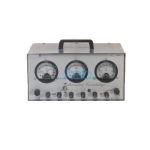
Power Supplies for Diode Valve Experiment Model
Product Code : EL-PSAT-1205
Output HT = 0 to 300 Volts 30mA. LT. Variable to 1 to 6, 3 Amps with 2 meters for Volt/Current.
View Details
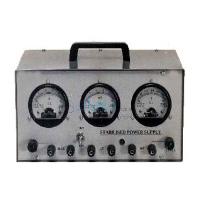
Power Supply for Triode Valve Experiment Model
Product Code : EL-PSAT-1207
Stabilised power supply for the triode valve experiment: HT 0 to 300 V at 50 mA, LT 6.3 V at 3 A, bias 0 to 25 V positive and negative.
View Details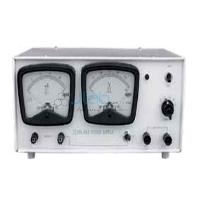
Power Supply for Electrophoresis Experiment Model
Product Code : EL-PSAT-1208
Stabilised power supply having Range 0-300 V current 100mA.
View Details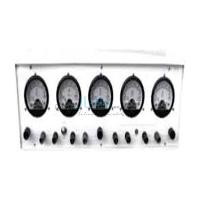
Fixed Voltage IC Regulated Dual Power Supplies
Product Code : EL-PSAT-1211
Two fixed voltages are provided in this unit.
View Details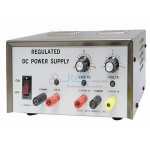
Regulated Power Supply Model
Product Code : EL-PSAT-1212
General-purpose laboratory power source for analog and digital ICs, with four fixed outputs: +5 V, -5 V, +12 V and -12 V.
View Details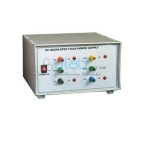
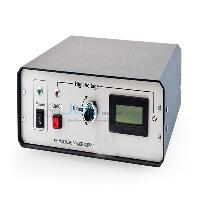

Dual Power Supply 0-30 Volt 1 Amp
Product Code : EL-PSAT-1215
Dual power supply for transistor and IC experiments: 0-30 V at 1 A positive and 0-30 V at 1 A negative, stabilization +/-0.1%, four meters, 220 V 50 Hz.
View Details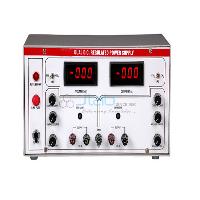
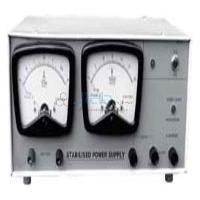
Power Supply 0-30 Volts 3 Amp
Product Code : EL-PSAT-1217
This supply is designed to meet requirement of general laboratory continuously variable 0 to 30 V.D.C. at current 0 to 3 Amps, continuous.
View Details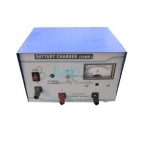
Battery Chargers
Product Code : EL-PSAT-1218
Battery chargers housed in a steel cabinet for 220 V 50 Hz mains, fuse protected, with an output current meter and full-wave bridge circuit; 6/12 V and 18 V versions.
View Details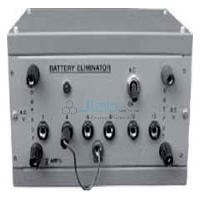
Battery Eliminators
Product Code : EL-PSAT-1219
Socket or Band-Switch provided for Selection of Volts output, with ON/OFF switch and main indication.
View Details