Battery Chargers Manufacturer,Supplier and Exporter in India

Product Code : EL-PSAT-1218
Jlab Export is a leading Battery Chargers Manufacturer,and suppliers in India
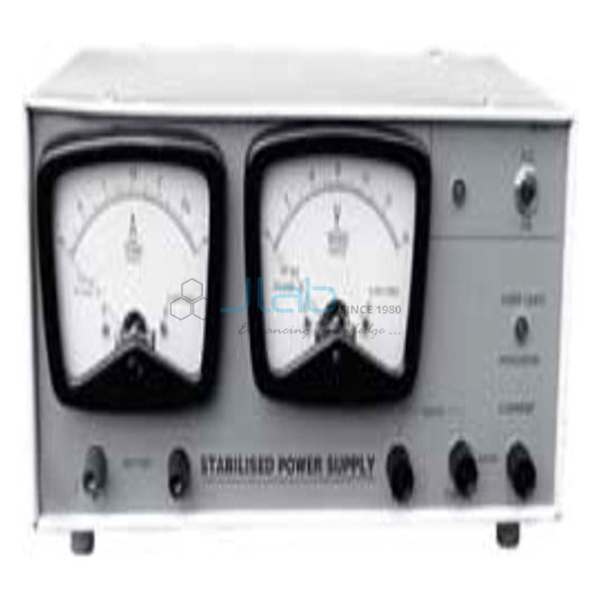
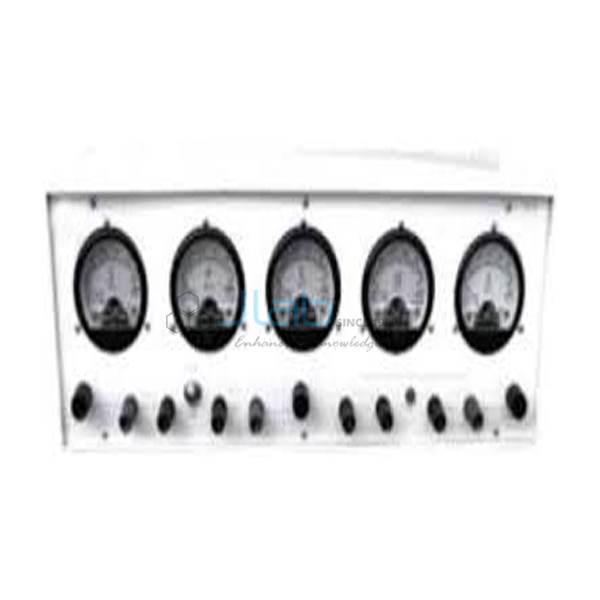
Battery Chargers (code EL-PSAT-1218) are mains-operated chargers for recharging the storage batteries and accumulators used in school, college and ITI laboratories. Each charger is housed in a steel cabinet, works on 220 V 50 Hz, uses a full-wave bridge circuit, is fuse protected and has a meter for the output current. Eight versions cover 6/12 V and 18 V outputs. They are made by Jain Laboratory Instruments Pvt Ltd (JLab) at its works in Ambala, India.
Specifications
| Parameter | Detail |
|---|---|
| Mains supply | 220 V, 50 Hz |
| Housing | Steel cabinet |
| Rectifier circuit | Full-wave bridge |
| Protection | Fuse |
| Metering | Meter for the output current |
| Testing | Tested for continuous operation |
| Versions | Eight, (A) to (H): 6/12 V at 2 to 6 A, or 18 V at 2 to 4 A (listed as automatic) — see the table below |
| Quality check | Each charger is visually inspected before dispatch |
| Pack quantity | Each (sold individually) |
| Minimum order quantity | 10 units |
| Dispatch time | Usually 7–10 working days |
| This listing covers | The charger; batteries, accumulators and hydrometers are separate catalogue items |
| Product code | EL-PSAT-1218 |
| Manufacturer | Jain Laboratory Instruments Pvt Ltd (JLab) — OEM |
| Country of origin | India (made in Ambala, Haryana) |
Which Battery Charger Version Do You Need?
| Version | Output voltage | Output current | Listed as |
|---|---|---|---|
| (A) | 6/12 V | 2 A | — |
| (B) | 18 V | 2 A | Automatic |
| (C) | 6/12 V | 3 A | — |
| (D) | 6/12 V | 4 A | — |
| (E) | 6/12 V | 5 A | — |
| (F) | 6/12 V | 6 A | — |
| (G) | 18 V | 3 A | Automatic |
| (H) | 18 V | 4 A | Automatic |
Choose one of the 6/12 V versions (A, C, D, E or F) for 6 V and 12 V batteries, with the current rating matched to the size of the batteries you charge: a lower rating for small accumulators, a higher one for larger batteries, always within the battery maker’s recommended charging current. The 18 V versions (B, G and H) are listed as automatic; the listing does not describe what the automatic function does, so ask JLab to confirm it before you order.
What Is a Laboratory Battery Charger Used For?
A battery charger converts mains AC into direct current and drives it back into a rechargeable battery to restore its charge. In school physics and chemistry labs it keeps the lead accumulators used for current-electricity practicals — Ohm’s law, potentiometer and meter bridge experiments, electrolysis — ready for the next class, and in ITI and TVET electrical and automotive workshops trainees use it to learn battery charging and maintenance. Inside, the full-wave bridge (four diodes) rectifies both halves of each mains cycle, and the output-current meter lets the teacher follow the charge; on a simple charger the current usually falls as the battery voltage rises.
A lead-acid cell has a nominal voltage of 2 V, so a 6 V battery has three cells and a 12 V battery six. Charge in a well-ventilated place away from flames and sparks, because lead-acid batteries give off hydrogen while charging. Connect positive to positive and negative to negative before switching on the mains, and switch off before disconnecting the battery. Check the electrolyte level of flooded batteries and top up with distilled water, and use a battery hydrometer to judge the state of charge. For flooded lead-acid batteries the charging current is often about one-tenth of the ampere-hour capacity, but follow the battery maker’s figure.
What to Specify When Ordering
- Version — give the letter (A to H) for the output voltage and current that suit your batteries.
- Mains supply — the chargers are listed as workable on 220 V 50 Hz; state your local supply in the enquiry.
- Automatic versions — if you choose B, G or H, ask JLab to explain the automatic function for your application.
- Quantity and related items — the minimum order is 10 chargers; add accumulators, hydrometers or other power supplies to the same enquiry.
Frequently Asked Questions
What is a battery charger used for in a teaching lab?
It recharges the storage batteries and accumulators that power current-electricity experiments, so they are ready for each practical class. Technical institutes also use it to teach battery charging and maintenance.
Which output voltages and currents are available?
There are eight versions. Versions A, C, D, E and F give 6/12 V at 2, 3, 4, 5 and 6 A respectively; versions B, G and H give 18 V at 2, 3 and 4 A and are listed as automatic.
What does “automatic” mean on the 18 V versions?
The listing marks versions B, G and H as automatic but does not define the function. Ask JLab to describe it for the version you are considering before you place the order.
What mains supply does the charger need, and how is it protected?
It is workable on 220 V 50 Hz. The circuit is fuse protected, a meter shows the output current, and the chargers are tested for continuous operation. If your lab runs on a different mains supply, mention it in your enquiry.
Are the batteries or a hydrometer included?
No. This listing covers the charger only. The lead accumulator and the battery hydrometer are separate items, linked below, and can be quoted together with the chargers.
What should an export enquiry include?
The version letters and quantities, the destination country and port or city, your preferred delivery terms such as FOB or CIF, any packing or labelling needs, and the tender reference if you are buying against a tender.
Who makes these battery chargers?
JLab — Jain Laboratory Instruments Pvt Ltd — builds them at its own works in Ambala, Haryana, India, and quotes for them directly as the manufacturer.
OEM Manufacturer
JLab is the trading name of Jain Laboratory Instruments Pvt Ltd, a manufacturer of laboratory instruments and power supplies in India, incorporated in 2017 and based on Hargolal Road, Ambala, Haryana. These chargers are assembled at JLab’s own works rather than bought in from a trader, so schools, colleges, technical institutes, dealers and importers deal with the maker directly; every unit is visually inspected before it is packed, and repeat orders and after-sales questions go straight to the manufacturer. JLab exports worldwide and ships to buyers in every region — for example Malta in Southern Europe, Canada in North America, Botswana in Southern Africa, Hong Kong in East Asia and Congo in Central Africa. Institutions buying through a tender will find details on the JLab lab tenders page.
Batteries and Power Supplies to Go With It
- Lead Accumulator — a 2 V lead accumulator in a hard rubber container with screw terminals, supplied with charging instructions.
- Battery Hydrometer — a pipette-type hydrometer for checking the state of charge of lead-acid batteries.
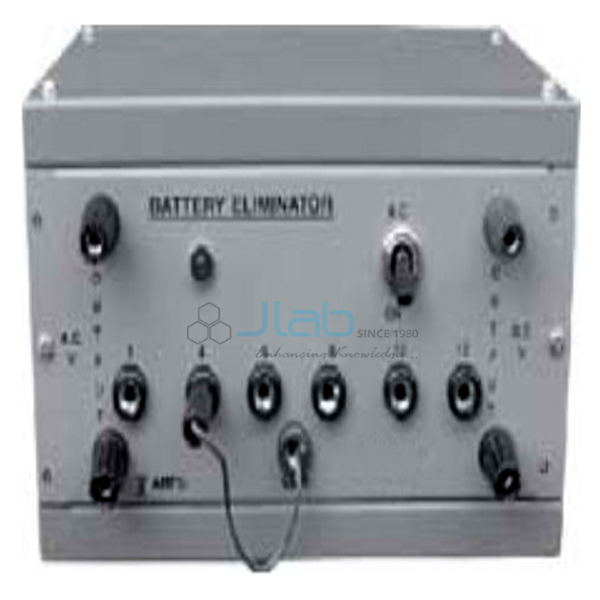
- Battery Eliminators — steel-cabinet mains units with 2 to 6 V and 2 to 12 V outputs that replace batteries in experiments.
- Power Supply 0-30 Volts 3 Amp — a variable DC bench supply with both voltage and current adjustable.
- Transformers and Stabilizers — wound with double-enamelled copper wire on silicon alloy steel cores.
See the full Power Supplies and Transformers range or all Scientific Instrument products.
Request a Quote
Quotes come direct from the manufacturer. Use the Add To Cart enquiry button on this page, or send the version letters (A to H), the quantity (minimum 10 units), your mains supply and your delivery location through the contact page.
Last updated: 8 October 2026