Battery Eliminators Manufacturer,Supplier and Exporter in India
Product Code : EL-PSAT-1219
Jlab Export is a leading Battery Eliminators Manufacturer,and suppliers in India
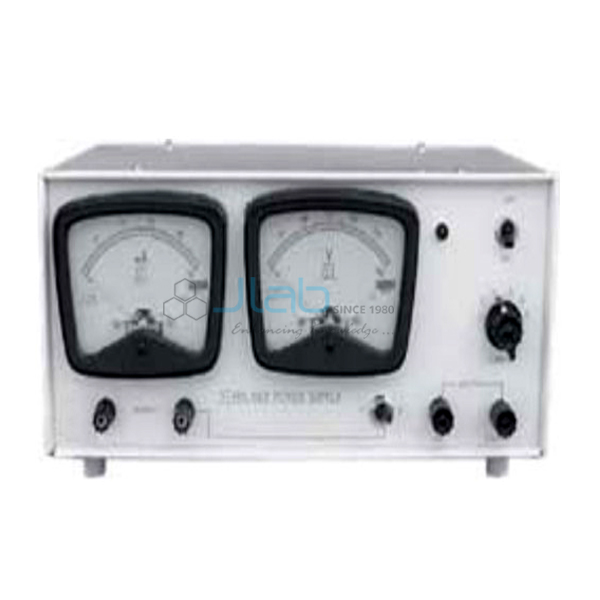
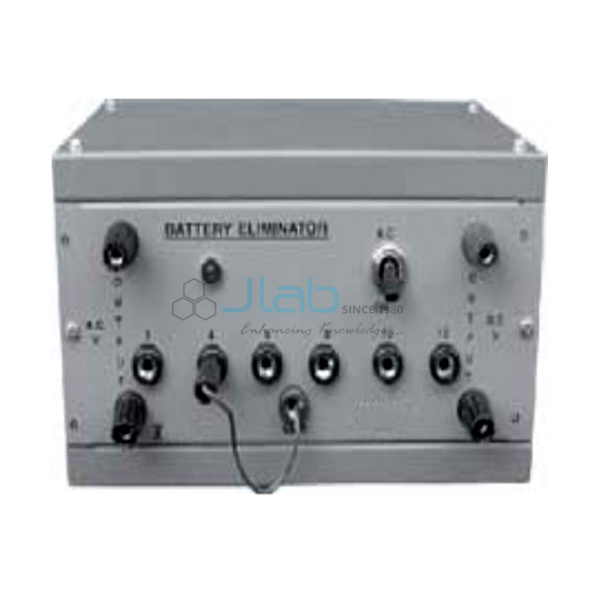
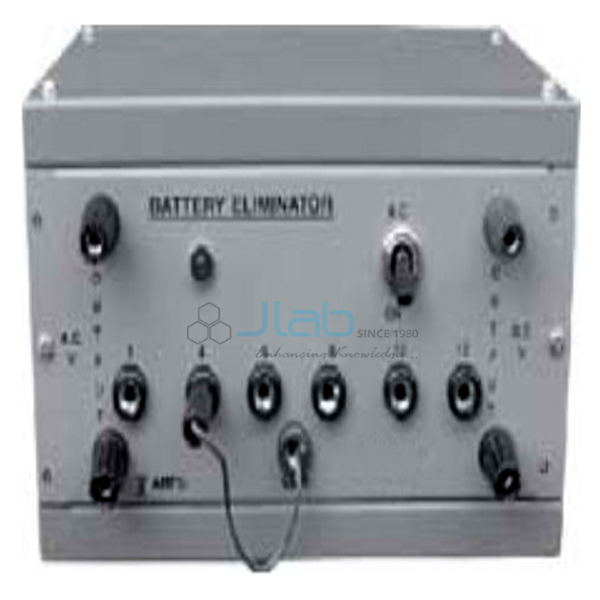
Battery Eliminators (code EL-PSAT-1219) are mains-operated low-voltage supplies that stand in for dry cells and accumulators in physics and electrical experiments at schools, colleges and technical institutes. Housed in a steel cabinet and workable on 220 V 50 Hz, they offer outputs of 2 to 6 V or 2 to 12 V, selected by socket or band-switch, at 1 A up to 6 A. They are made by Jain Laboratory Instruments Pvt Ltd (JLab) at its works in Ambala, India.
Specifications
| Parameter | Detail |
|---|---|
| Mains supply | Workable on 220 V, 50 Hz |
| Housing | Steel cabinet |
| Output voltage selection | Socket or band-switch |
| Controls and indication | ON/OFF switch with mains indication |
| Output ranges | 2 to 6 V, or 2 to 12 V, depending on version |
| Current ratings | 1, 2, 3, 4, 5 or 6 A, depending on version — see the table below |
| Quality check | Each battery eliminator is visually inspected before dispatch |
| Pack quantity | Each (sold individually) |
| Minimum order quantity | 10 units |
| Dispatch time | Usually 7–10 working days |
| Product code | EL-PSAT-1219 |
| Manufacturer | Jain Laboratory Instruments Pvt Ltd (JLab) — OEM |
| Country of origin | India (made in Ambala, Haryana) |
Versions
| Version | Output range | Current rating |
|---|---|---|
| (A) | 2 to 6 V | 1 A |
| (B) | 2 to 12 V | 2 A |
| (C) | 2 to 12 V | 3 A |
| (D) | 2 to 12 V | 4 A |
| (E) | 2 to 12 V | 5 A |
| (F) | 2 to 12 V | 6 A |
The catalogue also lists versions (G) and (H) with the same ratings as (A) and (B), so there are six distinct ratings in all. Quote the version letter and the rating together in your enquiry.
How Does It Compare with Other JLab Battery Eliminators?
| Listing | Output | Construction and controls |
|---|---|---|
| These battery eliminators (EL-PSAT-1219) | 2 to 6 V at 1 A, or 2 to 12 V at 2 to 6 A | Steel cabinet; socket or band-switch selection; ON/OFF switch with mains indication; 220 V 50 Hz |
| Battery Eliminator | Same ratings, 2 to 6 V at 1 A and 2 to 12 V at 2 to 6 A | Same steel-cabinet design and switching, listed by TE model number |
| Battery Eliminator (0-12 Volts) | 0–12 V DC | Classroom power pack; current rating and controls are not stated in its listing |
Choose this range when you want a stated current rating and a choice of six sizes; order the TE-model listing instead if your tender or previous order quotes TE model numbers. The 0–12 V power pack suits buyers who only need a basic classroom DC source and will confirm its rating with JLab.
What Is a Battery Eliminator Used For?
A battery eliminator takes the place of a battery bank, so practicals no longer stop because dry cells have run down. It is a standard item of physics lab equipment for current-electricity work — verifying Ohm’s law, resistors in series and parallel, the meter bridge and similar class 10 and class 12 practicals in CBSE and ICSE schools — and for electromagnet, lamp, small-motor and electrolysis demonstrations. In ITI and TVET electrical workshops and college labs it powers circuit boards and trainers that would otherwise need batteries. A 1 A or 2 A version is enough for most student resistor circuits; the 3 A to 6 A versions suit electromagnets, groups of lamps and other heavier loads.
Before switching on, set the selector to the lowest voltage and check the circuit, then raise the voltage to the value the experiment needs. Keep the load current within the rating of the version you have, use a rheostat or series resistor to limit current in low-resistance circuits, and never connect the output terminals directly together. Switch off before changing connections, and keep the unit dry and away from spilled solutions on the bench.
What to Specify When Ordering
- Version — the letter and rating, from 2 to 6 V at 1 A up to 2 to 12 V at 6 A.
- Voltage selection — whether you prefer socket or band-switch selection of the output.
- Mains supply — the units are workable on 220 V 50 Hz; state your local supply.
- Quantity — the minimum order is 10 units; many labs order one per bench, plus rheostats and connecting leads in the same enquiry.
Frequently Asked Questions
What does a battery eliminator do in a school lab?
It supplies the low voltage that batteries would otherwise provide, straight from the mains. Students can run Ohm’s law and other current-electricity experiments without replacing cells.
Which output ranges and currents can I order?
Version A gives 2 to 6 V at 1 A. Versions B to F give 2 to 12 V at 2, 3, 4, 5 and 6 A respectively. Versions G and H repeat the ratings of A and B.
How is the output voltage selected?
By socket or band-switch, as listed. The listing does not give the voltage steps, so say which selection method you prefer and ask JLab to confirm the steps on the version you choose.
Is the output regulated?
The listing does not give regulation or ripple figures. For experiments that need a closely regulated supply, see the variable power supplies in the same range or ask JLab for advice.
What details does JLab need for an export quotation?
The versions and quantities, the destination country and port or city, delivery terms (for example FOB or CIF), any packing or labelling instructions and, for tenders, the tender reference.
Who manufactures these battery eliminators?
JLab (Jain Laboratory Instruments Pvt Ltd) makes them at its works in Ambala, Haryana, India, and supplies them factory-direct.
OEM Manufacturer
JLab is the trading name of Jain Laboratory Instruments Pvt Ltd, an educational and scientific instrument manufacturer in India, incorporated in 2017 and based on Hargolal Road, Ambala, Haryana. The battery eliminators are made in JLab’s own works and not bought in from a trader, which lets schools, colleges, dealers and importers order factory-direct; each one is visually inspected before dispatch, and repeat orders are handled by the people who built them. JLab exports worldwide and ships to buyers in every region — for example Sierra Leone in West Africa, Sudan in North Africa, the UK in Western Europe, El Salvador in Central America and the Caribbean, and the Czech Republic in Eastern Europe. For tender purchases, see the JLab lab tenders page.
Related Power Supplies and Circuit Items
- Battery Chargers — steel-cabinet chargers with an output current meter, for labs that keep rechargeable accumulators.
- Ohm's Law Apparatus — two moving-coil meters and a wire-wound potentiometer, with terminals for connecting a 6 V battery or power supply.
- Slide Wire Rheostats — sliding-contact variable resistors for controlling current or dividing voltage.
- Battery Eliminator — the TE-model listing of the same steel-cabinet design.
- Battery Eliminator (0-12 Volts) — a classroom DC power pack.
Browse the full Power Supplies and Transformers range or the wider Scientific Instrument section.
Request a Quote
Quotes come direct from the manufacturer. Use the Add To Cart enquiry button on this page, or send the version letters, quantities (minimum 10 units), preferred voltage selection and delivery location through the contact page.
Last updated: 8 October 2026