Direct Vision Spectroscope Manufacturer,Supplier and Exporter in India
Product Code : EL-ELA-5463
Jlab Export is a leading Direct Vision Spectroscope Manufacturer,and suppliers in India
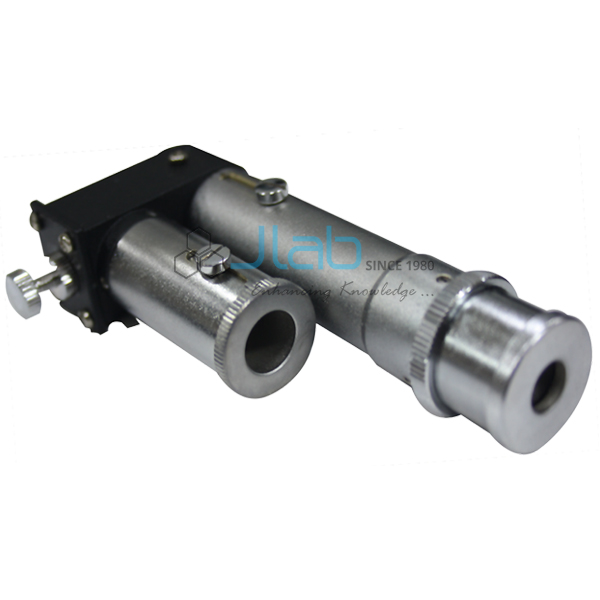
Direct Vision Spectroscope (code EL-ELA-5463) is a compact prism spectroscope for viewing the visible spectrum from 400 to 750 nm, used for flame tests of basic radicals such as sodium, strontium, potassium and copper in school and college labs. A three-element prism gives a well-defined spectrum, and the graticule carries an index at 590 nm, the wavelength of sodium light. It is made by Jain Laboratory Instruments Pvt Ltd (JLab) at its works in Ambala, India.
Specifications
| Parameter | Detail |
|---|---|
| Type | Direct vision spectroscope; prism dispersion |
| Spectral range | Visible, 400 to 750 nm |
| Prism | Three-element type, for a well-defined spectrum |
| Eyepiece | Single eyepiece |
| Graticule | Independent focusing tube; index at 590 nm (sodium light) |
| Index adjustment | Can be calibrated to a known light source with a knurled screw |
| Slit | Variable, adjusted by a knurled ring |
| Case | Packed in a velvet case |
| Listed use | Flame tests of basic radicals (sodium, strontium, potassium, copper and others) |
| Quality check | Each spectroscope is visually inspected before dispatch |
| Pack quantity | Each (sold individually) |
| Minimum order quantity | 10 units |
| Dispatch time | Usually 7–10 working days |
| Product code | EL-ELA-5463 |
| Manufacturer | Jain Laboratory Instruments Pvt Ltd (JLab) — OEM |
| Country of origin | India (made in Ambala, Haryana) |
How Does It Compare with the Other JLab Direct Vision Spectroscope?
| Model | Dispersion | Slit | Other listed details |
|---|---|---|---|
| This spectroscope (EL-ELA-5463) | Three-element prism; visible 400 to 750 nm | Variable, knurled ring | Graticule index at 590 nm; independent focusing tube; velvet case; listed for flame tests |
| Direct Vision Spectroscope (wooden case, 80 lines per mm) | 80 lines per mm; dispersion approx. 11° | Variable width, adjusted by rotating the end piece | Wooden case; for rapid examination of white light sources |
Choose this model when flame tests and identifying the sodium line matter, since it carries the 590 nm index; the wooden-case model is listed for quick checks of the spectral composition of white light sources.
What Is the Direct Vision Spectroscope Used For?
A direct vision spectroscope is pointed straight at a light source: its compound prism spreads the light into a spectrum while keeping the middle of the spectrum on the line of sight, so no angle has to be set. In chemistry it partners the flame test. A salt held in a flame gives characteristic coloured lines, and the spectroscope separates them, which helps students tell sodium, strontium, potassium, copper and other basic radicals apart more surely than by flame colour alone, in class 11 and class 12 salt analysis and in college inorganic labs.
In physics teaching it shows the continuous spectrum of a filament lamp next to the bright-line spectra of discharge tubes and fluorescent lamps, a simple way to introduce atomic spectra and the visible range of light. The variable slit controls how much light enters: a narrower slit gives sharper lines, a wider one a brighter view of faint sources.
What to Specify When Ordering
- Quantity — the number of spectroscopes for your benches or student groups.
- Model — this prism spectroscope with the 590 nm index, or the wooden-case direct vision model.
- Light sources and measuring instruments — spectrum tubes and spectrometers are separate items that can be quoted on the same enquiry.
Frequently Asked Questions
What wavelength range does this spectroscope cover?
The visible range, from 400 to 750 nm, dispersed by a three-element prism.
Can it be used for flame tests?
Yes. It is listed as useful for flame tests of basic radicals such as sodium, strontium, potassium and copper, where it separates the coloured lines given by each element.
What is the 590 nm index on the graticule?
It is a reference mark at the wavelength of sodium light. The graticule has its own focusing tube, and the index can be calibrated to a known light source with a knurled screw.
How is the amount of light controlled?
By a variable slit adjusted with a knurled ring. Narrowing the slit sharpens the lines; opening it brightens the spectrum of a weak source.
How does it differ from the wooden-case Direct Vision Spectroscope?
That model is listed at 80 lines per mm with a dispersion of approx. 11°, a slit adjusted by rotating the end piece, and a wooden case. This one uses a three-element prism, carries the 590 nm sodium index and comes in a velvet case.
Is a spectroscope the same as a spectrometer?
No. A spectroscope is for viewing a spectrum; a spectrometer adds a divided circle and verniers for measuring angles, as in prism and grating experiments. JLab lists spectrometers as separate instruments.
What information is needed for an export quotation?
The quantity, destination country and port or city, delivery terms (for example FOB or CIF), any packing or labelling requirements, and the tender reference for tender orders.
Who manufactures this spectroscope?
JLab — Jain Laboratory Instruments Pvt Ltd — makes it at its works in Ambala, Haryana, India.
OEM Manufacturer
JLab is the trading name of Jain Laboratory Instruments Pvt Ltd, an optics and physics lab instruments manufacturer in India, incorporated in 2017 and based on Hargolal Road, Ambala, Haryana. The direct vision spectroscope is assembled at JLab’s own works rather than sourced from a trader, so schools, colleges, dealers and importers buy direct from the factory; each instrument is visually inspected before dispatch, and repeat orders are handled by the manufacturer. JLab exports worldwide and ships to buyers in every region — for example Estonia in Northern Europe, Morocco in North Africa, Jamaica in Central America and the Caribbean, Burkina Faso in West Africa and Luxembourg in Western Europe. Tender information is on the JLab lab tenders page.
Related Optics Instruments
- Direct Vision Spectroscope (wooden case, 80 lines per mm) — for rapid examination of white light sources.
- Spectrometer — for observing and measuring spectra in prism and grating experiments.
- Intermediate Spectrometer — a spectrometer on a cast iron base with levelling screws and two opposite verniers.
Browse the Educational Laboratory Apparatus range or the full Laboratory Apparatus section.
Request a Quote
To order or ask for a quotation, use Add To Cart on this page or the contact page, and include the quantity, the model you want and the delivery destination.
Last updated: 15 October 2026