DV and DT Limitation of SCRS Manufacturer,Supplier and Exporter in India
Product Code : EL-PET-1416
Jlab Export is a leading DV and DT Limitation of SCRS Manufacturer,and suppliers in India
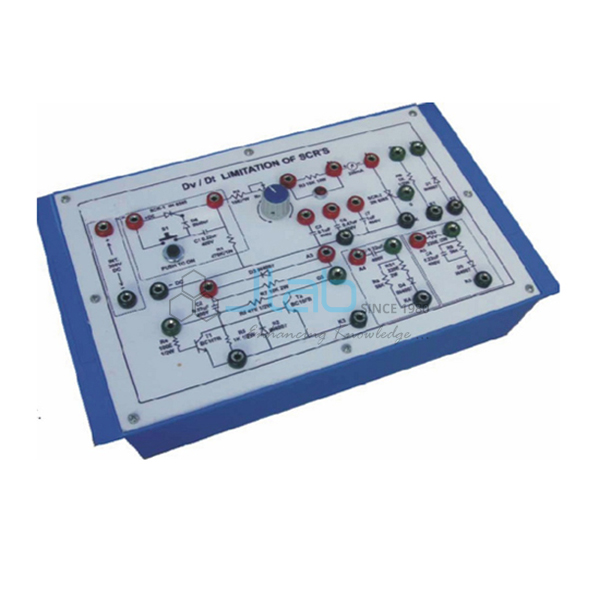
DV and DT Limitation of SCRS (code EL-PET-1416) is a power electronics training board for studying the dv/dt limitation of SCRs: how fast a rising anode voltage can be before it fires a thyristor without a gate signal, and how gate-cathode termination, gate biasing and snubber circuits raise that limit. A thyristor switch on the board applies the sudden voltage to the SCR under experiment. JLab makes the trainer at its Ambala works in India.
Specifications
| Parameter | Detail |
|---|---|
| DC supply | 300 V DC at 250 mA, internally connected |
| Voltage step | Thyristor switch for applying sudden voltage on the SCR under experiment |
| Device under experiment | SCR |
| Gate-cathode termination | Resistance for gate-cathode termination |
| Other parts | Silicon diode; transistorized snubber circuit; two schemes of R-C snubber circuits |
| Firing indication | Visual indication of SCR firing |
| Mains controls | Mains on/off switch, fuse and jewel light |
| Mains supply | 230 V ±10%, 50 Hz AC |
| Patch cords | Stackable, 4 mm spring-loaded plugs, half a metre long |
| Terminals | Terminals/sockets on the panel for connections and observation of waveforms |
| Operating instructions | Detailed, giving object, theory, design procedures, report suggestions and book references |
| Other apparatus required | Digital multimeter, 3¾ digit; 0–30 V, 1 A IC-regulated power supply |
| Weight | 3 kg (approx.) |
| Dimensions | W 340 x H 110 x D 210 |
| Packing | Corrugated box |
| Quality check | Each board is visually inspected before dispatch |
| Pack quantity | Each (sold individually) |
| Minimum order quantity | 10 units |
| Dispatch time | Usually 7–10 working days |
| Product code | EL-PET-1416 |
| Manufacturer | Jain Laboratory Instruments Pvt Ltd (JLab) — OEM |
| Country of origin | India (made in Ambala, Haryana) |
What Is the dv/dt Limitation Trainer Used For?
Every SCR has junction capacitance, so a steeply rising anode voltage drives a charging current through the device, and if the rate of rise (dv/dt) is high enough that current can turn the SCR on with no gate signal at all. Power converters guard against this false firing by terminating or biasing the gate and by fitting snubber circuits that slow the voltage rise. This board lets students see the effect directly and compare the remedies, a standard topic in power electronics courses at diploma and degree level. Experiments that can be performed:
- Test and estimation of the dv/dt of the SCR
- Comparison of dv/dt capability with different gate-cathode terminations
- Comparison of dv/dt capability with gate-cathode voltage biasing
- Comparison of dv/dt capability with gate-cathode current biasing
- Improving dv/dt capability with a transistor snubber circuit
- Effect of an R-C snubber circuit on dv/dt capability
- Study of different R-C snubber schemes and their effect on dv/dt capability
What to Specify When Ordering
- Other apparatus — the digital multimeter and the regulated power supply are separate items; add them to the enquiry if needed.
- Companion boards — other SCR trainers for the same course can be quoted together.
- Quantity — the number of boards for your lab.
Frequently Asked Questions
How does the board show that the SCR has fired?
A visual indicator on the board shows when the SCR under experiment fires, so students can see at once whether a voltage step has triggered it without a gate signal.
Why does an R-C snubber improve dv/dt capability?
The capacitor across the SCR slows the rate at which the anode voltage can rise, and the resistor limits the discharge current when the SCR turns on. Two R-C snubber schemes on the board allow different arrangements to be compared.
What other apparatus is needed?
A 3¾-digit digital multimeter and a 0–30 V, 1 A IC-regulated power supply. Both are separate items that can be quoted on the same enquiry.
What information is needed for an export quotation?
The number of boards, the destination country and port or city, the delivery terms you prefer such as FOB or CIF, any packing or labelling instructions and a tender reference if one applies.
Who manufactures this trainer?
JLab, the trading name of Jain Laboratory Instruments Pvt Ltd, makes it in Ambala, Haryana, India.
OEM Manufacturer
JLab is the trading name of Jain Laboratory Instruments Pvt Ltd, a manufacturer of power electronics training equipment in India, incorporated in 2017 and based on Hargolal Road, Ambala, Haryana. The board comes from JLab’s own works and not from a trading company, so colleges, dealers and importers buy it from the maker, each unit is visually inspected before dispatch, and repeat orders go back to the same works. JLab is registered under CIN U29309HR2017PTC069123 and holds MSME Udyam registration UDYAM-HR-01-0003849 as a manufacturing enterprise. JLab exports worldwide and ships to buyers in every region — for example Turkmenistan in Central Asia, Botswana in Southern Africa, Georgia in Eastern Europe, Afghanistan in South Asia and Mexico in North America. Tender details are on the JLab lab tenders page.
Related SCR Trainers
- Silicon Controlled Rectifier — for SCR gate firing, anode current, holding current and phase firing characteristics.
- SCR And AC Phase Control — resistance, RC and UJT trigger circuits for half-wave and full-wave SCR phase control.
- UJT Relaxation Oscillator — a UJT board for relaxation oscillator and SCR trigger circuit studies.
See all Power Electronics Trainers or the full Electronics Lab Equipments range.
Request a Quote
Request a quotation through the Add To Cart enquiry button or the contact page, giving the number of boards, the delivery destination and any other apparatus you need.
Last updated: 22 October 2026