Economic Plants Manufacturer,Supplier and Exporter in India
Product Code : EL-GSC-2946
Jlab Export is a leading Economic Plants Manufacturer,and suppliers in India
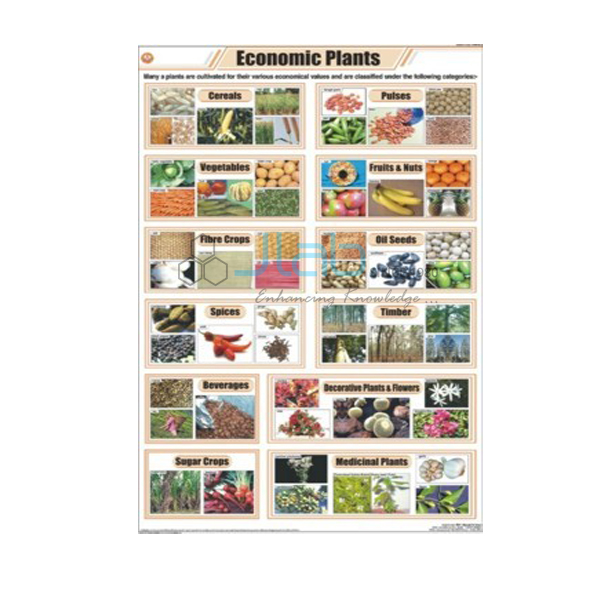
Economic Plants (code EL-GSC-2946) is a 58 x 90 cm wall chart on economic plants — the crops and trees people grow for food, fibre, oil, timber, spices and medicines — for botany, agriculture and environmental studies lessons. It is offset printed in full colour on 130 gsm coated art paper, laminated on both sides and fitted with plastic rollers. JLab (Jain Laboratory Instruments Pvt Ltd, Ambala, India) supplies it to schools, colleges and dealers.
Specifications
| Parameter | Detail |
|---|---|
| Chart topic | Economic plants |
| Size (overall) | 58 x 90 cm (about 22.8 x 35.4 in) |
| Size when rolled | 58 x 4 x 2 cm |
| Paper | Coated art paper, 130 gsm |
| Printing | Full colour, offset printing using CTP (computer-to-plate) technology |
| Lamination | Both sides, thick plastic film (30 micron heat-sealable polyester) |
| Fittings | Plastic rollers, for wall hanging |
| Surface | Markable and washable |
| Weight | 228 g |
| Language | English only |
| Quality check | Each chart is visually inspected before dispatch |
| Pack quantity | Each (sold individually) |
| Minimum order quantity | 10 units |
| Dispatch time | Usually 7–10 working days |
| Product code | EL-GSC-2946 |
| Supplied by | Jain Laboratory Instruments Pvt Ltd (JLab), Ambala, India |
What Is the Economic Plants Chart Used For?
Economic botany sorts plants by the use people make of them. Cereals such as rice, wheat and maize provide a large share of the food energy people eat, pulses such as gram and lentils add protein, and oilseeds such as groundnut, mustard and sunflower give cooking oil. Cotton and jute are the main fibre crops, sugarcane is the chief source of sugar in India, tea and coffee are beverage crops, and teak and sal are well-known timber trees. Spices, fruits and vegetables, ornamental flowers and medicinal plants complete the list.
The chart supports middle-school lessons on where our food comes from, the plant side of secondary-school lessons on food resources, and economic botany in college courses, where students collect, press and label specimens of useful plants. Hung beside a class herbarium or a tray of local seeds and grains, it helps students link each crop to products they use every day. The laminated surface is listed as markable and washable, so a teacher can tick off local crops during a lesson and wipe the sheet clean afterwards.
What to Specify When Ordering
- Quantity — the minimum order is 10 charts; each chart is sold individually.
- Companion chart — Medicinal plants - I, from the same general science series, gives medicinal plants a sheet of their own.
- Language — this title is listed in English only.
- Artwork — ask JLab for a larger image of the current print if you need to check which crops are pictured.
Frequently Asked Questions
Which plant groups does the chart cover?
The listing does not itemise the panels. Economic plants are usually grouped as cereals, pulses, vegetables, fruits, oilseeds, fibre crops, spices, beverages, sugar crops, timber and medicinal plants; ask JLab for a larger image of the current print to see exactly which are shown.
Which courses use an economic plants chart?
Middle-school science on food from plants, secondary-school lessons on food resources and agriculture, and the economic botany part of college botany courses. It also suits geography lessons on the crops grown in different regions.
How large is the chart and what is it made of?
It is 58 x 90 cm and weighs 228 g. The full-colour artwork is offset printed, using CTP technology, on 130 gsm coated art paper, and both faces are laminated with 30 micron heat-sealable polyester.
How is it hung and stored?
Plastic rollers are fitted for wall hanging. Rolled up, the chart measures 58 x 4 x 2 cm, which keeps storage cupboards tidy and export cartons small.
What details does an export quotation need?
The quantity, the destination country and port or city, your delivery terms such as FOB or CIF, packing or labelling requirements and any tender reference.
Who supplies the Economic Plants chart?
JLab (Jain Laboratory Instruments Pvt Ltd), Ambala, Haryana, supplies the chart and quotes directly to schools, colleges and dealers.
Supplier
JLab is the trading name of Jain Laboratory Instruments Pvt Ltd, a company incorporated in 2017 on Hargolal Road, Ambala, Haryana. Besides the laboratory equipment it produces, JLab supplies printed science charts like this one, which lets a botany or agriculture department combine wall charts, herbarium equipment and practical apparatus in a single order; each chart is checked visually before packing. JLab exports worldwide and ships to buyers in every region — for example Vanuatu in Oceania, Uzbekistan in Central Asia, Thailand in Southeast Asia, Peru in South America and Sweden in Northern Europe. Tender buyers can refer to the JLab lab tenders page.
Related Botany Charts and Herbarium Equipment
- Medicinal plants - I — the series chart on medicinal plants, one of the economic plant groups.
- Basic Agricultural Practices — the series chart on how crops are grown.
- The Seed: Structure and Germination Chart — a 58 x 90 cm botany chart on the parts of a seed and how it germinates.
- Herbarium Press — painted wooden pressure plates tightened with fly-nuts, for pressing plant specimens.
- Herbarium Cabinets — for keeping botanical specimens on herbarium sheets.
Browse the General Science Charts range or all Charts.
Request a Quote
JLab quotes directly. Press the Add To Cart enquiry button on this page or write through the contact page with the number of charts (minimum 10 units), any other titles you want and the delivery location.
Last updated: 4 October 2026