The Seed: Structure and Germination Chart Manufacturer,Supplier and Exporter in India
Product Code : EL-BC-9254
Jlab Export is a leading The Seed: Structure and Germination Chart Manufacturer,and suppliers in India
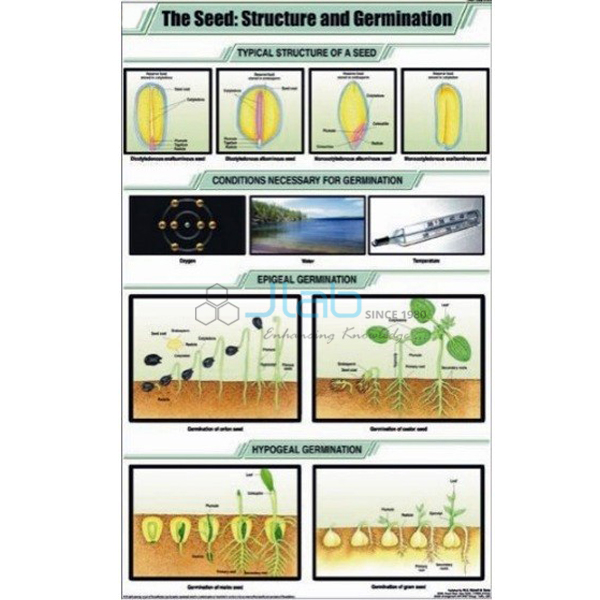
The Seed: Structure and Germination Chart (code EL-BC-9254) is a 58 x 90 cm botany wall chart for two linked lessons in school biology and college botany: the parts of a seed and how a seed grows into a seedling. It is printed in full colour on art paper, laminated on both sides with thick plastic film, fitted with plastic rollers and written in English only. JLab (Jain Laboratory Instruments Pvt Ltd, Ambala, India) supplies it to schools, colleges and dealers.
Get a quote: use the Add To Cart enquiry button below, or send your quantity and destination through the contact page.
Specifications
| Parameter | Detail |
|---|---|
| Subject | The seed — seed structure and seed germination |
| Chart group | Botany Charts |
| Size | 58 x 90 cm |
| Printing | Full colour on art paper |
| Finish | Laminated on both sides with thick plastic film |
| Rollers | Plastic rollers fitted |
| Language | English only |
| Quality check | Each chart is visually inspected before dispatch |
| Pack quantity | Each (sold individually) |
| Minimum order quantity | 10 units |
| Dispatch time | Usually 7–10 working days |
| Product code | EL-BC-9254 |
| Supplied by | Jain Laboratory Instruments Pvt Ltd (JLab), Ambala, India |
What Is the Seed Structure and Germination Chart Used For?
A seed is a ripened ovule. On the outside is the seed coat, usually with a hilum, the scar where the seed was joined to its stalk, and a micropyle, a tiny pore through which water enters. Inside is the embryo: the radicle, which becomes the root, the plumule, which becomes the shoot, and one or two cotyledons, the seed leaves. Some seeds store food in a separate endosperm (albuminous seeds such as maize and castor), while in others the cotyledons hold it (non-albuminous seeds such as gram and pea). Germination needs water, oxygen and a suitable temperature. In epigeal germination the cotyledons are carried above the soil, as in bean and castor; in hypogeal germination they stay below ground, as in pea, gram and maize.
In practical classes students soak seeds overnight, split them open to find the embryo, and set up simple germination tests that leave out water, air or warmth in turn; the chart gives the class the names and stages to compare with what they see. Seed structure is part of the class 11 biology chapter on the morphology of flowering plants. Wipe the laminated face with a damp cloth and keep the chart rolled when it is not on the wall.
What to Specify When Ordering
- Quantity — minimum 10 units; the bean and pea germination chart and other Botany Charts titles can go on the same order.
- Language — listed in English only; ask before ordering if you need another language.
- Artwork — request a photo of the current print to see which seeds and stages are drawn.
Frequently Asked Questions
What does this chart cover?
As its title says, the structure of the seed and seed germination. The listing does not name the seeds drawn or the labels used, so ask JLab for a photo of the current print if you need to check them against your syllabus.
What is the difference between epigeal and hypogeal germination?
In epigeal germination the hypocotyl lengthens and lifts the cotyledons above the soil, as in bean and castor. In hypogeal germination the epicotyl lengthens and the cotyledons stay underground, as in pea and maize.
How large is the chart and how is it finished?
It measures 58 x 90 cm and is printed in full colour on art paper, laminated on both sides with thick plastic film and fitted with plastic rollers.
What is the minimum order and dispatch time?
Ten units minimum, sold individually. Orders are usually dispatched within 7–10 working days after a visual check of every chart; export transit time depends on the destination and the shipping method.
Who supplies The Seed: Structure and Germination Chart?
JLab — Jain Laboratory Instruments Pvt Ltd of Ambala, Haryana, India — supplies it and quotes directly to schools, colleges, dealers and importers.
Supplier
Jain Laboratory Instruments Pvt Ltd, which trades as JLab, was incorporated in 2017 and works from Hargolal Road in Ambala, Haryana. Besides its own botany lab equipment and other school laboratory apparatus, the company supplies printed science charts like this one, so a school can equip its biology room through one supplier. Charts are inspected visually before they are packed, and repeat orders are handled by the same people. JLab sells to buyers worldwide, for example in South Korea (East Asia), Fiji (Oceania), Afghanistan (South Asia), Uruguay (South America) and Canada (North America). Tender information is on the JLab lab tenders page.
Charts and Models on Seeds and Germination
- Germination of Seed: Bean & Pea Chart — a chart on germination in bean and pea seeds.
- Germination Model — a markable three-dimensional model of monocot and dicot germination, with activities on seed development.
- Fruits Chart — the fruit that develops around the seeds.
- Double Fertilization Chart — how the embryo and endosperm of a seed begin.
- Root System Chart — for the root system that grows from the radicle.
All titles are listed under Botany Charts; the wider Charts range covers other subjects.
Request a Quote
Quotes come straight from JLab. Press the Add To Cart enquiry button, or use the contact page to send the number of charts (minimum 10 units), any companion titles and where they should be delivered.
Last updated: 3 October 2026