Germination of Seed: Bean & Pea Chart Manufacturer,Supplier and Exporter in India
Product Code : EL-BC-9255
Jlab Export is a leading Germination of Seed: Bean & Pea Chart Manufacturer,and suppliers in India
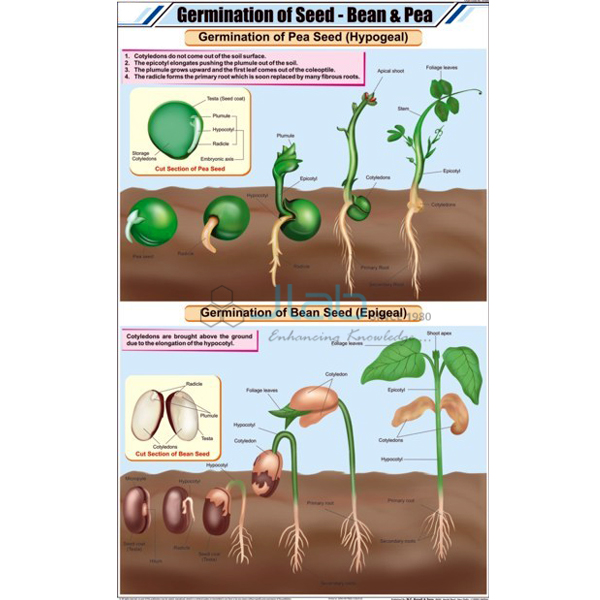
Germination of Seed: Bean & Pea Chart (code EL-BC-9255) is a 58 x 90 cm botany wall chart on how bean and pea seeds germinate — the pair biology teachers use to compare the two ways a seedling can come up through the soil. It is printed in full colour on art paper, laminated on both sides with thick plastic film, fitted with plastic rollers and has English text only. JLab (Jain Laboratory Instruments Pvt Ltd, Ambala, India) supplies it to schools, colleges and dealers.
Specifications
| Parameter | Detail |
|---|---|
| Subject | Germination of bean and pea seeds |
| Chart group | Botany Charts |
| Size | 58 x 90 cm |
| Printing | Full colour on art paper |
| Finish | Laminated on both sides with thick plastic film |
| Rollers | Plastic rollers fitted |
| Language | English only |
| Quality check | Each chart is visually inspected before dispatch |
| Pack quantity | Each (sold individually) |
| Minimum order quantity | 10 units |
| Dispatch time | Usually 7–10 working days |
| Product code | EL-BC-9255 |
| Supplied by | Jain Laboratory Instruments Pvt Ltd (JLab), Ambala, India |
What Is the Bean and Pea Germination Chart Used For?
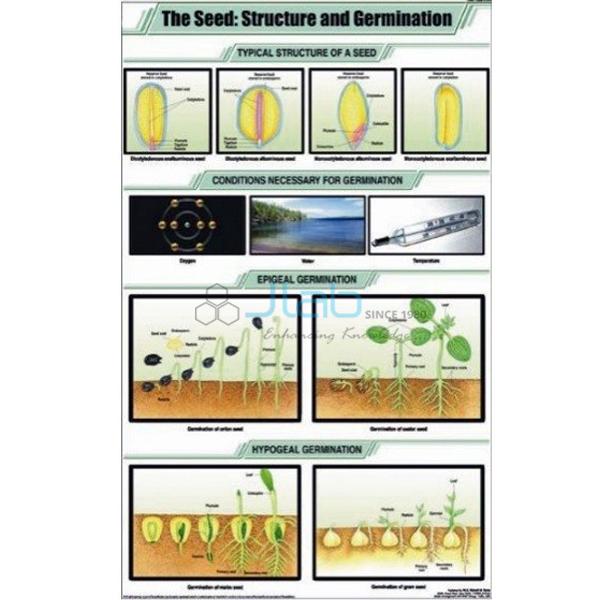
Bean and pea are both dicots with non-albuminous seeds, in which the two cotyledons hold the stored food, yet they germinate differently. In the bean the hypocotyl, the part of the axis below the cotyledons, grows first and arches up through the soil, pulling the cotyledons above ground, where they turn green for a short time before they shrivel: this is epigeal germination. In the pea the epicotyl, above the cotyledons, lengthens instead, so the plumule rises while the cotyledons stay below ground inside the seed coat and pass their food to the seedling: this is hypogeal germination. In both seeds the radicle comes out first and grows down to form the primary root.
The comparison makes a simple practical: students soak bean and pea seeds, sow them in pots or on damp cotton and note what appears each day, using the chart to name the radicle, plumule, hypocotyl, epicotyl and cotyledons. Hang it at eye level near the bench, wipe the laminated face with a damp cloth and roll it up on its rollers for storage.
What to Specify When Ordering
- Number of charts — minimum 10 units; add the seed structure chart for a complete germination lesson.
- Language — English only as listed; check with JLab first if you need another language.
- Delivery — the school address or, for export, the destination country and port or city.
Frequently Asked Questions
Why are bean and pea used to teach germination?
Because together they show both types: the bean shows epigeal germination, with the cotyledons lifted above the soil, and the pea shows hypogeal germination, with the cotyledons left underground.
Which part of the seedling appears first?
The radicle, the embryonic root, normally emerges first and grows downwards; the shoot then develops from the plumule.
What size and finish is the chart?
58 x 90 cm, printed in full colour on art paper, laminated on both sides with thick plastic film and fitted with plastic rollers.
How many charts must I order, and when are they dispatched?
At least 10 units, sold individually. Dispatch is usually within 7–10 working days after each chart has been visually inspected. For export, also send the destination country, the port or city and your delivery terms such as FOB or CIF.
Who supplies the Germination of Seed: Bean & Pea Chart?
JLab, the trading name of Jain Laboratory Instruments Pvt Ltd in Ambala, Haryana, India, which quotes for it directly.
Supplier
JLab is short for Jain Laboratory Instruments Pvt Ltd, a company incorporated in 2017 with its base on Hargolal Road, Ambala, Haryana. It offers its own school laboratory and plant biology lab equipment and also supplies teaching charts such as this germination chart, so schools and dealers can source both from one place. Every chart is looked over before it is packed, and the same team looks after repeat orders. JLab can ship to buyers in any region of the world — Slovakia in Eastern Europe, Latvia in Northern Europe, Botswana in Southern Africa, Egypt in North Africa and Portugal in Southern Europe, for example. Tender enquiries can start from the JLab lab tenders page.
More on Seeds and Seedlings
- The Seed: Structure and Germination Chart — the parts of the seed and germination in general.
- Germination Model — a markable three-dimensional model of monocot and dicot germination.
- Root System Chart — the root system that develops from the radicle.
- Typical Plant Chart — the parts of the grown flowering plant.
- Dispersal of Fruits and Seeds Chart — how seeds travel to the place where they germinate.
See the rest of the Botany Charts series, or every subject in the Charts range.
Request a Quote
JLab quotes for this chart directly. Use the Add To Cart enquiry button, or send the quantity (minimum 10 units) and your delivery location through the contact page; mention any other botany charts you want so they can go on the same quotation.
Last updated: 3 October 2026