Root System Chart Manufacturer,Supplier and Exporter in India
Product Code : EL-BC-9249
Jlab Export is a leading Root System Chart Manufacturer,and suppliers in India
Root System Chart (code EL-BC-9249) is a 58 x 90 cm botany wall chart for teaching how plant root systems are organised, in middle-school science, class 11 plant morphology and college botany. It is printed in full colour on art paper, laminated on both sides with thick plastic film and fitted with plastic rollers, with English text. JLab (Jain Laboratory Instruments Pvt Ltd, Ambala, India) supplies it to schools, colleges and dealers.
Get a quote: use the Add To Cart enquiry button below, or send your quantity and destination through the contact page.
Specifications
| Parameter | Detail |
|---|---|
| Chart topic | Plant root systems |
| Size | 58 x 90 cm (about 22.8 x 35.4 in) |
| Printing | Full colour on art paper |
| Lamination | Both sides, thick plastic film |
| Fittings | Plastic rollers for hanging |
| Language | English only |
| Quality check | Each chart is visually inspected before dispatch |
| Pack quantity | Each (sold individually) |
| Minimum order quantity | 10 units |
| Dispatch time | Usually 7–10 working days |
| Product code | EL-BC-9249 |
| Supplied by | Jain Laboratory Instruments Pvt Ltd (JLab), Ambala, India |
What Is the Root System Chart Used For?
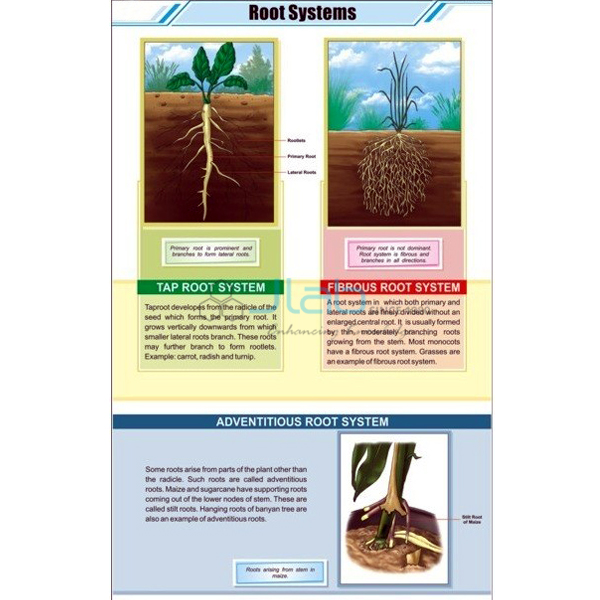
In most dicots the radicle grows into a main or primary root that bears lateral roots of several orders, forming a tap root system, as in mustard and gram; the carrot is a tap root swollen to store food. In monocots such as wheat and rice the primary root is short-lived and is replaced by many roots of similar size growing from the base of the stem, forming a fibrous root system. Roots that grow from any part of the plant other than the radicle are called adventitious roots — the prop roots of the banyan tree and the stilt roots of maize and sugarcane are familiar examples. Roots anchor the plant and absorb water and minerals, and some are modified for storage or extra support. Root systems are taught in middle-school science and in the class 11 chapter on the morphology of flowering plants.
Hang the chart up and let students compare it with real plants they have dug up. The laminated finish can be wiped with a damp cloth, and the chart rolls up on its plastic rollers between lessons.
What to Specify When Ordering
- Quantity — 10 units or more.
- Language — English only, as listed.
- Root series — the regions of root chart, the root section charts and the root teaching item linked below can share one enquiry.
- Delivery — destination city and country.
Frequently Asked Questions
What is the difference between a tap root and a fibrous root system?
A tap root system has one main root, grown from the radicle, with smaller lateral roots branching from it, and is typical of dicots such as mustard. A fibrous root system has many thin roots of similar size arising from the base of the stem and is typical of monocots such as wheat and other grasses.
What are adventitious roots?
Roots that grow from a part of the plant other than the radicle, such as the stem or leaves. Examples include the roots of grass, the hanging prop roots of the banyan tree and the stilt roots at the base of maize and sugarcane stems.
How can students study root systems in practice?
Carefully uproot a mustard or gram seedling and a wheat or grass plant, wash off the soil and compare the two root systems with the chart. Pressed and labelled, the specimens make a good record for a practical file.
Which root types does the artwork show?
The listing does not itemise them; the product photograph on this page shows the chart. Ask JLab to confirm the current print if your lesson depends on a particular example.
What size is the chart, and how is it finished?
58 x 90 cm, about 22.8 x 35.4 inches, printed in full colour on art paper. Both sides are laminated with thick plastic film, and plastic rollers are fitted.
What is the minimum order, and when is it dispatched?
The minimum order is 10 units. Charts are visually inspected and normally dispatched within 7–10 working days, with shipping time added for export destinations.
Who supplies the Root System Chart?
JLab — Jain Laboratory Instruments Pvt Ltd of Ambala, Haryana, India — supplies it and quotes directly.
Supplier
JLab is the trading name of Jain Laboratory Instruments Pvt Ltd, a school science and laboratory equipment company in India, incorporated in 2017 and located on Hargolal Road, Ambala, Haryana. Alongside the equipment it makes itself, JLab supplies printed science charts such as this botany title, so schools, colleges, dealers and importers can cover charts and apparatus in one enquiry; each chart is inspected visually before it ships, and repeat orders are dealt with by the same team. JLab exports worldwide and can supply buyers in every region — for example Turkmenistan in Central Asia, Botswana in Southern Africa, Bahrain in the Middle East, Chile in South America and Germany in Western Europe. Tender information is available on the JLab lab tenders page.
Root Charts and Teaching Items
- Regions of Root Chart — the zones along a growing root tip.
- T.S. Root - Monocot Chart — the inside of a monocot root in transverse section.
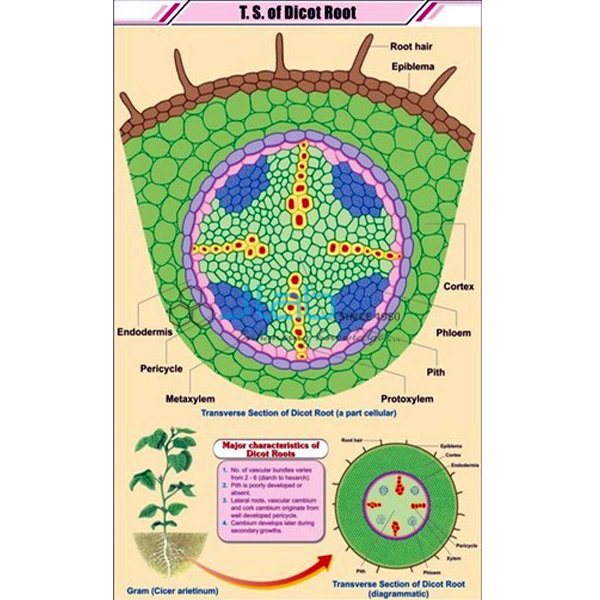
- T.S. of Dicot Root Chart — the inside of a dicot root in transverse section.
- The Root of a Flowering Plant — listed with a buttercup root, root cap, root hairs and the zones of growth, elongation and maturation.
- Typical Plant Chart — where the root system fits in the whole plant.
See every title in the Botany Charts range or browse all Charts.
Request a Quote
JLab quotes directly. Use the Add To Cart enquiry button on this page or the contact page to send the quantity (minimum 10 units), any other root charts, and the delivery destination.
Last updated: 4 October 2026