
Artificial Vegetative Propagation Chart Manufacturer,Supplier and Exporter in India
Product Code : EL-BC-9295
Jlab Export is a leading Artificial Vegetative Propagation Chart Manufacturer,and suppliers in India
Artificial Vegetative Propagation Chart (code EL-BC-9295) is a botany chart on the methods people use to grow new plants from parts of a parent plant rather than from seed, for school biology and horticulture lessons. It is 58 x 90 cm, printed in full colour on art paper, laminated on both sides with thick plastic film and fitted with plastic rollers, in English only. Jain Laboratory Instruments Pvt Ltd (JLab) prints it in Ambala, Haryana, and sells it to schools, colleges and dealers.
Specifications
| Parameter | Detail |
|---|---|
| Chart topic | Artificial vegetative propagation of plants |
| Size | 58 x 90 cm (about 22.8 x 35.4 in) |
| Printing | Full colour on art paper |
| Lamination | Both sides, thick plastic film |
| Fittings | Plastic rollers |
| Language | English only |
| Quality check | Each chart is visually inspected before dispatch |
| Pack quantity | Each (sold individually) |
| Minimum order quantity | 10 units |
| Dispatch time | Usually 7–10 working days |
| Product code | EL-BC-9295 |
| Manufacturer | Jain Laboratory Instruments Pvt Ltd (JLab) — OEM |
| Country of origin | India (made in Ambala, Haryana) |
What Is the Artificial Vegetative Propagation Chart Used For?
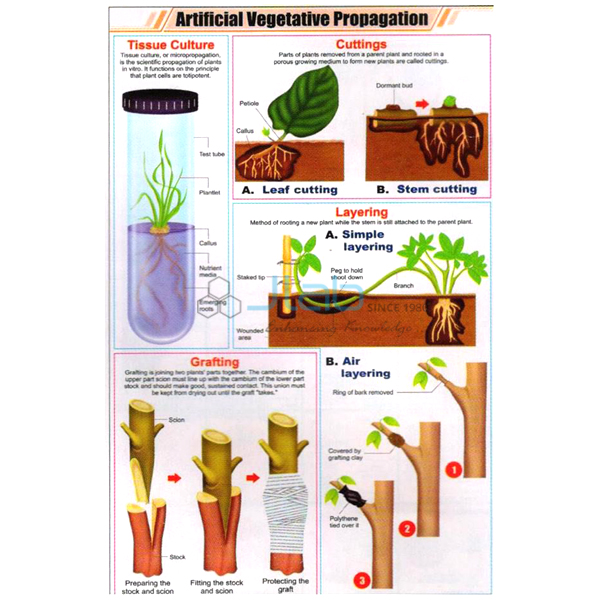
Vegetative propagation produces a new plant from a root, stem or leaf instead of a seed. Some plants do this naturally — potato tubers, onion bulbs and the leaf buds of Bryophyllum are the usual examples — while gardeners and farmers use artificial methods. In cutting, a piece of stem is planted to grow roots, as with rose, sugarcane and money plant. In layering, a branch is made to root while still attached to the parent; air layering is used for litchi and guava. In grafting, a shoot (the scion) of a chosen variety is joined to a rooted plant (the stock) so that the two grow as one, which is common for mango and citrus. Tissue culture now raises many plants from a few cells. These methods appear in the class 10 chapter on how organisms reproduce and in horticulture and agriculture courses.
The methods are easier to remember when students try them, so the chart can be paired with a practical in which they plant stem cuttings or a simple layer and record root growth. The laminated chart wipes clean and rolls up on its rollers for storage. Which methods the artwork shows is not stated in the listing; ask JLab for a larger image to check that it covers the ones in your syllabus.
What to Specify When Ordering
- Quantity — the minimum order is 10 units.
- Language — English only; ask JLab before ordering if you need another language.
- Related charts — the reproduction in plants and stem modification charts below fit the same unit of work.
- Delivery — city and country or port of delivery, and any labelling needed for the consignment.
Frequently Asked Questions
What is the Artificial Vegetative Propagation Chart used for?
It is used to teach how plants are multiplied from cuttings, layers, grafts and similar methods, in class 10 biology, horticulture and agriculture lessons. The listing does not describe the artwork; see the photograph on this page or ask JLab for a larger image.
What are the dimensions and finish?
The chart measures 58 x 90 cm (about 22.8 x 35.4 in). It is printed in full colour on art paper, laminated on both sides with thick plastic film and has plastic rollers.
Why do growers propagate plants vegetatively?
Plants raised this way are genetically the same as the parent, so a good variety keeps its fruit quality, colour or yield. The method also works for plants that set few or no viable seeds, such as banana, and grafted fruit trees usually bear fruit sooner than seedlings.
What is the difference between grafting and layering?
In layering the new plant forms its own roots while still attached to the parent and is cut free later. In grafting nothing roots: a scion of one plant is joined onto the rooted stock of another, and their tissues grow together.
Who makes this chart?
JLab makes it in Ambala, Haryana. JLab is the trading name of Jain Laboratory Instruments Pvt Ltd, and it quotes directly to schools, colleges and dealers.
OEM Manufacturer
JLab is the trading name used by Jain Laboratory Instruments Pvt Ltd, incorporated in 2017 and based on Hargolal Road in Ambala, Haryana. In addition to its own lab equipment, JLab prints educational charts such as this title in Ambala for schools, colleges, dealers and importers; staff look over each chart before it is packed, and repeat orders are handled by the same company. JLab exports worldwide and ships to buyers in every region — examples include Kyrgyzstan in Central Asia, Fiji in Oceania, Estonia in Northern Europe, Ethiopia in East Africa and North Macedonia in Southern Europe. See the JLab lab tenders page for tender purchases.
Related Plant Reproduction Charts
- Reproduction in Plants Chart — the wider topic of sexual and asexual reproduction in plants.
- Stem Modification Chart — tubers, rhizomes, bulbs and runners, the stems behind natural vegetative propagation.
- Root Modifications Chart — modified roots, including storage roots that can give rise to new plants.
- Leaf Modification Chart — modified leaves, a related plant morphology topic.
Browse all titles in the Botany Charts range or the complete Charts range.
Request a Quote
JLab quotes directly. Use the Add To Cart enquiry button on this page, or send your quantity (minimum 10 units), any other plant reproduction charts, and the delivery city and country through the contact page.
Last updated: 25 October 2026