Life Cycle of a Mushroom Chart Manufacturer,Supplier and Exporter in India
Product Code : EL-BC-9286
Jlab Export is a leading Life Cycle of a Mushroom Chart Manufacturer,and suppliers in India
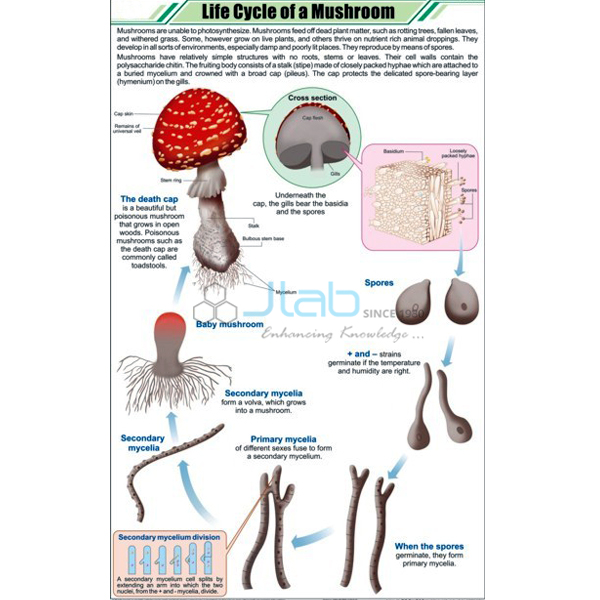
Life Cycle of a Mushroom Chart (code EL-BC-9286) is a fungi wall chart that follows a mushroom from spore to fruiting body, for biology lessons in schools and colleges. It is 58 x 90 cm, printed in full colour on art paper, laminated on both sides with thick plastic film and fitted with plastic rollers; the text is English only. JLab (Jain Laboratory Instruments Pvt Ltd, Ambala, India) supplies it to schools, colleges and dealers.
Specifications
| Parameter | Detail |
|---|---|
| Chart topic | Life cycle of a mushroom |
| Size | 58 x 90 cm (about 22.8 x 35.4 in) |
| Printing | Full colour on art paper |
| Lamination | Both sides, thick plastic film |
| Fittings | Plastic rollers |
| Language | English only |
| Quality check | Each chart is visually inspected before dispatch |
| Pack quantity | Each (sold individually) |
| Minimum order quantity | 10 units |
| Dispatch time | Usually 7–10 working days |
| Product code | EL-BC-9286 |
| Supplied by | Jain Laboratory Instruments Pvt Ltd (JLab), Ambala, India |
What Is the Mushroom Life Cycle Chart Used For?
A mushroom is only the visible fruiting body of a fungus. Most of the organism is a mycelium — a mass of fine threads called hyphae — spreading through soil, compost or rotting wood and absorbing food from dead organic matter. Under the cap, the gills are lined with club-shaped basidia that produce basidiospores. A spore germinates into a primary mycelium; when hyphae of two compatible strains fuse, they form a secondary mycelium whose cells carry two nuclei, and this mycelium eventually pushes up a new mushroom with its stalk and cap. The common mushroom Agaricus is the class 11 example of the basidiomycetes in the chapter on biological classification, and the same life cycle is taught in college mycology.
Display the chart during the fungi lessons, and if possible let students examine the gills of a shop-bought mushroom with a hand lens to see where the spores form. Remind them never to eat wild mushrooms, as some are poisonous and hard to tell apart. The laminated chart can be wiped clean and rolled away on its rollers. The listing does not describe the artwork stage by stage; ask JLab for a larger image if you need to check it.
What to Specify When Ordering
- Quantity — a minimum of 10 units.
- Language — supplied in English only, as listed.
- Other fungi charts — the Mucor and fungi charts below complete the topic and can go in the same enquiry.
- Delivery location — city and country or port, and the delivery terms you need for export.
Frequently Asked Questions
What does the Life Cycle of a Mushroom Chart teach?
It teaches how a mushroom-forming fungus grows from a spore through its mycelium to the fruiting body and back to spores, for school biology and college botany. The listing does not detail the artwork; see the photograph on this page or ask JLab for a larger image.
What are the chart’s size and materials?
It is 58 x 90 cm (about 22.8 x 35.4 in), printed in full colour on art paper and laminated on both sides with thick plastic film, with plastic rollers for hanging.
Is a mushroom a plant?
No. Mushrooms belong to the kingdom Fungi. They have no chlorophyll and cannot make their own food, so they absorb nutrients from dead organic matter, and their cell walls contain chitin rather than cellulose.
Where are the spores of a mushroom produced?
On the gills under the cap. Each gill is lined with basidia, and each basidium usually bears four basidiospores, which are released and carried away by air currents.
Who supplies this chart?
JLab (Jain Laboratory Instruments Pvt Ltd) in Ambala, Haryana, India supplies it and gives quotations directly.
Supplier
The chart is supplied by JLab, the trading name of Jain Laboratory Instruments Pvt Ltd, incorporated in 2017 and located on Hargolal Road, Ambala, Haryana. JLab offers biology charts like this one to schools, colleges, dealers and importers next to its own laboratory equipment, checks each chart visually before dispatch, and keeps repeat orders in the same hands. The company exports worldwide and ships to buyers in every region — for example Kuwait in the Middle East, Togo in West Africa, Hungary in Eastern Europe, DR Congo in Central Africa and Tajikistan in Central Asia. Information for tender buyers is on the JLab lab tenders page.
Fungi Charts and Related Titles
- Mucor Chart — a chart from the same series on Mucor, the pin mould, another fungus taught in class 11.
- Fungi Chart — an overview chart of the fungi group from the same series.
- Plant Diseases Chart — for the lesson on crop diseases, many of which are caused by fungi.
- Life Cycle of Fern Chart — a spore-based plant life cycle for comparison.
Explore the full Botany Charts range or all Charts.
Request a Quote
Get a quotation from JLab by using the Add To Cart enquiry button on this page or the contact page. Send the quantity (minimum 10 units), any other fungi charts you want, and your delivery city and country.
Last updated: 3 October 2026