
Insectivorous Plants Chart Manufacturer,Supplier and Exporter in India
Product Code : EL-BC-9269
Jlab Export is a leading Insectivorous Plants Chart Manufacturer,and suppliers in India
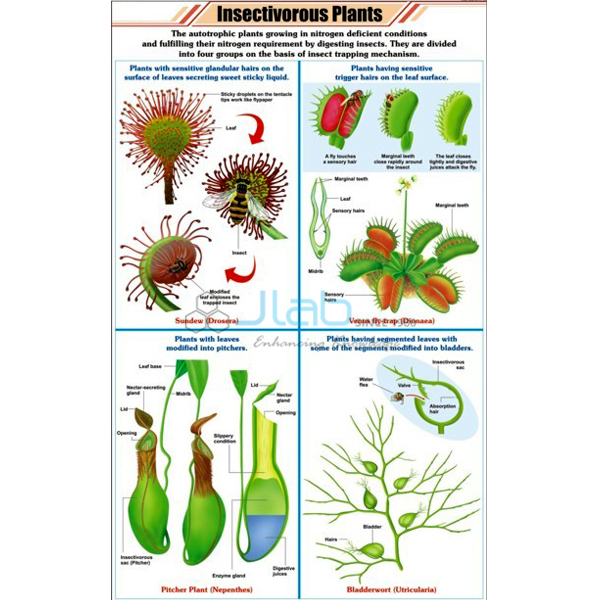
Insectivorous Plants Chart (code EL-BC-9269) is a 58 x 90 cm botany wall chart on insectivorous plants — green plants that trap and digest insects to make up for poor soil — for school and college lessons on the modes of nutrition in plants. It is printed in full colour on art paper, laminated on both sides with thick plastic film, fitted with plastic rollers and in English only. JLab (Jain Laboratory Instruments Pvt Ltd, Ambala, India) supplies it to schools, colleges and dealers.
Specifications
| Parameter | Detail |
|---|---|
| Subject | Insectivorous plants |
| Chart group | Botany Charts |
| Size | 58 x 90 cm |
| Printing | Full colour on art paper |
| Finish | Laminated on both sides with thick plastic film |
| Rollers | Plastic rollers fitted |
| Language | English only |
| Quality check | Each chart is visually inspected before dispatch |
| Pack quantity | Each (sold individually) |
| Minimum order quantity | 10 units |
| Dispatch time | Usually 7–10 working days |
| Product code | EL-BC-9269 |
| Supplied by | Jain Laboratory Instruments Pvt Ltd (JLab), Ambala, India |
What Is the Insectivorous Plants Chart Used For?
Insectivorous, or carnivorous, plants usually grow in bogs and other places where the soil is poor in nitrogen. They still make their own food by photosynthesis, but they catch insects and other small animals and digest them with enzymes to obtain extra nitrogen and minerals, using leaves that are modified into traps. In the pitcher plant (Nepenthes) part of the leaf forms a pitcher with a lid, and insects that slip inside drown in the digestive fluid at the bottom. The sundew (Drosera) has leaves covered with glandular hairs tipped with sticky drops that hold the insect while the leaf curls over it. The Venus flytrap (Dionaea) has a hinged two-lobed leaf that snaps shut when the trigger hairs inside are touched, and the bladderwort (Utricularia), mostly an aquatic plant, sucks small animals into tiny bladders.
These plants are a favourite example in lessons on the modes of nutrition in plants — autotrophic, parasitic, saprophytic and insectivorous — and the pitcher plant is a common textbook example. The chart can hang beside the parasitic plants chart from the same series for that lesson. Clean the laminated face with a damp cloth and store the chart rolled.
What to Specify When Ordering
- Quantity — minimum 10 units; the parasitic plants chart covers the other special mode of nutrition.
- Language — English only as listed; ask before ordering for any other language.
- Photo of the print — ask for one to see which plants are drawn.
Frequently Asked Questions
Why do insectivorous plants trap insects?
To obtain nitrogen and other minerals that are scarce in the boggy or poor soils where they grow. They still make their own food by photosynthesis.
What are common examples of insectivorous plants?
The pitcher plant (Nepenthes), sundew (Drosera), Venus flytrap (Dionaea) and bladderwort (Utricularia).
Which part of the pitcher plant forms the pitcher?
The leaf. Part of the leaf is modified into the pitcher, and its tip forms the lid over the opening.
Who supplies the Insectivorous Plants Chart?
JLab — Jain Laboratory Instruments Pvt Ltd, Ambala, Haryana, India — supplies it and quotes directly.
Supplier
JLab is the trading name of Jain Laboratory Instruments Pvt Ltd, incorporated in 2017 and based on Hargolal Road in Ambala, Haryana. The company combines its own range of laboratory equipment for schools and colleges with teaching charts like this one, which makes it simple for a science department or a dealer to order both. Every chart is looked over before packing, and the same team handles repeat business. JLab exports to all parts of the world: Guyana in South America, Lesotho in Southern Africa, the Czech Republic in Eastern Europe, Finland in Northern Europe and Yemen in the Middle East are examples. The JLab lab tenders page has tender details.
Charts on Plant Nutrition and Leaves
- Parasitic Plants Chart — another special mode of nutrition in plants.
- Leaf Modification Chart — on leaves modified for other functions.
- Photosynthesis Chart — how green plants, insectivorous ones included, make their food.
- Hydrophytes Chart — water plants and their adaptations.
See the full Botany Charts series or the complete Charts range.
Request a Quote
Quotations come straight from JLab. Use the Add To Cart enquiry button, or send the quantity (minimum 10 units), the other plant nutrition charts you need and the delivery location through the contact page.
Last updated: 3 October 2026