
Pollination Chart Manufacturer,Supplier and Exporter in India
Product Code : EL-BC-9261
Jlab Export is a leading Pollination Chart Manufacturer,and suppliers in India
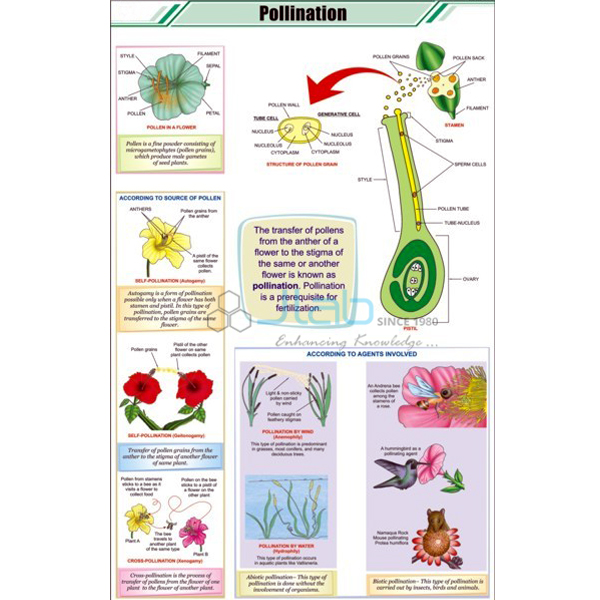
Pollination Chart (code EL-BC-9261) is a 58 x 90 cm botany wall chart for lessons on how pollen travels from the anther to the stigma in flowering plants, used in school biology and college botany classes. It is printed in full colour on art paper, laminated on both sides with thick plastic film, fitted with plastic rollers and in English only. JLab (Jain Laboratory Instruments Pvt Ltd) makes the chart at its works in Ambala, India, for schools, colleges and dealers.
Specifications
| Parameter | Detail |
|---|---|
| Subject | Pollination in flowering plants |
| Chart group | Botany Charts |
| Size | 58 x 90 cm |
| Printing | Full colour on art paper |
| Finish | Laminated on both sides with thick plastic film |
| Rollers | Plastic rollers fitted |
| Language | English only |
| Quality check | Each chart is visually inspected before dispatch |
| Pack quantity | Each (sold individually) |
| Minimum order quantity | 10 units |
| Dispatch time | Usually 7–10 working days |
| Product code | EL-BC-9261 |
| Manufacturer | Jain Laboratory Instruments Pvt Ltd (JLab) — OEM |
| Country of origin | India (made in Ambala, Haryana) |
What Is the Pollination Chart Used For?
Pollination is the transfer of pollen grains from the anther to the stigma of a flower. In self-pollination the pollen lands on the stigma of the same flower (autogamy) or of another flower on the same plant (geitonogamy); in cross-pollination, or xenogamy, it reaches a flower on a different plant of the same species, which brings in new genetic combinations. Pollen is carried by abiotic agents — wind, as in grasses and maize, and in a few plants water, as in Vallisneria — or by biotic agents such as insects, birds and bats. Flowers show matching adaptations: wind-pollinated flowers are small, without scent or nectar, and release plenty of light, dry pollen, often with feathery stigmas, while insect-pollinated flowers are usually large or brightly coloured, scented and rich in nectar, with sticky pollen.
Pollination is part of school science on plant reproduction and is studied in depth in the class 12 biology chapter on sexual reproduction in flowering plants. Students can examine fresh flowers with a hand lens beside the chart, dust some pollen onto a slide, and compare a grass flower with a showy insect-pollinated one. The laminated surface can be wiped clean, and the chart rolls up on its plastic rollers.
What to Specify When Ordering
- Charts needed — minimum 10 units; the flower structure and double fertilization charts complete the sequence.
- Language — English only as listed; ask before ordering for any other language.
- Content check — ask for a photo of the current print to see which flowers and pollinators are shown.
Frequently Asked Questions
What is the difference between self-pollination and cross-pollination?
In self-pollination the pollen reaches the stigma of the same flower or of another flower on the same plant; in cross-pollination it comes from a different plant of the same species, which increases genetic variation.
Which agents carry pollen?
Wind and water are the abiotic agents; insects, birds, bats and some other animals are the biotic ones. Most flowering plants rely on animals, especially insects.
How big is the chart?
It is 58 x 90 cm, printed in full colour on art paper, laminated on both sides with thick plastic film and fitted with plastic rollers.
Who makes the Pollination Chart?
JLab (Jain Laboratory Instruments Pvt Ltd) makes it in Ambala, Haryana, India, and quotes directly to schools, colleges and dealers.
OEM Manufacturer
The chart is made by JLab, the trading name of Jain Laboratory Instruments Pvt Ltd, which was incorporated in 2017 and is located on Hargolal Road, Ambala, Haryana. JLab makes laboratory equipment for schools, colleges and training institutes and prints charts such as this one in Ambala, so buyers can complete a biology room from one source. Each chart is checked visually before it is packed, and the same team takes care of repeat orders. Shipments can go to any region; Mexico in North America, Uzbekistan in Central Asia, Denmark in Northern Europe, Madagascar in East Africa and Nepal in South Asia are a few examples. Tender buyers will find details on the JLab lab tenders page.
Charts and Models on Flowers and Pollination
- Structure of Flower Chart — the parts of the flower that take part in pollination.
- Calyx and Corolla Chart — on the calyx and corolla, the outer whorls of the flower.
- Inflorescences Chart — how flowers are arranged on the plant.
- Double Fertilization Chart — what happens after the pollen reaches the stigma.
- Typical Flower Model — a large flower model with all parts detachable.
Find the other titles in Botany Charts, or browse all Charts.
Request a Quote
Quotations come directly from JLab. Click the Add To Cart enquiry button, or use the contact page to send the quantity (minimum 10 units), the other flower charts you would like and the delivery address or port.
Last updated: 25 October 2026