Structure of Flower Chart Manufacturer,Supplier and Exporter in India
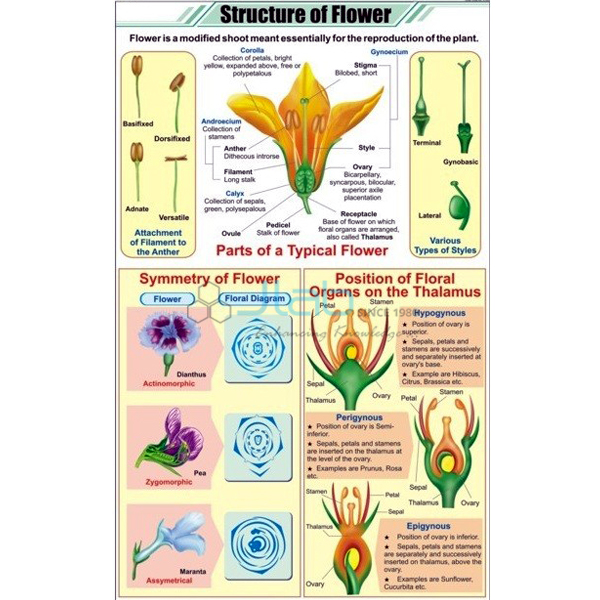
Product Code : EL-BC-9252
Jlab Export is a leading Structure of Flower Chart Manufacturer,and suppliers in India
Structure of Flower Chart (code EL-BC-9252) is a 58 x 90 cm botany wall chart for teaching the parts of a flower and how they are arranged, in class 11 and class 12 biology and in college botany. It is printed in full colour on art paper, laminated on both sides with thick plastic film and fitted with plastic rollers, with English text. JLab (Jain Laboratory Instruments Pvt Ltd, Ambala, India) supplies it to schools, colleges and dealers.
Get a quote: use the Add To Cart enquiry button below, or send your quantity and destination through the contact page.
Specifications
| Parameter | Detail |
|---|---|
| Chart topic | Structure of a flower |
| Size | 58 x 90 cm (about 22.8 x 35.4 in) |
| Printing | Full colour on art paper |
| Lamination | Both sides, thick plastic film |
| Fittings | Plastic rollers for hanging |
| Language | English only |
| Quality check | Each chart is visually inspected before dispatch |
| Pack quantity | Each (sold individually) |
| Minimum order quantity | 10 units |
| Dispatch time | Usually 7–10 working days |
| Product code | EL-BC-9252 |
| Supplied by | Jain Laboratory Instruments Pvt Ltd (JLab), Ambala, India |
What Is the Structure of Flower Chart Used For?
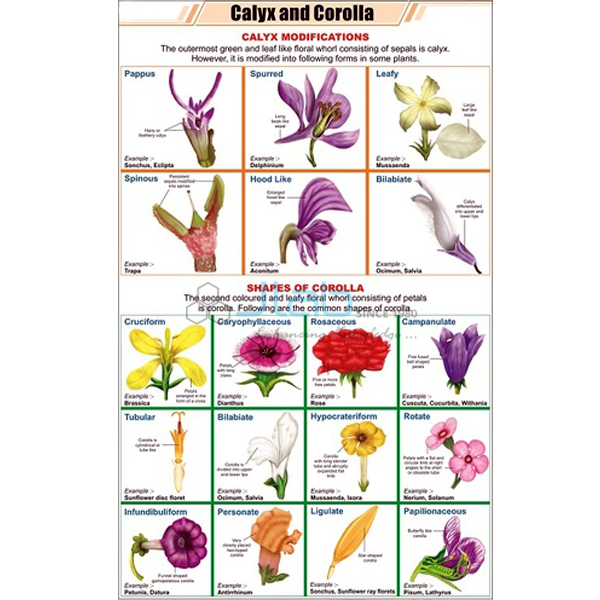
A typical flower is borne on a stalk, the pedicel, whose swollen tip — the thalamus or receptacle — carries four whorls: the calyx of sepals, the corolla of petals, the androecium of stamens, each made of a filament and an anther, and the gynoecium of one or more carpels, each with a stigma, style and ovary. Flowers are also described by their symmetry (actinomorphic, zygomorphic or asymmetric) and by the position of the ovary: hypogynous with a superior ovary, as in mustard and china rose; perigynous, as in plum and rose; and epigynous with an inferior ovary, as in guava, cucumber and the ray florets of sunflower. These terms are taught in the class 11 chapter on the morphology of flowering plants, and the stamen and pistil lead on to class 12 lessons on sexual reproduction and pollination.
The chart is most useful next to a real flower: give each group a china rose or mustard flower to take apart whorl by whorl and match to the drawing. The laminated faces wipe clean with a damp cloth, and the chart rolls up on its rollers for storage.
What to Specify When Ordering
- Quantity — the minimum order is 10 units.
- Language — listed in English only.
- Flower models and charts — the flower models and the pollination, double fertilization and inflorescence charts linked below can be quoted together.
- Delivery — destination country and city or port; for exports, your preferred delivery terms.
Frequently Asked Questions
What are the essential parts of a flower?
The androecium (stamens) and gynoecium (carpels) are the essential or reproductive whorls, because they produce pollen and ovules. The calyx and corolla are accessory whorls that protect the bud and, in many flowers, attract pollinators.
What is the difference between hypogynous and epigynous flowers?
In a hypogynous flower the ovary sits on top of the thalamus, above the other parts, and is called superior, as in mustard. In an epigynous flower the thalamus grows up around the ovary and the other parts arise above it, so the ovary is inferior, as in guava and cucumber.
Which classes use a flower structure chart?
Middle-school science introduces the parts of a flower, class 11 biology covers floral morphology in detail, and class 12 builds on the stamen and pistil in the chapter on sexual reproduction in flowering plants. College botany uses the same terms for floral descriptions.
What are the size and finish of the chart?
58 x 90 cm (about 22.8 x 35.4 in), printed in full colour on art paper, laminated on both sides with thick plastic film and fitted with plastic rollers for hanging.
What should an export enquiry include?
The quantity (minimum 10 units), destination country and port or city, delivery terms such as FOB or CIF, any packing or labelling needs, and a tender reference if applicable. Each chart is visually inspected, and dispatch is usually within 7–10 working days.
Who supplies the Structure of Flower Chart?
JLab, which is Jain Laboratory Instruments Pvt Ltd of Ambala, Haryana, India, supplies the chart and quotes directly.
Supplier
JLab is the trading name of Jain Laboratory Instruments Pvt Ltd, a laboratory equipment and educational aids company in India, incorporated in 2017 and based on Hargolal Road, Ambala, Haryana. Next to the lab equipment it makes itself, JLab supplies printed botany charts such as this one, so schools, colleges, dealers and importers can order charts and flower models together; each chart receives a visual inspection before dispatch, and repeat orders are handled by the same team. Its corporate identity number is CIN U29309HR2017PTC069123, and it is registered for GST under GSTIN 06AADCJ9848D1ZE. JLab exports worldwide and can ship to buyers in every region — for example Mozambique in East Africa, Bhutan in South Asia, Sudan in North Africa, Gabon in Central Africa and Germany in Western Europe. Tender buyers can refer to the JLab lab tenders page.
Flower Charts and Models
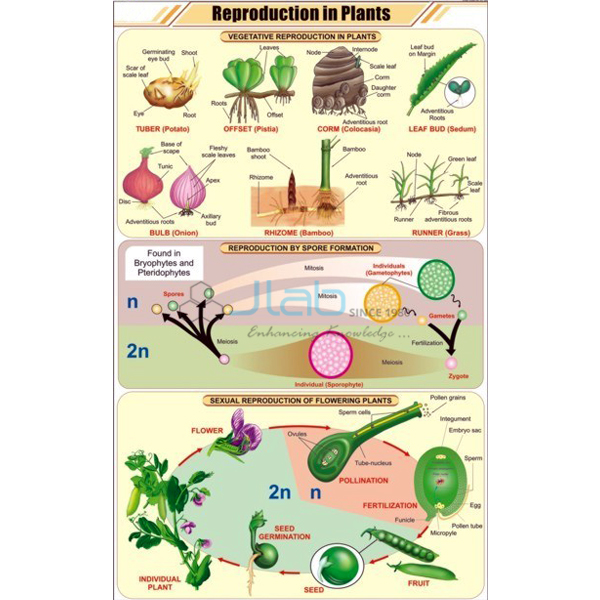
- Pollination Chart — what happens to the pollen made in the anthers.
- Double Fertilization Chart — fertilisation inside the ovary after pollination.
- Inflorescences Chart — how flowers are arranged on the plant.
- Typical Flower L.S. Model — a model of a typical flower in longitudinal section.
- Typical Flower Model — a large model with all parts detachable and a single ovule inside the ovary.
See every title in the Botany Charts range or browse all Charts.
Request a Quote
Quotes come directly from JLab. Use the Add To Cart enquiry button on this page or the contact page, and send the number of charts (minimum 10 units), any flower models or companion charts, and the delivery destination.
Last updated: 4 October 2026