Plant Tissues Chart Manufacturer,Supplier and Exporter in India
Product Code : EL-BC-9233
Jlab Export is a leading Plant Tissues Chart Manufacturer,and suppliers in India
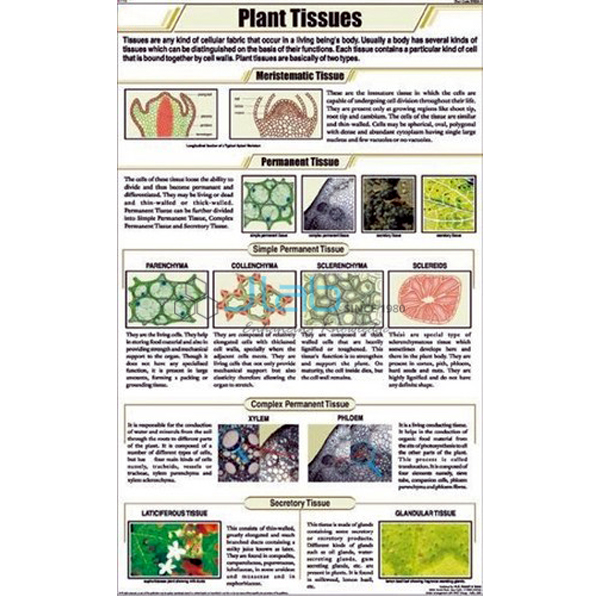
Plant Tissues Chart (code EL-BC-9233) is a 58 x 90 cm plant anatomy wall chart on the tissues that make up a plant, from dividing meristems to xylem and phloem, for class 9 and class 11 biology and college botany. It is printed in full colour on art paper, laminated on both sides with thick plastic film and fitted with plastic rollers; the text is in English. JLab (Jain Laboratory Instruments Pvt Ltd, Ambala, India) supplies it to schools, colleges and dealers.
Get a quote: use the Add To Cart enquiry button below, or send your quantity and destination through the contact page.
Specifications
| Parameter | Detail |
|---|---|
| Chart topic | Plant tissues |
| Size | 58 x 90 cm (about 22.8 x 35.4 in) |
| Printing | Full colour on art paper |
| Lamination | Both sides, thick plastic film |
| Fittings | Plastic rollers for hanging |
| Language | English only |
| Quality check | Each chart is visually inspected before dispatch |
| Pack quantity | Each (sold individually) |
| Minimum order quantity | 10 units |
| Dispatch time | Usually 7–10 working days |
| Product code | EL-BC-9233 |
| Supplied by | Jain Laboratory Instruments Pvt Ltd (JLab), Ambala, India |
What Is the Plant Tissues Chart Used For?
Plant tissues fall into two groups. Meristematic tissues have small, actively dividing cells and occur at the tips of roots and shoots (apical meristems), between mature tissues such as at the bases of internodes in grasses (intercalary meristems), and in the cambium (lateral meristems). Permanent tissues are made of cells that have stopped dividing: the simple tissues — parenchyma, collenchyma and sclerenchyma — each consist of one kind of cell, while the complex tissues xylem and phloem contain several kinds of cell and carry water and food through the plant. Students meet the topic in the class 9 chapter on tissues and again in class 11 plant anatomy, where they pick out the tissues in sections of roots, stems and leaves.
The chart is most useful just before students examine stained sections under the microscope, so that they know what each tissue should look like. Hang it by its rollers; the laminated faces wipe clean with a damp cloth, and the chart rolls up for storage.
What to Specify When Ordering
- Quantity — the minimum order is 10 units.
- Language — English only, as listed.
- Section charts and slides — the T.S. stem charts and the chlorenchyma slide linked below show the tissues in place and can be quoted with this chart.
Frequently Asked Questions
What is the difference between meristematic and permanent tissue?
Meristematic tissue is made of small, thin-walled cells that keep dividing and add new cells to the plant. Permanent tissue forms when those cells stop dividing and take on a particular shape and job, such as storage, support or conduction.
How do collenchyma and sclerenchyma differ?
Collenchyma is a living tissue whose cell walls are thickened at the corners with cellulose and pectin, giving flexible support to young stems and leaf stalks. Sclerenchyma cells usually die at maturity and have thick, lignified walls; as fibres and sclereids they give rigid support.
Why are xylem and phloem called complex tissues?
Each contains more than one kind of cell working together. Xylem, made of tracheids, vessels, fibres and parenchyma, carries water and minerals up from the roots; phloem, made of sieve tubes, companion cells, phloem parenchyma and fibres, carries the food made in the leaves.
What size is the Plant Tissues Chart?
58 x 90 cm (about 22.8 x 35.4 in), printed in full colour on art paper, laminated on both sides and fitted with plastic rollers.
What is the minimum order and usual dispatch time?
At least 10 units. Every chart is inspected by eye before packing and is usually dispatched in 7–10 working days, with transit time on export orders depending on the destination.
Who supplies this chart?
Jain Laboratory Instruments Pvt Ltd, which trades as JLab from Ambala, Haryana, India, supplies it and answers enquiries directly.
Supplier
JLab, the trading name of Jain Laboratory Instruments Pvt Ltd, is a biology teaching aids and laboratory equipment company in India, incorporated in 2017 and based on Hargolal Road, Ambala, Haryana. Besides its own lab equipment, JLab supplies printed anatomy charts such as this one, so schools, colleges, dealers and importers can source charts and apparatus from one place; each chart is visually inspected before dispatch, and repeat orders go through the same team. JLab exports worldwide and can supply buyers in every region — Greece in Southern Europe, Estonia in Northern Europe, Trinidad and Tobago in Central America and the Caribbean, Belgium in Western Europe and Madagascar in East Africa, for example. Tender buyers will find details on the JLab lab tenders page.
Plant Anatomy Charts and Slides
- T.S. Dicot Stem Chart — plant tissues in place in a dicot stem section.
- T.S. Stem - Monocot Chart — the same idea for a monocot stem.
- Animal Tissues Chart — for comparing plant tissues with animal tissues.
- Tissue Chlorenchyma Prepared Slide — a prepared slide of chlorenchyma, parenchyma that contains chloroplasts.
- Typical Plant Cell Chart — the single cell from which every tissue is built.
See every title in the Botany Charts range or browse all Charts.
Request a Quote
JLab quotes directly. Click the Add To Cart enquiry button on this page or use the contact page to send the quantity (minimum 10 units), any other anatomy charts or slides, and the delivery destination.
Last updated: 4 October 2026