Typical Plant Cell Chart Manufacturer,Supplier and Exporter in India
Product Code : EL-BC-9230
Jlab Export is a leading Typical Plant Cell Chart Manufacturer,and suppliers in India
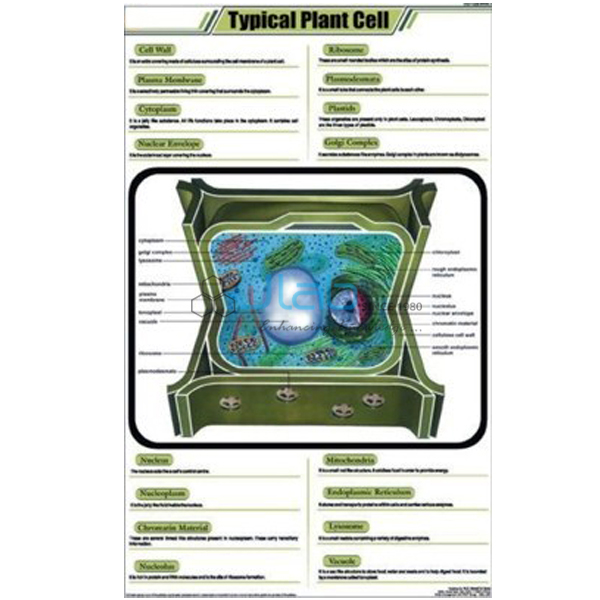
Typical Plant Cell Chart (code EL-BC-9230) is a 58 x 90 cm wall chart on the structure of a plant cell, used in school science and college cell biology lessons before students look at plant cells under the microscope. It is printed in full colour on art paper, laminated on both sides with thick plastic film and fitted with plastic rollers, with English text. JLab (Jain Laboratory Instruments Pvt Ltd, Ambala, India) supplies it to schools, colleges and dealers.
Specifications
| Parameter | Detail |
|---|---|
| Chart topic | Structure of a typical plant cell |
| Size | 58 x 90 cm (about 22.8 x 35.4 in) |
| Printing | Full colour on art paper |
| Lamination | Both sides, thick plastic film |
| Fittings | Plastic rollers |
| Language | English only |
| Quality check | Each chart is visually inspected before dispatch |
| Pack quantity | Each (sold individually) |
| Minimum order quantity | 10 units |
| Dispatch time | Usually 7–10 working days |
| Product code | EL-BC-9230 |
| Supplied by | Jain Laboratory Instruments Pvt Ltd (JLab), Ambala, India |
What Is the Typical Plant Cell Chart Used For?
A plant cell is enclosed by a rigid cell wall, made mainly of cellulose, which lies outside the plasma membrane. Inside are the nucleus, mitochondria, endoplasmic reticulum, Golgi apparatus, ribosomes and plastids such as chloroplasts, together with a large central vacuole bounded by the tonoplast, and neighbouring cells are linked through their walls by plasmodesmata. The cell wall, the plastids and the large central vacuole are the features students use to tell a plant cell from an animal cell — a comparison that recurs throughout school biology, from class 9 science to the class 11 chapter on the cell.
The chart works well next to a microscope practical: stained onion peel shows the cell wall and nucleus clearly, and a moss leaf shows chloroplasts. A three-dimensional plant cell model adds depth if you have one. Wipe the laminated surface with a damp cloth and store the chart rolled up on its rollers.
What to Specify When Ordering
- Quantity — 10 units is the minimum order.
- Language — the listing offers English only.
- Matching teaching aids — the organelles chart, plant cell model and prepared slide linked below can be quoted on the same enquiry.
- Destination — the city and country, or port, for delivery.
Frequently Asked Questions
Which classes use a plant cell chart?
Plant cell structure is taught in class 9 science, in the chapter on the fundamental unit of life, and in more detail in the class 11 biology chapter on the cell. College cell biology and botany courses also use it for revision before microscope work.
How does a plant cell differ from an animal cell?
A plant cell has a cellulose cell wall, plastids such as chloroplasts, and usually one large central vacuole. An animal cell has no cell wall or plastids, its vacuoles are small, and it has centrioles, which most plant cells lack.
How is this different from the Plant Cell Organelles Chart?
The titles show the difference: this chart covers the plant cell as a whole, while the organelles chart deals with the structures inside it. Both are listed at 58 x 90 cm with lamination on both sides and plastic rollers, so they hang well side by side.
What size and finish is the chart?
58 x 90 cm (about 22.8 x 35.4 in), printed in full colour on art paper, laminated on both sides with thick plastic film and fitted with plastic rollers. The text is in English.
How many must I order, and when will it ship?
At least 10 units. Each chart is visually inspected before packing and orders are usually dispatched in 7–10 working days; delivery time after dispatch depends on the destination and how the order is shipped.
Who supplies the Typical Plant Cell Chart?
Jain Laboratory Instruments Pvt Ltd (JLab) in Ambala, Haryana, India supplies it and handles quotations and repeat orders.
Supplier
JLab is the trading name of Jain Laboratory Instruments Pvt Ltd, a school and college laboratory equipment company incorporated in 2017 and located on Hargolal Road, Ambala, Haryana, India. It supplies printed teaching charts such as this cell biology chart alongside the lab equipment it produces itself, which lets schools, colleges, distributors and importers buy charts, models and slides from one source; each piece is visually inspected before dispatch, and repeat supplies are handled by the same team. JLab exports worldwide and is able to ship to every region — for instance Lesotho in Southern Africa, Nepal in South Asia, Singapore in Southeast Asia, Canada in North America and Mauritius in East Africa. Tender buyers can refer to the JLab lab tenders page.
Plant Cell Teaching Aids
- Plant Cell Organelles Chart — a companion chart on the structures inside the cell.
- Typical Plant Cell on Plastic Base Model — a plant cell model based on the electron-microscope view, with part of the wall removed to show plastids, vacuoles, the nucleus and mitochondria.
- Plant Cell Prepared Slide — a prepared microscope slide of plant cells.
- Plant Cell Mitosis Chart — on how the plant cell divides.
- Plant Tissues Chart — on how plant cells are organised into tissues.
See every title in the Botany Charts range or browse all Charts.
Request a Quote
Quotations come directly from JLab. Use the Add To Cart enquiry button on this page, or send through the contact page the number of charts (minimum 10 units), any models or slides to add, and where the order should be delivered.
Last updated: 4 October 2026