Xerophytes Chart Manufacturer,Supplier and Exporter in India
Product Code : EL-BC-9268
Jlab Export is a leading Xerophytes Chart Manufacturer,and suppliers in India
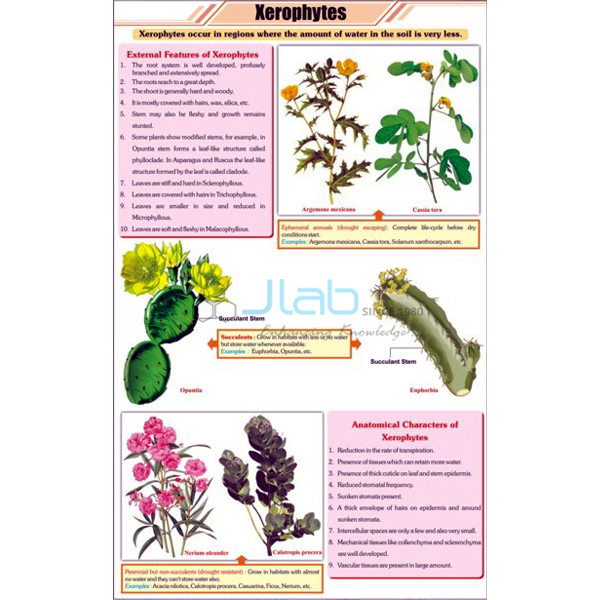
Xerophytes Chart (code EL-BC-9268) is a 58 x 90 cm botany wall chart on xerophytes, the plants that survive in deserts and other dry places, for school and college lessons on how plants cope with a shortage of water. It is printed in full colour on art paper, laminated on both sides with thick plastic film, fitted with plastic rollers and in English only. JLab (Jain Laboratory Instruments Pvt Ltd, Ambala, India) supplies it to schools, colleges and dealers.
Specifications
| Parameter | Detail |
|---|---|
| Subject | Xerophytes (plants of dry habitats) |
| Chart group | Botany Charts |
| Size | 58 x 90 cm |
| Printing | Full colour on art paper |
| Finish | Laminated on both sides with thick plastic film |
| Rollers | Plastic rollers fitted |
| Language | English only |
| Quality check | Each chart is visually inspected before dispatch |
| Pack quantity | Each (sold individually) |
| Minimum order quantity | 10 units |
| Dispatch time | Usually 7–10 working days |
| Product code | EL-BC-9268 |
| Supplied by | Jain Laboratory Instruments Pvt Ltd (JLab), Ambala, India |
What Is the Xerophytes Chart Used For?
Xerophytes deal with drought in three main ways. Ephemerals avoid it, finishing their short life cycle during the brief rainy season and surviving the dry months as seeds. Succulents such as Opuntia and other cacti, Aloe and Euphorbia store water in fleshy stems or leaves. Non-succulent perennials such as Calotropis, Nerium, Acacia and Casuarina endure dry conditions without storing water. Typical adaptations include long or widely spreading roots, leaves reduced to spines or scales with a green, flattened stem (a phylloclade) taking over photosynthesis, a thick waxy cuticle, sunken stomata, hairy surfaces and, in succulents, water-storing tissue.
In class, an Opuntia pad, an Aloe leaf and a Nerium leaf make useful specimens: cut sections show the water-storing tissue of succulents and, under a microscope, the sunken stomata of Nerium. Adaptations to dry habitats belong to school biology and college ecology and are usually taught with hydrophytes and mesophytes. Wipe the laminated surface clean and keep the chart rolled when it is not in use.
What to Specify When Ordering
- Quantity — minimum 10 units; the hydrophytes and mesophytes charts can be added for a habitat set.
- Language — English only as listed; ask JLab first if you need another language.
- Photo of the print — ask for one to check which plants and features are shown.
Frequently Asked Questions
What are xerophytes?
Plants adapted to dry habitats such as deserts and dry rocky or sandy places where water is scarce.
How do xerophytes reduce water loss?
With a thick waxy cuticle, sunken stomata, hairy surfaces and leaves reduced to spines or scales; in many of them a green, flattened stem carries out photosynthesis instead of the leaves.
What is the difference between succulent and non-succulent xerophytes?
Succulents such as Opuntia and Aloe store water in fleshy organs; non-succulents such as Calotropis and Nerium survive dry periods without storing water, relying on deep roots and water-saving leaves.
Who supplies the Xerophytes Chart?
JLab, the trading name of Jain Laboratory Instruments Pvt Ltd, Ambala, Haryana, India, supplies it and quotes directly.
Supplier
JLab is how Jain Laboratory Instruments Pvt Ltd trades; incorporated in 2017, the company is based on Hargolal Road, Ambala, Haryana. Besides its own school and college laboratory equipment, JLab supplies biology charts such as this one, so customers can bring charts and apparatus together in one order. The company is identified by GSTIN 06AADCJ9848D1ZE and holds Importer-Exporter Code 3317504552. Charts receive a visual check before dispatch, and repeat orders are handled by the same team. JLab exports to all regions — Brazil in South America, Portugal in Southern Europe, Zambia in East Africa, Thailand in Southeast Asia and Bangladesh in South Asia, to name a few. Tender information is on the JLab lab tenders page.
Charts on Plant Habitats and Modifications
- Hydrophytes Chart — plants of water and waterlogged places, the opposite extreme.
- Mesophytes Chart — land plants of habitats with a moderate water supply.
- Leaf Modification Chart — on leaves modified for other functions.
- Stem Modification Chart — on stems modified for other functions.
Other botany titles are listed under Botany Charts, and every subject under Charts.
Request a Quote
JLab sends its quotation directly. Use the Add To Cart enquiry button, or send the quantity (minimum 10 units), any companion habitat charts and your delivery address or destination port through the contact page.
Last updated: 3 October 2026