
Inflorescences Chart Manufacturer,Supplier and Exporter in India
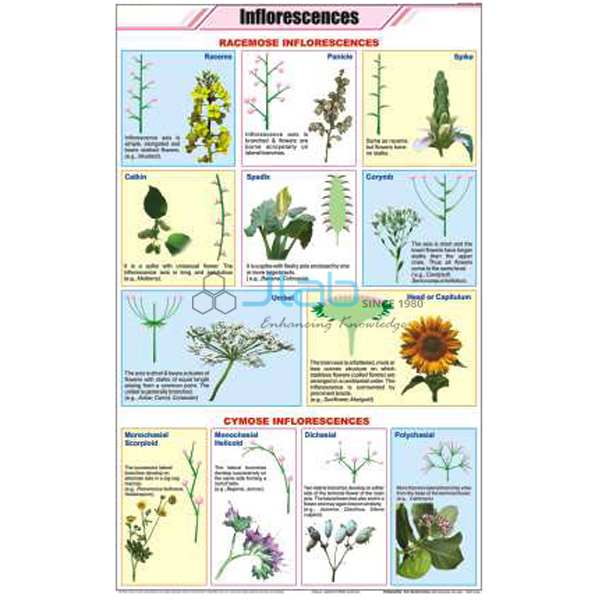
Product Code : EL-BC-9291
Jlab Export is a leading Inflorescences Chart Manufacturer,and suppliers in India
Inflorescences Chart (code EL-BC-9291) is a botany chart for teaching how flowers are arranged on a plant’s flowering shoot, a standard topic in plant morphology at school and college level. It is a 58 x 90 cm chart printed in full colour on art paper, with thick plastic film lamination on both sides, plastic rollers and English text. JLab (Jain Laboratory Instruments Pvt Ltd) publishes it from its Ambala works in Haryana for schools, colleges and dealers.
Specifications
| Parameter | Detail |
|---|---|
| Chart topic | Inflorescences (arrangement of flowers on the floral axis) |
| Size | 58 x 90 cm (about 22.8 x 35.4 in) |
| Printing | Full colour on art paper |
| Lamination | Both sides, thick plastic film |
| Fittings | Plastic rollers |
| Language | English only |
| Quality check | Each chart is visually inspected before dispatch |
| Pack quantity | Each (sold individually) |
| Minimum order quantity | 10 units |
| Dispatch time | Usually 7–10 working days |
| Product code | EL-BC-9291 |
| Manufacturer | Jain Laboratory Instruments Pvt Ltd (JLab) — OEM |
| Country of origin | India (made in Ambala, Haryana) |
What Is the Inflorescences Chart Used For?
An inflorescence is the arrangement of flowers on the floral axis. Botanists divide inflorescences into two main kinds. In a racemose inflorescence the main axis keeps growing and the flowers arise on its sides in acropetal order, so the oldest flowers are at the base, as in mustard; spikes, catkins, umbels such as coriander and the flower heads of sunflower are variations of this plan. In a cymose inflorescence the main axis ends in a flower and stops growing, and the younger flowers develop below it. Special types such as the cyathium of Euphorbia, the verticillaster of tulsi and the hypanthodium of the fig are also taught. These distinctions appear in the class 11 chapter on the morphology of flowering plants and are used to describe plant families in college taxonomy.
Display the chart while students sort fresh flowering twigs from the school garden into racemose and cymose groups; seeing the printed examples beside real material makes the terms easier to remember. The laminated chart can be cleaned with a slightly damp cloth and rolled up on its rollers. The listing does not say which inflorescence types the artwork shows, so ask JLab for a larger image if that matters for your syllabus.
What to Specify When Ordering
- Quantity — minimum 10 units.
- Language — English only; confirm with JLab before ordering if another language is needed.
- Related flower charts — the flower structure, calyx and corolla and pollination charts below can be added to the enquiry.
- Delivery — destination city and country or port, plus any packing instructions.
Frequently Asked Questions
What is the Inflorescences Chart for?
It is for teaching the types of inflorescence, the ways flowers are arranged on a plant, in class 11 biology and college botany. The listing does not detail the artwork; check the photograph on this page or ask JLab for a larger image.
How big is the chart and what is it made of?
It measures 58 x 90 cm (about 22.8 x 35.4 in). It is printed in full colour on art paper, laminated on both sides with thick plastic film and fitted with plastic rollers.
What is the difference between racemose and cymose inflorescences?
In racemose types the main axis continues to grow and bears flowers on its sides, oldest at the base. In cymose types the main axis ends in a flower and growth continues from side branches, so the oldest flower is at the top or centre.
Which special inflorescences are taught in class 11?
The usual examples are the cyathium of Euphorbia (poinsettia), the verticillaster of tulsi and other mint-family plants, and the hypanthodium of the fig, in which tiny flowers line a hollow, fleshy receptacle.
Who makes this chart?
The maker is JLab, the trading name of Jain Laboratory Instruments Pvt Ltd, which produces it in Ambala, Haryana, India, and quotes directly to buyers.
OEM Manufacturer
JLab trades on behalf of Jain Laboratory Instruments Pvt Ltd, incorporated in 2017 and run from Hargolal Road, Ambala, Haryana. Together with its own laboratory equipment, it prints plant-science charts like this one in Ambala for schools, colleges, dealers and importers, visually checks each chart before sending it, and keeps repeat orders under its own management. JLab exports worldwide and ships to buyers in every region — for example Barbados in Central America and the Caribbean, Laos in Southeast Asia, Lebanon in the Middle East, France in Western Europe and New Zealand in Oceania. Tender information is available on the JLab lab tenders page.
Flower Morphology Charts and Models
- Structure of Flower Chart — the parts of an individual flower, from the same series.
- Calyx and Corolla Chart — sepals, petals and their arrangement in the bud.
- Pollination Chart — how pollen is carried between the flowers of an inflorescence and between plants.
- Dicot Flower Model — an enlarged, numbered flower model for studying floral parts.
More plant morphology titles are in the Botany Charts range; see also the full Charts range.
Request a Quote
Quotations come straight from JLab. Use the Add To Cart enquiry button on this page or the contact page and include the quantity (minimum 10 units), any companion charts, and the city and country for delivery.
Last updated: 25 October 2026