Stem Modification Chart Manufacturer,Supplier and Exporter in India
Product Code : EL-BC-9297
Jlab Export is a leading Stem Modification Chart Manufacturer,and suppliers in India
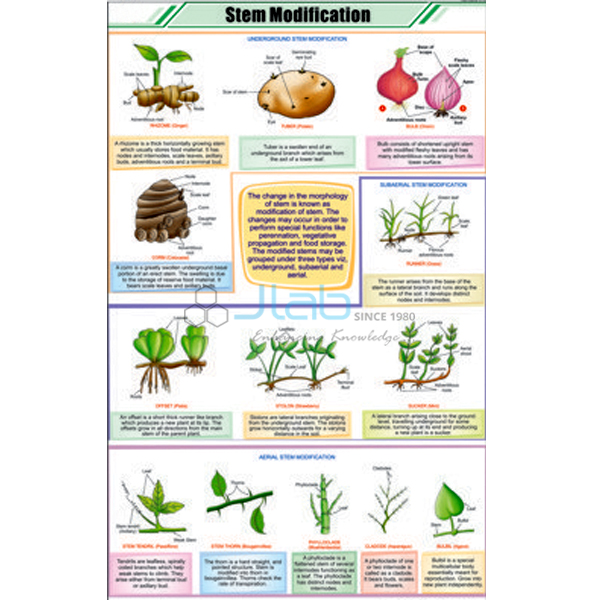
Stem Modification Chart (code EL-BC-9297) is a plant morphology chart on stems that have changed shape to store food, climb, protect the plant or reproduce, for biology classes in schools and colleges. The 58 x 90 cm chart is printed in full colour on art paper, laminated on both sides with thick plastic film, fitted with plastic rollers and lettered in English. JLab (Jain Laboratory Instruments Pvt Ltd, Ambala, India) supplies it to schools, colleges and dealers.
Get a quote: use the Add To Cart enquiry button below, or send your quantity and destination through the contact page.
Specifications
| Parameter | Detail |
|---|---|
| Chart topic | Modifications of the stem |
| Size | 58 x 90 cm (about 22.8 x 35.4 in) |
| Printing | Full colour on art paper |
| Lamination | Both sides, thick plastic film |
| Fittings | Plastic rollers |
| Language | English only |
| Quality check | Each chart is visually inspected before dispatch |
| Pack quantity | Each (sold individually) |
| Minimum order quantity | 10 units |
| Dispatch time | Usually 7–10 working days |
| Product code | EL-BC-9297 |
| Supplied by | Jain Laboratory Instruments Pvt Ltd (JLab), Ambala, India |
What Is the Stem Modification Chart Used For?
A stem is recognised by its nodes, internodes and buds, and these features remain even when the stem looks nothing like a typical shoot. Underground stems store food and help the plant survive bad seasons: the potato tuber, whose “eyes” are buds at the nodes; the rhizome of ginger and turmeric; the corm of Colocasia; and the bulb of onion, where the stem is reduced to a small disc beneath fleshy leaves. Above ground, stem tendrils help gourds and grapevines climb, axillary buds become protective thorns in Bougainvillea and citrus, and flattened green stems take over photosynthesis in cacti such as Opuntia. Runners, stolons, offsets and suckers, as in grasses, mint, water hyacinth and banana, spread the plant and give rise to new plants. The topic belongs to the class 11 chapter on the morphology of flowering plants and to college botany practicals.
A useful exercise is to bring a potato, a piece of ginger, an onion and a twig of Bougainvillea into the lab and ask students to find the nodes and buds that prove each one is a stem, using the chart as the reference. The laminated sheet wipes clean and rolls up on its rollers. The listing does not say which examples the artwork uses, so ask JLab for a larger image if you need to match it to your syllabus.
What to Specify When Ordering
- Quantity — minimum 10 units.
- Language — English only, as listed.
- Companion morphology charts — the root and leaf modification charts below complete the set for this chapter.
- Delivery — destination city and country or port, and your preferred delivery terms.
Frequently Asked Questions
What is the Stem Modification Chart used for?
It is used to teach the modified stems of flowering plants — underground, sub-aerial and aerial types — in class 11 biology and college botany. The listing does not detail the artwork; see the photograph on this page or ask JLab for a larger image.
What size and finish does it have?
It is 58 x 90 cm, about 22.8 x 35.4 inches, printed in full colour on art paper, laminated on both sides with thick plastic film and fitted with plastic rollers.
Why is a potato a stem but a sweet potato a root?
A potato tuber has nodes, seen as “eyes”, each with buds that can sprout into new shoots, so it is a swollen underground stem. A sweet potato has no nodes or buds of that kind and develops from the roots, so it is a modified root that stores food.
Is onion a stem or a leaf?
Both parts are present. The onion bulb has a very short, disc-shaped stem at its base; the fleshy layers we eat are leaf bases that store food around it.
What is the minimum order and dispatch time?
The minimum order is 10 units, with each chart supplied singly and visually inspected. Dispatch is usually within 7–10 working days; export shipments need extra transit time.
Who supplies the Stem Modification Chart?
It is supplied by JLab, the trading name of Jain Laboratory Instruments Pvt Ltd, Ambala, Haryana, India, which handles quotations directly.
Supplier
JLab is the trading name of Jain Laboratory Instruments Pvt Ltd, a company incorporated in 2017 whose office is on Hargolal Road, Ambala, Haryana. It supplies biology charts such as this one to schools, colleges, dealers and importers alongside its own range of laboratory equipment, gives each chart a visual inspection before dispatch, and manages repeat orders itself. JLab exports worldwide and ships to buyers in every region — for example Ethiopia in East Africa, the USA in North America, Cambodia in Southeast Asia, Italy in Southern Europe and Morocco in North Africa. Tender buyers should see the JLab lab tenders page.
Other Plant Morphology Charts
- Root Modifications Chart — roots modified for storage, support and other functions.
- Leaf Modification Chart — leaves turned into tendrils, spines and other forms.
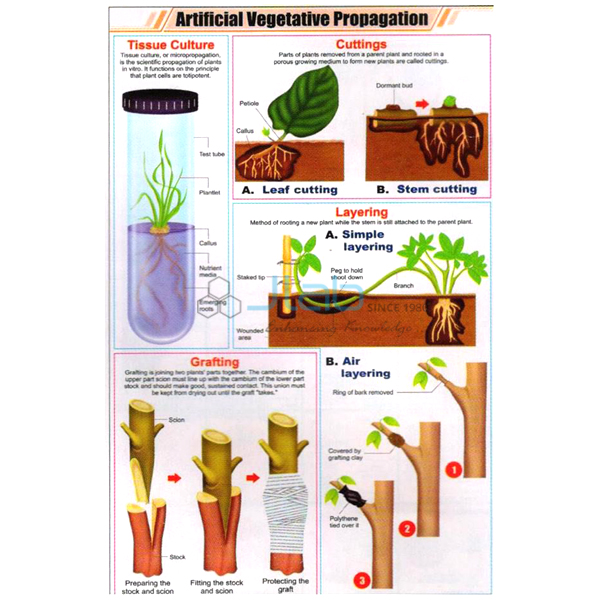
- Artificial Vegetative Propagation Chart — how stems are used to raise new plants by cutting, layering and grafting.
- Typical Plant Chart — the unmodified parts of a flowering plant, for comparison.
View more titles in the Botany Charts range, or the whole Charts range.
Request a Quote
Request your quotation from JLab through the Add To Cart enquiry button on this page or the contact page. Please state the quantity (minimum 10 units), any companion morphology charts, and the delivery city and country.
Last updated: 3 October 2026