Plant Cell Meiosis Chart Manufacturer,Supplier and Exporter in India
Product Code : EL-BC-9232
Jlab Export is a leading Plant Cell Meiosis Chart Manufacturer,and suppliers in India
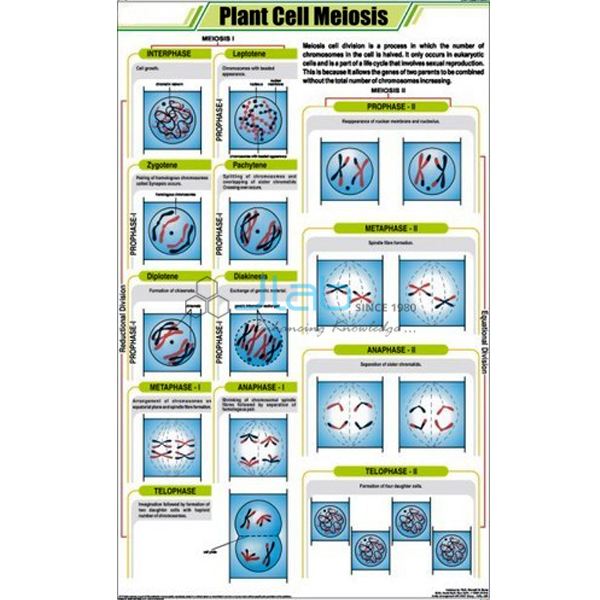
Plant Cell Meiosis Chart (code EL-BC-9232) is a 58 x 90 cm wall chart on meiosis in plant cells, the division that halves the chromosome number, for class 11 and class 12 biology and college botany. It is printed in full colour on art paper, laminated on both sides with thick plastic film and fitted with plastic rollers, with English text. JLab (Jain Laboratory Instruments Pvt Ltd, Ambala, India) supplies it to schools, colleges and dealers.
Get a quote: use the Add To Cart enquiry button below, or send your quantity and destination through the contact page.
Specifications
| Parameter | Detail |
|---|---|
| Chart topic | Meiosis in plant cells |
| Size | 58 x 90 cm (about 22.8 x 35.4 in) |
| Printing | Full colour on art paper |
| Lamination | Both sides, thick plastic film |
| Fittings | Plastic rollers for hanging |
| Language | English only |
| Quality check | Each chart is visually inspected before dispatch |
| Pack quantity | Each (sold individually) |
| Minimum order quantity | 10 units |
| Dispatch time | Usually 7–10 working days |
| Product code | EL-BC-9232 |
| Supplied by | Jain Laboratory Instruments Pvt Ltd (JLab), Ambala, India |
What Is the Plant Cell Meiosis Chart Used For?
Meiosis runs as two divisions. In meiosis I, the reductional division, homologous chromosomes pair up and then separate; its long prophase I is divided into leptotene, zygotene, pachytene — when crossing over between non-sister chromatids takes place — diplotene and diakinesis. Meiosis II, the equational division, separates the sister chromatids much as mitosis does. One diploid cell therefore gives rise to four haploid cells, and in flowering plants this happens in the anthers and ovules when spores are formed. The stages belong to the class 11 chapter on the cell cycle and cell division, and class 12 practical work includes identifying meiosis stages in onion bud cells on permanent slides.
Hang the chart beside the microscope bench during the slide practical, so that students can compare each stage they find with the drawing, and keep a mitosis chart nearby to point out the differences. The laminated surface wipes clean, and the chart rolls up on its rollers for storage.
What to Specify When Ordering
- Quantity — the minimum order is 10 units.
- Language — listed in English only.
- Cell division set — the mitosis chart, animal cell meiosis chart, meiosis model and prepared slides linked below can be quoted together.
- Delivery — destination country and city or port, plus delivery terms for export orders.
Frequently Asked Questions
What is the difference between meiosis I and meiosis II?
Meiosis I is the reductional division: homologous chromosomes pair, exchange segments by crossing over and separate, so each daughter cell receives half the chromosome number. Meiosis II is the equational division, in which sister chromatids separate as they do in mitosis, giving four haploid cells in all.
How does meiosis differ from mitosis?
Mitosis is a single division that gives two cells genetically identical to the parent and serves growth and repair. Meiosis is two divisions that give four haploid cells, which differ genetically because of crossing over and the random assortment of chromosomes; in plants it takes place where spores are formed.
Which classes study plant meiosis?
It is part of the class 11 chapter on cell cycle and cell division, and class 12 students identify meiosis stages on permanent slides, for example of onion bud cells. College genetics and botany courses take it further.
What are the size, finish and language?
58 x 90 cm (about 22.8 x 35.4 in), printed in full colour on art paper, laminated on both sides with thick plastic film and fitted with plastic rollers. The text is in English.
What do you need for an export quotation?
The quantity (minimum 10 units), the destination country and port or city, your preferred delivery terms such as FOB or CIF, any packing or labelling requirements, and a tender reference if there is one. Dispatch is usually within 7–10 working days after the order, and every chart is visually inspected first.
Who supplies the Plant Cell Meiosis Chart?
JLab, the trading name of Jain Laboratory Instruments Pvt Ltd in Ambala, Haryana, India, supplies it and quotes directly.
Supplier
JLab is the trading name of Jain Laboratory Instruments Pvt Ltd, a laboratory equipment and teaching aids company in India, incorporated in 2017 with its base on Hargolal Road, Ambala, Haryana. Alongside the equipment it makes itself, JLab supplies teaching charts such as this cell division chart, so schools, colleges, dealers and importers can order charts, models and slides together; each chart is inspected visually before it leaves, and repeat orders are handled by the same team. JLab is registered for GST under GSTIN 06AADCJ9848D1ZE and holds Importer-Exporter Code 3317504552. It exports worldwide and can ship to every region — Malta in Southern Europe, Fiji in Oceania, Qatar in the Middle East, Guatemala in Central America and the Caribbean, and Ivory Coast in West Africa, for example. See the JLab lab tenders page for tender enquiries.
Cell Division Charts, Models and Slides
- Plant Cell Mitosis Chart — the companion chart on mitosis, for comparing the two divisions.
- Animal Cell Meiosis Chart — meiosis in animal cells, where it forms sperm and egg cells.
- Plant Meiosis Model — a model showing how the exact number of chromosomes is passed on from one generation to the next.
- Meiosis Prepared Slide — a labelled glass slide set for teaching the stages of plant meiosis.
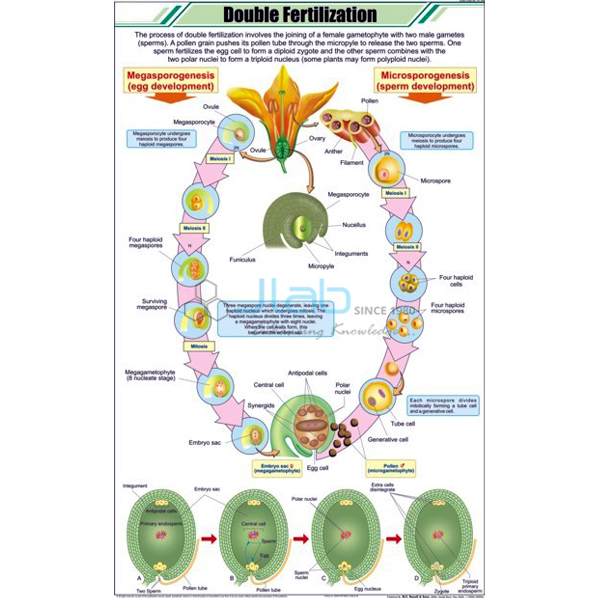
- Double Fertilization Chart — for the fertilisation that follows gamete formation in flowering plants.
See every title in the Botany Charts range or browse all Charts.
Request a Quote
JLab quotes directly. Use the Add To Cart enquiry button on this page or the contact page, and give the number of charts (minimum 10 units), any companion charts, models or slides, and the delivery destination.
Last updated: 4 October 2026